

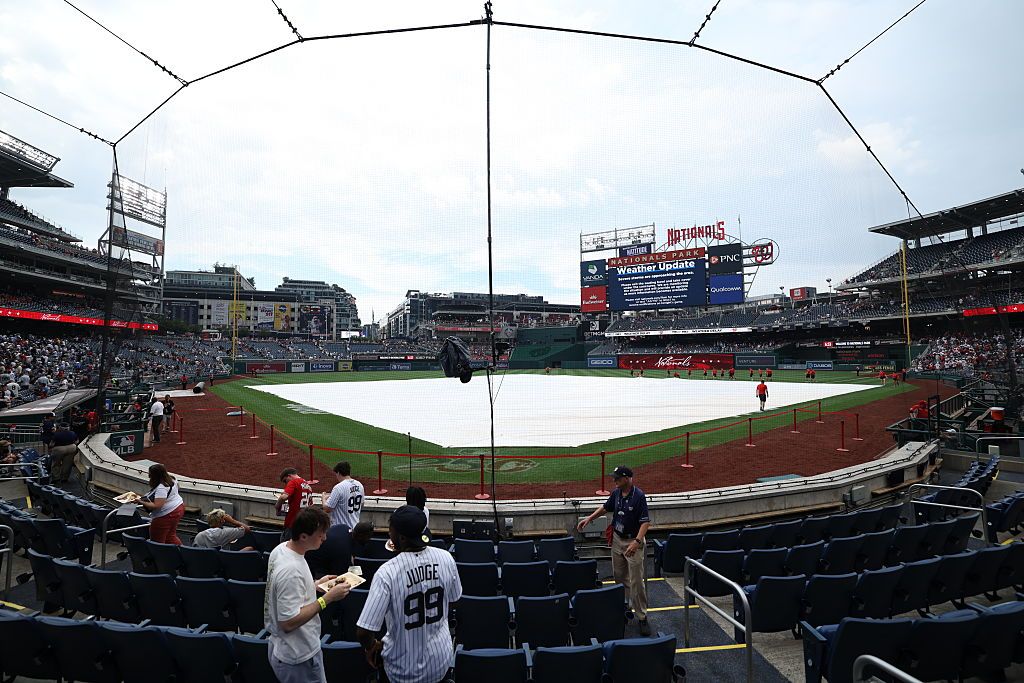
Looking for today’s MLB weather forecast? Below you’ll find every game on Thursday’s seven-game slate, its weather risk, and fantasy baseball and sports betting impacts worth monitoring before first pitch.
Today’s MLB Weather Forecast
- Highest Weather Risk: Rockies at Nationals in Washington, where severe thunderstorms could develop mid-game after 2:00 p.m.
- Expected Postponements: None anticipated, though Washington and the New York metro area require monitoring
- Most Significant Wind: No significant wind concerns across Thursday’s slate; all stadiums expect light winds under 10 mph
- Primary Weather Story: A severe thunderstorm threat targets the mid-Atlantic from Washington through New York, with a Flood Watch in effect for the Bronx and Queens through 11:00 p.m.
At-a-Glance Weather Table
| Matchup | First Pitch (ET) | Weather Risk | Rain % | Wind | Temp | Roof |
|---|---|---|---|---|---|---|
| Rockies at Nationals | 1:05 p.m. | MODERATE | 50% | S 7-10 mph | 90 | Open |
| Astros at Yankees | 7:05 p.m. | MODERATE | 40-70% | S 5-9 mph | 83 | Open |
| Brewers at Mets | 7:10 p.m. | MODERATE | 30-60% | S 5-10 mph | 78 | Open |
| Dodgers at Braves | 7:15 p.m. | MODERATE | 30% | Calm | 84 | Open |
MLB Games to Monitor for Weather
Rockies at Nationals (1:05 p.m. ET)
Weather Risk: MODERATE
Severe thunderstorms are possible across the Washington metro area beginning after 2:00 p.m., roughly one hour after first pitch. The National Weather Service warns that storms could produce damaging winds, hail, and isolated tornadoes. The 1:05 p.m. start allows the first inning or two to play under mostly cloudy skies before the threat window opens.
Forecast confidence is moderate. The severe potential is real, but 50% storm coverage means the game could also escape largely unscathed. If cells develop on schedule, middle innings face the highest exposure. Conditions remain unsettled through the evening with scattered activity before 11:00 p.m.
Weather Timeline
- 1:00-2:00 p.m. — Mostly cloudy, warm (90°F), storms developing to the west.
- 2:00-3:30 p.m. — Thunderstorm chance increases; severe potential peaks.
- 3:30-5:00 p.m. — Continued risk of strong storms passing through the area.
- 5:00 p.m. — Activity gradually diminishes as forcing weakens.
Astros at Yankees (7:05 p.m. ET)
Weather Risk: MODERATE
A Flood Watch remains in effect for the Bronx through 11:00 p.m., reflecting concerns about heavy rainfall from lingering thunderstorm activity. The daytime carries a 70% precipitation chance with showers and storms, transitioning to a 40% chance during the evening. First pitch at 7:05 p.m. falls in the transition window, where residual cells could still be active.
Dewpoints near 68°F keep the atmosphere primed for heavy downpours if storms redevelop. The primary question is whether daytime convection clears in time or lingers into early evening. An interruption is plausible, particularly during the first few innings, but a prolonged stoppage appears unlikely if the transition occurs on schedule.
Weather Timeline
- 5:00-6:30 p.m. — Daytime storms potentially still active; Flood Watch conditions.
- 7:00-8:00 p.m. — Transition period; residual showers and thunderstorms possible near first pitch.
- 8:30-10:00 p.m. — Decreasing probability; conditions gradually improve.
- After 10:00 p.m. — Storms largely exit; scattered showers possible before 2:00 a.m.
Brewers at Mets (7:10 p.m. ET)
Weather Risk: MODERATE
Queens shares the same Flood Watch as the Bronx, though the evening precipitation chance is slightly lower at 30%. Daytime storms carrying a 60% chance of showers and thunderstorms should largely exit before the 7:10 p.m. first pitch, with the evening outlook showing residual chances through the early hours.
The forecast favors dry conditions for most of the game window, but the Flood Watch signals that any storms that do develop could produce heavy rainfall quickly. Conditions are muggy with dewpoints near 67°F. An interruption remains possible but less likely than at Yankee Stadium given the slightly later timing and lower probability.
Weather Timeline
- 5:00-6:30 p.m. — Daytime storms weaken and exit to the east.
- 7:00-8:00 p.m. — Mostly cloudy with a lingering chance of showers.
- 8:00-10:00 p.m. — Probability continues to decrease; conditions stabilize.
- After 10:00 p.m. — Slight chance of showers remains before clearing.
Dodgers at Braves (7:15 p.m. ET)
Weather Risk: MODERATE
Atlanta’s typical late-summer thunderstorm pattern continues Thursday, with scattered storms possible throughout the afternoon transitioning to a 30% chance during the evening hours. The 7:15 p.m. first pitch falls as daytime heating diminishes, reducing storm potential. However, remaining cells could linger through 11:00 p.m.
Truist Park is one of the more weather-sensitive venues during summer storm season. Winds remain calm, and temperatures sit in the low-to-mid 80s with dewpoints near 69°F creating a muggy environment. The probability leans toward dry conditions, but a brief thunderstorm interruption cannot be ruled out.
Weather Timeline
- 5:00-6:30 p.m. — Daytime storms (50% chance) weakening as heating fades.
- 7:00-8:30 p.m. — Transition to evening; scattered cells still possible.
- 9:00-11:00 p.m. — Residual thunderstorm chance; activity ending before midnight.
Games Expected to Play in Favorable Weather
- Orioles at Cardinals (2:15 p.m.) — Sunny skies, 86°F, light north wind 5-8 mph. No precipitation expected.
- Royals at Blue Jays (7:07 p.m.) — Retractable roof at Rogers Centre. No weather concerns.
- Diamondbacks at Giants (9:45 p.m.) — Mostly cloudy, 62°F, light south wind 5-9 mph at Oracle Park. Marine layer present but only a 20% chance of light rain.
DFS and Betting Weather Notes
Rockies at Nationals
Severe thunderstorm potential mid-game creates meaningful uncertainty for DFS lineups and betting markets. Starting pitchers face workload risk if an interruption occurs during the middle innings, which could shorten outings and push games into bullpen-heavy finishes. DFS players relying on pitcher length should consider the possibility of an abbreviated start. Bettors may find value monitoring weather developments closer to first pitch, as any confirmed clearing would reduce the risk substantially.
Astros at Yankees
The Flood Watch and transitional storm timing add volatility to an already premium evening matchup. If storms linger into early innings, starting pitcher efficiency could suffer through interruptions or shortened outings. The muggy, unstable atmosphere creates uncertainty around game flow. DFS exposure to this game carries additional risk compared to a clean-weather environment, and live betting could offer opportunities if a weather pause creates a market reset.
Brewers at Mets
Similar atmospheric conditions to the Bronx, though the lower evening precipitation probability (30%) makes this a more playable environment for lineup construction. The primary risk is a sudden heavy downpour given the Flood Watch parameters, which could create an abrupt interruption. Conditions otherwise remain warm and humid without meaningful wind, producing a neutral offensive environment. Monitor late-afternoon radar to gauge whether residual cells threaten the first-pitch window.
FAQs
Which MLB games have weather concerns today?
Four of Thursday’s seven games carry MODERATE weather risk. The most significant concern is Washington’s severe thunderstorm potential during the Rockies-Nationals afternoon game. The New York metro area (both Yankee Stadium and Citi Field) falls under a Flood Watch through 11:00 p.m., and Atlanta faces its typical summer thunderstorm pattern at Truist Park.
How does humidity affect home runs in baseball?
High humidity slightly reduces air density, which can marginally improve ball carry compared to dry conditions at the same temperature. However, the effect is modest and rarely produces measurable changes in game outcomes on its own. Humidity matters more as a contributor to thunderstorm development, which creates interruption risk and lineup uncertainty rather than directly boosting offense.
What wind speed affects MLB games?
Sustained winds above 15 mph generally begin to produce noticeable effects on fly-ball trajectory and home-run distance. Below 10 mph, wind rarely influences gameplay meaningfully regardless of direction. The combination of wind speed, direction, and stadium orientation determines the actual impact. Stadiums like Wrigley Field and Guaranteed Rate Field are particularly sensitive due to their orientations relative to prevailing winds.
Do over/unders move when rain is in the forecast?
Sportsbooks occasionally adjust totals when significant weather threatens game completion or creates extreme conditions, but moderate rain chances alone rarely trigger line movement. Markets react more to confirmed postponement risk or extreme wind than to a generic precipitation percentage. Bettors monitoring weather should focus on timing relative to first pitch and whether conditions are likely to interrupt play rather than simply whether rain appears somewhere in the forecast.
More MLB Betting Content
Check out more MLB content and player props throughout the season on DraftKings Network!