Texas Tech closed 2025 by beating BYU 34-7 for the Big 12 championship, capping a dominant 12-win season. The Red Raiders won every game by at least 20 points and allowed only 11.8 points per game. Much of that defensive front has since departed, while Will Hammond returns from ACL surgery and Tommy Castellanos arrived in late August. Texas Tech still enters 2026 as the -115 favorite, with BYU next at +550 after losing only twice last season. Utah returns its productive backfield, Houston carries substantial offensive continuity, and several middle prices have credible championship paths. Tech’s reconstruction makes returning production, quarterback stability, and schedule placement central to this year’s futures outlook.
Below is my Big 12 2026 season preview, packaged with my favorite bet on the market to take home the conference crown. Follow my handle @dansby_edits for more college football betting write-ups all season long.
Big 12: 2026 season preview
Texas Tech’s -115 price reflects how completely the Red Raiders controlled last season. They finished 12-2, won eight conference games, and recorded every victory by at least 20 points. The offense averaged 39.4 points, 461.4 yards, and 6.2 yards per play. The defense allowed 11.8 points, 258.3 yards, and 3.9 yards per play. Opponents averaged 2.2 yards per rush and 5.5 per pass attempt. Tech added 41 sacks, 32 takeaways, and a +14 turnover margin.
The underlying efficiency numbers looked equally imposing. Texas Tech ranked among the national leaders in defensive EPA per play, success rate, and havoc. Opponents converted only 29.8% of their third downs. The Red Raiders allowed touchdowns on 53.6% of red-zone possessions. Their offense converted 49.5% of its third downs, keeping the defense fresh and creating enormous possession advantages. Tech returns 65% of its production, 12th nationally, with top-20 returning-production rankings on both sides.
Several important pieces of that defense have departed. The entire starting front and linebacker Jacob Rodriguez accounted for much of last season’s pressure and run disruption. A.J. Holmes, Ben Roberts, and Brice Pollock return behind the rebuilt front. Tech recruited aggressively through the portal, but last season’s front played with unusual cohesion. Forty-one sacks and 68.1 rushing yards allowed represent an exceptionally high standard. Even a strong replacement group can regress substantially from those numbers.
Quarterback became a genuine complication during the final week of August. Will Hammond remains the expected starter after missing 10 months with a torn ACL. He completed 63.3% of his passes for 680 yards, seven touchdowns, and three interceptions before the injury. Hammond also rushed for 299 yards and five scores at 7.0 per carry. Tommy Castellanos joined the roster on Aug. 26 following a successful court injunction. Castellanos owns 8,433 career yards of total offense, although his late arrival limits immediate command of the system.
Texas Tech also left plenty of points inside the 20-yard line. The offense scored touchdowns on 55.4% of its red-zone possessions despite ranking seventh nationally in scoring. Cleaner quarterback health and ordinary finishing improvement could push Tech beyond 40 points per game. The same statistic creates some concern around the current price. Last season’s offense already benefited from exceptional field position and a defense generating more than two takeaways per game. Those short fields will become less frequent if the reconstructed front creates fewer hurried throws.
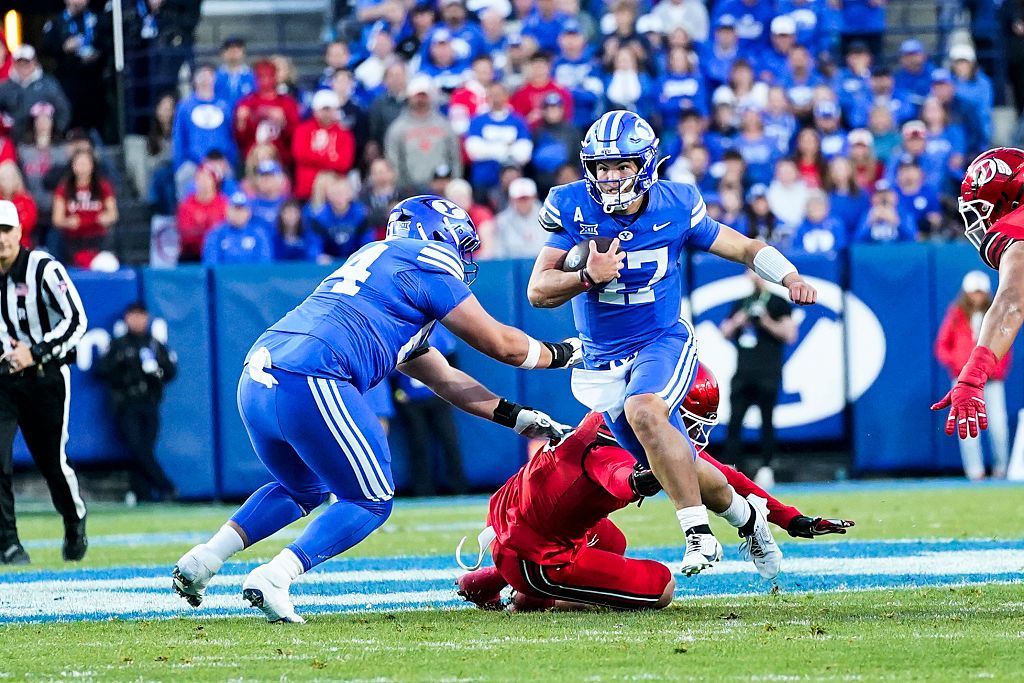
BYU returns the conference’s best combination of quarterback continuity, rushing production, and defensive experience. Bear Bachmeier threw for 3,033 yards, completed 64.9%, and added 527 rushing yards. He produced 26 combined touchdowns. LJ Martin rushed for 1,305 yards at 5.5 per carry, with 12 touchdowns. The offensive line ranked 12th nationally in sack avoidance and returns Bruce Mitchell and Andrew Gentry. BYU loses its two leading receivers, who combined for more than 1,700 yards. Walker Lyons, Kyler Kasper, and Jurrion Dickey replenish that room.
Eight defensive starters return from a unit that ranked 19th nationally in scoring defense. BYU intercepted 17 passes and allowed more than 27 points only twice. Texas Tech produced both instances. The Cougars led the Big 12 in opponent red-zone touchdown rate and rank sixth nationally in defensive returning production. Their staff also returns intact for a third consecutive season. Defensive communication, coverage checks, and pressure timing should remain considerably steadier than Tech’s rebuilt front.
Prediction, pick for 2026 Big 12 champion
BYU’s schedule provides another important advantage. Texas Tech, Houston, and Kansas State are absent from the conference slate. Arizona, Iowa State, Arizona State, Baylor, and Cincinnati visit Provo. The road schedule includes TCU, UCF, Utah, and Kansas. Utah lost all five offensive-line starters and changed head coaches for the first time since 2005. Kansas State lost quarterback John Pastore for the season and six of its seven leading tacklers. BYU has several credible paths to seven or eight conference victories.
Houston deserves attention at +1550 after finishing 10-3 with 65% of its production returning. Conner Weigman accounted for 36 touchdowns, while Amare Thomas caught 67 passes for 966 yards and 12 scores. Houston allowed touchdowns on only 48.8% of opponent red-zone trips. The Cougars also went 6-1 in one-score games and 6-0 away from home. Those results are difficult to repeat. Five conference road games include Texas Tech, Kansas State, Utah, Colorado, and West Virginia.
The entire Big 12 board contains a 19.5% hold. BYU’s +550 price implies 15.4%, which falls near 12.9% after normalization. I place the Cougars around 19%, giving them a fair price close to +426. Texas Tech remains the conference’s strongest team and most likely champion. Its -115 price asks for another season of exceptional defensive finishing amid considerable personnel change. BYU has fewer ways for its season to unravel and a much more forgiving conference schedule.
Big 12 Winner: BYU (+550)