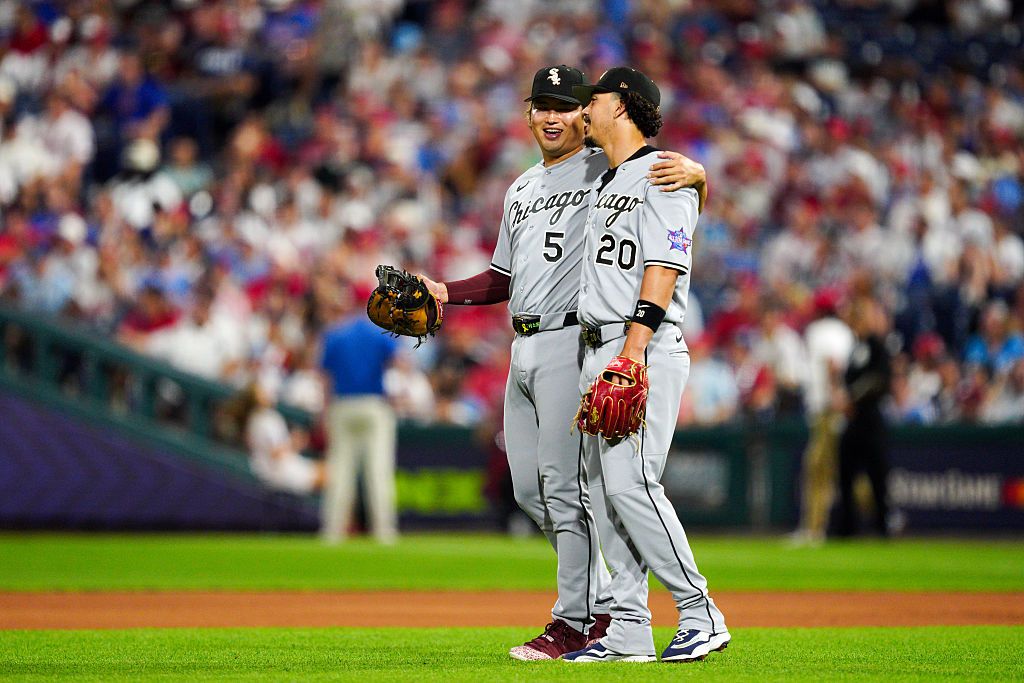
White Sox 3B Miguel Vargas arrived in Philadelphia as an All-Star, and left the city limits having provided the game’s only home run, a 433-foot drive which, symbolically, gathered much of southside Chicago’s first half into one swing. Two years earlier, he had been buried inside a 121-loss season. Now he stood at the center of the stage, joined by Munetaka Murakami and Tristan Peters as one of three White Sox All-Stars. A club that had reached modern baseball’s bottom entered the break tied for first place.
The White Sox are 50-45 and priced at -115 to reach October, an implied postseason probability of 53.5%. Chicago has played well enough to command belief far beyond its preseason reputation. The question now concerns whether an ascending roster still offers value after the market has begun to recognize it.
Follow my handle @dansby_edits for more betting plays.
White Sox first half: a breakdown
Chicago opened 6-13, extending the exhaustion of three consecutive 100-loss seasons. Will Venable’s club has gone 44-32 since, the American League’s second-best record during that span. No losing streak has lasted longer than three games. The White Sox also reached consecutive winning months for the first time since 2021.
The record has enough statistical support to withstand ordinary regression. Chicago has scored 454 runs and allowed 419, producing a +35 differential and a 51-44 expected record. Its actual standing trails that estimate by one victory. Late drama has defined the season, but Chicago has not depended upon impossible sequencing.
Much of the turnaround has unfolded at Rate Field, where Chicago is 31-17 and 27-9 across its last 36 games. All five series sweeps have come on the South Side. Seven hitters have delivered walk-off winners, spreading late-inning responsibility across one of baseball’s youngest rosters. The novelty hat and Mike Vasil’s dugout wand have supplied the imagery. The deeper change lies in a team that now expects another chance after a bad inning.
Chicago’s offense has produced a .241/.319/.413 line, 104 wRC+, 129 home runs, and 61 steals. Its .321 wOBA sits below a .325 expected mark, while its .414 expected slugging percentage nearly matches the actual .413. A 40.7% hard-hit rate and 8.8% barrel rate both exceed league averages, giving the power a credible foundation. The lineup still carries a 26.9% whiff rate and an 81.3% zone-contact rate, leaving considerable failure between its best swings.
No player explains the improvement more fully than Miguel Vargas. He hit .104 after joining the 121-loss team and often looked emotionally spent. This season, he carries a .245/.355/.493 line with 21 homers, 20 doubles, 56 walks, and 11 steals. His .366 wOBA sits below a .401 expected mark, supported by a 90.6 mph average exit velocity, 47.0% hard-hit rate, and 15.4% barrel rate. South Side MVP chants now follow a player who had to rediscover pleasure in his profession.
Munetaka Murakami has supplied a more volatile form of power. He owns a .232/.371/.540 line with 20 homers across 259 plate appearances. His 94.1 mph average exit velocity, 59.2% hard-hit rate, and 20.0% barrel rate describe uncommon force. A 43.2% whiff rate and 66.2% zone-contact rate preserve considerable risk inside each plate appearance. Murakami has also assumed a leadership role, organizing a team dinner and earning Venable’s praise for his daily clubhouse engagement.
Colson Montgomery has given Chicago another exceptional source of power. His .220/.302/.469 line includes 23 homers and a .249 isolated-power figure. A 13.7% barrel rate, 50.0% pull rate, and 23-degree average launch angle support the production. His 121 strikeouts across 381 plate appearances guarantee prolonged dry spells. Still, Montgomery has 42 homers since July 22, 2025, tied for second in MLB during that span.
The supporting cast contains both promise and regression risk. Tristan Peters earned an All-Star selection with a .301/.354/.478 line, but his .361 wOBA exceeds a .308 expected mark. His 30.9% hard-hit rate also offers limited support for another identical half. Chase Meidroth’s .322 wOBA stands above a .287 expected mark, accompanied by a 4.3% barrel rate. Simultaneous decline from both hitters would narrow Chicago’s margin.
Sam Antonacci offers some protection against that correction. He has hit .287/.381/.418 with a .367 expected wOBA above his actual .358 mark. His 15.6% whiff rate and 89.2% zone-contact rate stabilize the top of the order. Braden Montgomery remains less developed, with a .231/.302/.394 line, 59.3% ground-ball rate, and 3.7% barrel rate. His manageable 20.7% strikeout rate still leaves room for growth.
The pitching staff has provided less certainty. Chicago owns a 4.12 ERA, 4.24 FIP, and 4.39 xFIP, with a 10.0% walk rate increasing pressure throughout the staff. Davis Martin carries a 3.41 ERA, 3.09 FIP, 22.1% strikeout rate, and 0.54 HR/9 across 100⅓ innings. Sean Burke has matched his 3.41 ERA with a 3.66 FIP and 26.4% strikeout rate across 105⅔ innings. Together, they have given Chicago two legitimate starters while approaching unfamiliar workloads.
Grant Taylor has become Venable’s most valuable bullpen option, producing a 2.79 ERA, 2.46 FIP, and 33.8% strikeout rate across 48⅓ innings. Sean Newcomb and Bryan Hudson have also excelled, though both carry regression indicators. Newcomb’s 2.52 ERA sits beside a 3.65 xFIP. Hudson’s 2.20 ERA accompanies a 4.12 xFIP. Both can remain useful after allowing more damage during the second half.
Second-half outlook
The road record remains the clearest weakness in the postseason case. Chicago is 19-28 away from Rate Field and only 17-19 against winning clubs. Its first assignment after the break brings six road games against Toronto and Texas. A seven-game homestand against Houston and New York follows, returning the White Sox to the environment in which their improvement has looked most convincing.
Murakami’s return should deepen the offense immediately. He rejoined the White Sox before the break after missing 35 games with a Grade 2 hamstring strain. Chicago went 17-18 without him, then swept the Athletics during his difficult 1-for-11 return weekend. Even while Murakami searches for his timing, opposing pitchers must reconsider how they approach Vargas and Montgomery around him.
The hamstring requires continued observation, but the White Sox have already received their largest second-half offensive addition. Braden Montgomery’s next advancement will depend upon lifting more of the pitches he already reaches. Peters and Meidroth must preserve enough value as their favorable first-half outcomes begin moving closer to the quality of their contact.
The greater uncertainty surrounds a pitching staff approaching unfamiliar workloads. September will demand innings that Martin and Burke have never previously carried. Chicago always intended to develop Taylor carefully, but a pennant race can turn a flexible relief role into overuse with remarkable speed.
The rotation’s lower half gives the trade deadline its urgency. Anthony Kay owns a 4.23 ERA, 4.97 FIP, and 17.6% strikeout rate. Noah Schultz carries a 5.60 ERA, 5.27 FIP, and 12.6% walk rate. Schultz closed the half with five walk-free innings, offering a glimpse of the strike-thrower Chicago still hopes he can become.
Several internal reinforcements could help, but none offers dependable innings yet. Tanner McDougal returned from a flexor strain with a scoreless inning and two strikeouts. His fastball reaches 101 mph, and a bullpen assignment could allow Chicago to manage his workload. Shane Smith has resumed rehabilitation work after a rotator-cuff strain, while Drew Thorpe recently progressed to live batting practice.
The remainder of the injury list offers possibility more readily than certainty. Ky Bush is long tossing after suffering a setback during his Tommy John rehabilitation. Prelander Berroa experienced elbow inflammation four pitches into his first rehab appearance. Hagen Smith’s strikeout ability remains enticing, but his shoulder and command leave him outside the safest second-half forecast.
Chris Getz therefore enters an unusually revealing deadline. Chicago needs pitching depth as Martin, Burke, Taylor, and Schultz approach demands their professional histories have not prepared them to carry. The organization has little appetite for dismantling a system assembled through several years of public humiliation, especially for a brief rental. Getz has already converted present depth into draft capital while promising to pursue help for both the current race and the seasons beyond it.
Restraint at the deadline would not necessarily indicate indifference. Chicago controls an inexpensive young core and possesses enough financial room to absorb a useful veteran. One competent starter could protect several young arms without requiring a spectacular acquisition. Pitching will command a severe price, which makes Getz’s judgment part of the risk contained in every -115 ticket.
Betting landscape
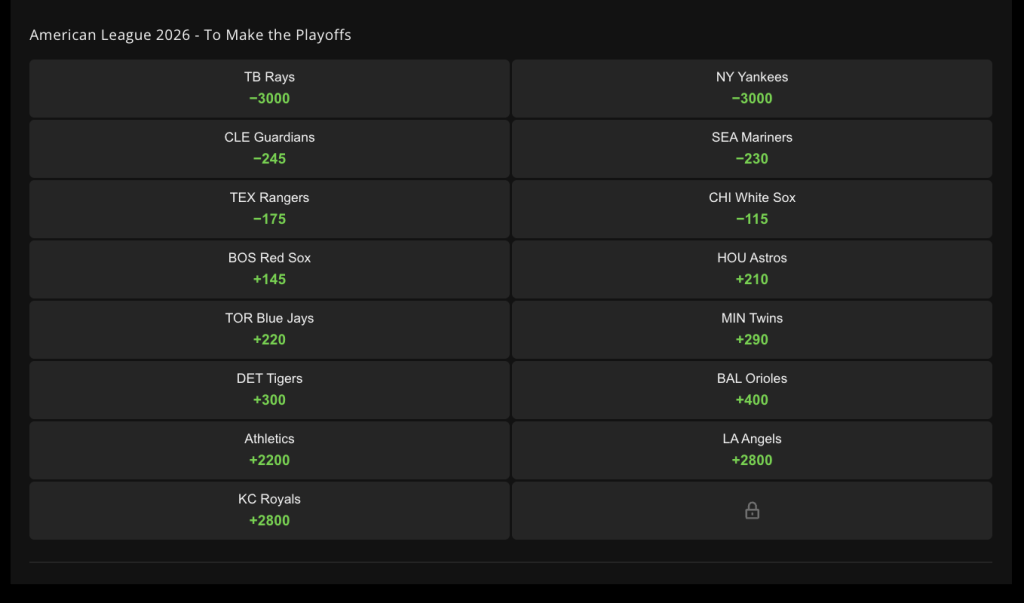
The division gives Chicago two credible paths into October. Cleveland owns a 51-46 record and a 62.3% playoff projection. Minnesota sits three games back, while Detroit trails by 6½ and carries a strong second-half forecast. Chicago’s remaining schedule ranks among MLB’s easiest, although the team’s road weakness keeps that apparent advantage conditional.
Available projection systems disagree because the White Sox remain unusually difficult to classify. One model assigns them a 40.2% postseason probability and an 80.5-win finish. Another reaches 52.6%, while a season-driven simulation places the probability at 76.0%. The market’s 53.5% implied figure sits near the optimistic middle of a very wide range.
I place Chicago’s postseason probability around 56%. That estimate credits Murakami’s return, Vargas’ statistically supported improvement, legitimate team power, and two routes into the field. It also discounts probable regression from Peters, Meidroth, Newcomb, and Hudson. The projection assumes Getz adds at least one credible pitcher before August 3rd.
The White Sox spent three summers teaching their supporters how quickly hope could become embarrassment. This team has begun to repair that relationship through youth, power, and seven different walk-off heroes. Chicago reached first place before Murakami returned and before Braden Montgomery found any comfort in the league. The pitching remains vulnerable, and several first-half performances will soften, but the roster retains enough growth to justify a probability above the current price.
Best bet: Chicago White Sox to make the playoffs at -115. I project an 84-78 finish and a narrow AL Central victory. The wager remains playable to -120, with meaningful value available at -110 or better.