

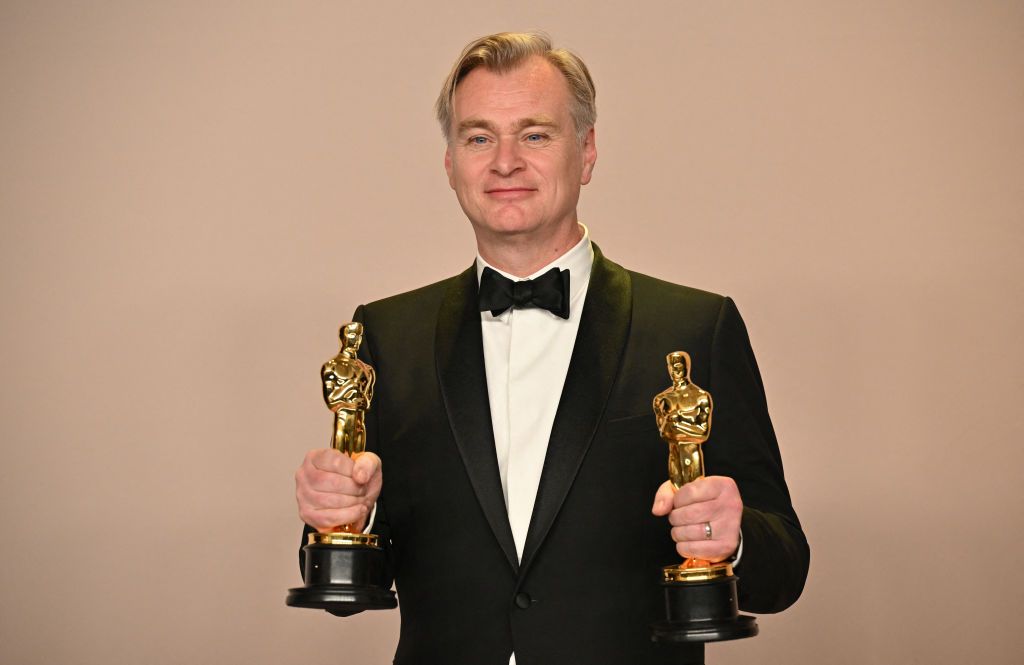
One of the greatest directors of all-time is back with his most anticipated film to date. Ahead of The Odyssey, our experts ranked all 12 Christopher Nolan movies from worst to best. Find their full rankings with analysis for each film below.
Ranking All 12 Christopher Nolan Films
| Ranking | Movie |
| #12 | Following |
| #11 | The Dark Knight Rises |
| #10 | Insomnia |
| #9 | Tenet |
| #8 | Batman Begins |
| #7 | Memento |
| #6 | Inception |
| #5 | Dunkirk |
| #4 | The Prestige |
| #3 | The Dark Knight |
| #2 | Interstellar |
| #1 | Oppenheimer |
Find full analysis for all 12 Christopher Nolan movies ranked below. Stay tuned to see where The Odyssey lands in these rankings after its release.
#12: Following
Blake Krass: Following was Christopher Nolan’s debut feature, and is still his least-seen film. It’s completely different than anything else he has ever made, but still has a distinct Nolan style. Nolan has become the master of the modern day epic, making films that feel larger than life. However, Following is an incredibly intimate film, with a run time of just 70 minutes and a budget of just $6,000. Nolan was not yet 30 years old when he made this film, but it still showed some of the ideas that came to define his future films. He shot on black-and-white film and while the film is linear, there are multiple layers to the story that provide twists and turns as more secrets get revealed. For any fan of Nolan’s films, it is worth visiting this first feature.
#11: The Dark Knight Rises
Bryan Armetta: The Dark Knight Rises was one of the most anticipated sequels in recent history, so it’s no wonder the film disappointed quite a few fans and critics. With that being said, it’s not a bad picture by any means. The show-stopper is Tom Hardy as Bane, one of the most memorable comic book movie antagonists ever put to screen. Physically imposing and surprisingly cunning, the mysterious muscle-bound stranger served as a perfect foil to the aging Bruce Wayne. Anne Hathaway’s turn as Catwoman was terrific as well, providing a lighter villain to bounce off of Bruce. Does Rises hit all its marks, especially during a somewhat rushed finale? Not quite, but it’s a worthy climax to Nolan’s epic Batman trilogy.
#10: Insomnia
Sam Connon: In many ways, Insomnia is the least Nolan of Nolan’s filmography. He doesn’t distort time or make grand, sweeping statements about humanity at-large. Michael Caine, Tom Hardy, Christian Bale, Anne Hathaway, Cillian Murphy and Gary Oldman are nowhere to be seen. Instead, Nolan’s third feature is a pretty standard, boiler plate detective thriller starring three actors he never reunited with – Al Pacino, Robin Williams and Hilary Swank. On top of that, it’s a remake of a Norwegian film from 1997, which is quite the departure for a filmmaker long lauded for his originality. That being said, Nolan really does leave his mark on Insomnia, fully leaning into the paranoia and disorientation of Pacino’s lead character.
Nolan made the most of his first big budget, not just by landing a cast of Oscar-winners but also by delivering some sweeping visuals of Alaska that he hadn’t been able to capture to that point in his career. The seeds that would grow into Nolan’s takes on justice, vengeance, symbols and sacrifice in the Dark Knight trilogy also start here, which can make it satisfying on a retrospective, metatextual level. And any time you get to see Robin Williams play a sociopathic villain, you soak up everything you can. Insomnia may only be a good Nolan movie, but that doesn’t hold it back from being a great movie in its own right.
#9: Tenet
Dan Johnson: Tenet may never receive the recognition given to Christopher Nolan’s more accessible films. Its dense exposition, aggressive sound, and deliberate emotional distance made resistance understandable. Yet the film remains one of his boldest achievements because every major idea operates through character, performance, and structure.
Robert Pattinson’s Neil is Nolan’s finest piece of character writing in Tenet, and a career achievement. Pattinson enters with an ease that initially reads as charm and tradecraft-professional confidence. He knows the Protagonist’s drink order, understands his instincts, and watches him with unmistakable affection. The explanation arrives only at the close. This meeting begins their friendship for the Protagonist, but Neil has already lived through years beside him. Pattinson has carried that private history in every smile and softened glance. The Protagonist has just discovered one of his closest friends. Neil, long ago, decided to die for his.
Kenneth Branagh as Andrei Sator is quietly one of Nolan’s most physically-imposing villains. Ideologically, Sator views the future as property and other people as extensions of his will. But in the film’s most terrifying scene, his reversed speech sounds dragged from the guttural muck beneath ordinary language. The way he jams the gun in the temple of Elizabeth Debicki’s Kat turns the film’s immense science-fiction stakes into the recognizable horror of domestic assault. Sator’s wealth, grievance, and entitlement now resemble a post-pandemic-America-revived billionaire masculinity built around dominance and immunity. And so: a most prescient villain, too.
The screenplay holds these performances inside an astonishingly exact construction. Major events unfold forward, then reappear from the opposite direction with new causes and consequences. Each masked figure, locked door, and unexplained movement must survive both timelines. Nolan preserves that precision, and offers nary an explanation for any of the mystery.
That balance explains the film’s enduring power. Tenet remains difficult, cold, and sometimes punishing. It also contains a tragic friendship, a frightening villain, and one of modern blockbuster cinema’s most disciplined narrative designs.
#8: Batman Begins
Sam Connon: Despite being the first of Nolan’s groundbreaking Dark Knight trilogy, Batman Begins is often overlooked. It was neither as critically acclaimed as The Dark Knight itself, nor was it as widely discussed or nitpicked as The Dark Knight Rises. Both of those movies made over $1 billion, while Batman Begins only made it to $375 million worldwide. One simple defence of Batman Begins is that without it, the other two era-defining sequels don’t exist. But beyond that, Batman Begins is the best exploration of Bruce Wayne of the three – and maybe of the entire franchise. Some of the action and the suit are a little clunky and some of the cinematography may be a little dated, but the themes and character work is among Nolan’s best.
The text is rich, to the point that – pardon the cliché – Gotham feels like a character of its own. The chaos and fear that Falcone has bestowed upon the city fit perfectly with the Scarecrow’s role in the story, as well as the League of Shadows’ goal to burn it all down. That sets the stage for a Batman built around fear as well, which starts out as thrilling and satisfying before Bruce realizes he needs to become a symbol for something more. Other directors have proven themselves capable of creating great Batman movies, but perhaps no one understands the character better than Nolan did here, alongside co-screenwriter David S. Goyer.
#7: Memento
Blake Krass: Memento is the film that put Christopher Nolan on the map. His debut feature, Following, was the definition of an indie production. While it got some critical acclaim, it was not widely seen at the time. Memento was the real introduction to Nolan for many. Guy Pearce puts on an incredible performance as one of Nolan’s best-ever characters, Leonard Shelby. This film showed how unique Nolan can tell stories in a non-linear fashion, something that defined the rest of his career. This film got Christopher Nolan his first Academy Award nominations and launched his career into the stratosphere.
Find a full breakdown of The Odyssey’s cast here! Continue reading for more analysis on all 12 Christopher Nolan movies ranked.
#6: Inception
Sam Connon: With The Matrix coming out in 1999, Nolan might just be responsible for the most influential science fiction flick of the 21st century in Inception. The visual effects, sound design and score alone are among the most iconic in cinema history, to say nothing of the mysterious marketing and grand ideas. But beyond its influences throughout Hollywood, Inception is simply a masterfully-constructed puzzle in the best way possible. The concepts are fresh, the delivery is always engaging and the technical execution is near-perfect. Nolan’s abilities as a solo screenwriter really shine here, since he is able to get across intricate exposition and traumatic character backgrounds with a deft hand.
For a filmmaker who is regularly criticized for making cold, emotionless films, he found a way to paint several poignant relationships in very little time – namely Cobb and Mal, as well as Robert and his father. Eliot Page, Joseph Gordon-Levitt, Tom Hardy and Michael Caine round out a particularly memorable ensemble, too. Often imitated but never duplicated, Inception is truly one-of-a-kind.
#5: Dunkirk
Blake Krass: Dunkirk is Christopher Nolan’s love letter to his native England. It is a war movie in a sense, but the heart of the story comes from the ordinary British citizens who were willing to risk everything to help get their troops home. The film also uses Nolan’s classic time-bending technique to have multiple storylines converge at the perfect time.
Whether it is Cillian Murphy lost at sea, Tom Hardy flying through the air, Kenneth Branagh leading the troops on the beach, Barry Keoghan and Mark Rylance on a rescue mission or Fionn Whitehead and Harry Styles just looking to get home, Nolan has the audience on the edge of their seat from start to finish.
#4: The Prestige
Jeff Pratt: This is the most underrated Nolan film to date. If you disagree with that take, you either haven’t watched it, or you haven’t watched it enough. The Prestige features Christian Bale and Hugh Jackman at the height of their powers as dueling magicians. The film focuses on Robert Angier’s incessant desire to figure out Alfred Borden’s seemingly impossible trick, sending him on a rampant quest to best it. Along the way, just how far he’s willing to go to accomplish this is tested, and no one is safe, including himself… in a way.
The Prestige keeps its viewers guessing up until the very end, delivering arguably the best conclusion of any Nolan film. It’s scale isn’t nearly as large as some of his other blockbusters, but this is probably the most unique addition to his filmography. It’s hard to say more without spoiling the story, so if you haven’t yet seen The Prestige, find time to do so ASAP.
#3: The Dark Knight
Dan Johnson: Few blockbusters have stress-tested civic virtue with the severity Christopher Nolan brings to The Dark Knight. Gotham feels bruised, frightened, and recognizably American, with every institution bending under fear.
Heath Ledger’s Joker renders fear as kaleidoscopic contradiction—all the chaos is both random and hyperplanned—and as sociopathic jubilee. His smeared makeup, wet mouth, restless tongue, and shifting scar stories make identity feel both prismatic and altogether unimportant, a vaudevillian farce. His presence in the frame destabilized everything with joy and purpose both, and the perfection in the delivery came at a cost. A performance bursting with invention became inseparable from a life abruptly ended in post-production. Ledger’s death and posthumous Oscar—see also Gary Oldman up there accepting the SAG award, the statue trembling in his hands—hold as one of the industry’s most tragic and moving cultural memories this century.
Not many movie lines have endured like Harvey Dent’s creed: “You either die a hero, or you live long enough to see yourself become the villain.” The phrase transcends the film because it describes power with a terrible half-life, a flat-circled groove of its own. Dent fulfills it through vengeance. Batman fulfills it through sacrifice, accepting public hatred so Gotham can preserve its faith in another man. Nolan makes the antihero essential to the city’s survival. Someone must carry the lie, absorb the blame, and disappear into the darkness.
That bargain makes The Dark Knight quintessentially late-aughts American. Batman turns Wayne technology into a surveillance network capable of listening through every phone in Gotham. The machine reflects a post-Patriot Act country seduced by extraordinary powers during permanent emergencies. And thus every victory leaves damage behind: burned faces, broken faith, and corrupted symbols. Civilization as we know it in the bleak endstage, when heroes flee to obscurity in fear of the power to which they now have access. A tale as old as time, and plenty poignant today.
#2: Interstellar
Jeff Pratt: Nearly 12 years after its release, probably 80% of people who have seen Interstellar don’t full understand it. That doesn’t matter. You don’t need to fully grasp a film for it to leave a lasting impression, and this is certainly the most memorable Nolan project to date, even if it’s not the “best”.
Matthew McConaughey delivers an all-time great performance as the enigmatic Cooper, an ambitious farmer turned spaceman who is sent on a mission to save the world, only to return and watch the life he desperately longs for slip from his fingertips. Jessica Chastain’s Murph is the best female Nolan character to date (we’ll see if that changes after The Odyssey), and the immaculate supporting cast of Anne Hathaway, Matt Damon, Casey Affleck and more deliver throughout the picture.
At its core, a major theme of Interstellar is duty vs. desire, both at an intergalactic and familial level. Despite playing within such an intricate concept, Nolan grounds the story by making Cooper an extremely relatable character, faced with common interpersonal battles and decisions, simply at the grandest scale.
#1: Oppenheimer
Bryan Armetta: The most recent and most successful Nolan film is Oppenheimer, and for good reason. With respect to The Odyssey, it’ll take quite the effort to ever supplant this one as the director’s magnum opus. On a technical level, the editing and sound design are flawless. It’s an absolutely loaded cast as well, netting Cillian Murphy and Robert Downey Jr. well deserved Oscars. However, we’ve come to expect that level of acting and behind the scenes excellence from any Nolan project. What separates this one from the pack is a tightly wound script that leaves viewers in awe and uncomfortable, often at the same time. Despite being set in the middle of the 20th century, the questions presented by Oppenheimer remain just as relevant in the modern age. Admiration for this film should only continue to grow in the future.
Those are our experts’ rankings of all 12 Christopher Nolan movies! Stay tuned to see how The Odyssey factors into these Christopher Nolan movie rankings after its release.