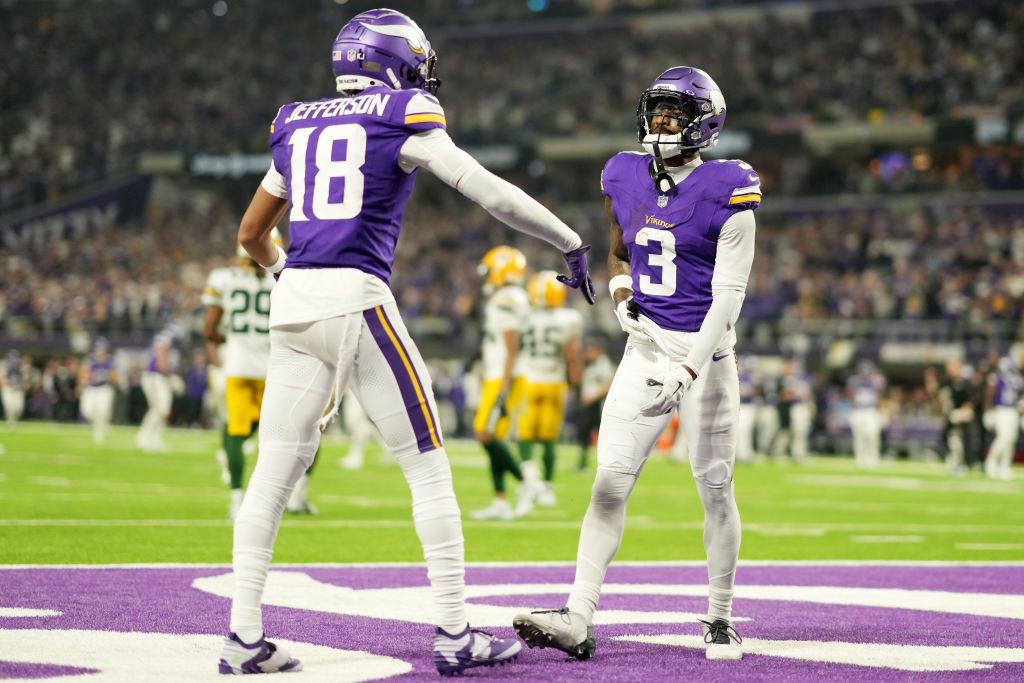
U.S. Bank Stadium turns this rematch into a controlled-pressure chamber, and Bears/Vikings walks in loaded with context. Chicago arrives at 6–3, sitting in the NFC’s sixth seed and riding late-game heroics after another fourth-quarter comeback against the Giants. Minnesota sits at 4–5, just outside the playoff bracket, fresh off a flat nineteen-point showing in Baltimore that re-lit pressure under Kevin O’Connell. The Week 1 meeting swung late—Bears up seventeen–six before the Vikings stole it twenty–seven–twenty–four—and that collapse still hums under every Chicago rep. Now the roles flip: Bears chasing validation, Vikings fighting for survival, indoors, with no weather excuses.Below is my prediction for NFL Week 11’s game between the the Minnesota Vikings and the Chicago Bears.
Here’s how I’ll play it. I’ll be pumping out these predictions for individual games all season, with plenty of coverage here on DraftKings Network. Follow my handle @dansby_edits for more betting plays.
Vikings vs. Bears prediction, preview
Minnesota’s offensive shape quietly fits this spot. With J.J. McCarthy back, the Vikings lean pass at a 55.8% neutral rate, marry play-action at 22.1%, and use motion or shifts on 59.1% of snaps. Over the last four, they’ve averaged 63.5 plays with a 28.3% success rate and –0.029 EPA per snap—modest efficiency, but real volume. McCarthy has added roughly thirty rushing yards and half a rushing touchdown per game since Week 9, giving O’Connell constraint answers when protection frays. The matchup piece is Chicago’s defensive profile: 28th in opponent points allowed at 27.4 per game and near the bottom in defensive success rate, pressure rate, and explosive runs allowed. They have surrendered 1,434 yards to wide receivers and 546 to tight ends, ranking top-10 and top-12 in those categories, and they give up the second-highest EPA per play and the deepest yards per catch to opposing wideouts. Minnesota’s zone-beater pairing lands directly on that soft tissue: Justin Jefferson has 40 catches for 556 yards versus zone on 226 routes with a 25.7% target rate and 0.45 PPR points per route, and Jordan Addison adds 312 yards on 165 zone routes as the primary auxiliary option. That is a bad overlap for a coverage unit graded bottom-eight by PFF with an also bottom-tier pass rush.
The Bears’ counterpunch is real and loud. Ben Johnson’s offense is seventh in scoring at 26.6 points per game, third in total yardage at 379.8 per game, and second in rushing yardage at 147.3 per game. D’Andre Swift and Kyle Monangai drive a red-zone run split where Swift owns 43.6% of carries and four rushing scores, while Monangai takes roughly 33% of attempts with two touchdowns. Rome Odunze has a 93.6% red-zone route rate, a 20.4% target share inside the twenty, and three receiving touchdowns; DJ Moore adds a mid-70s route rate, over eleven percent of red-zone targets, gadget carries, and two scores. That battery is facing a Vikings defense that has allowed just 14 red-zone touchdowns all season and sits in the league’s upper tier in pass-defense EPA. The Flores piece is the crux: Minnesota still blitzes at one of the league’s highest rates—over forty percent of opponent dropbacks—but those pressures have not turned into many takeaways. Caleb Williams is not the typical second-year victim; through this season’s first half, he holds the league’s best passer rating against the blitz at 136.3 with six touchdowns and zero interceptions, and multiple breakdowns have highlighted his comfort extending plays and punishing extra rushers.
Bears vs. Vikings pick, best bet
That forms the true tension. Chicago owns the NFL’s best turnover differential at plus-fourteen, with only six giveaways all year, and that ball security has covered for a defense leaking points. Minnesota, by contrast, sits at minus-zero-point-eight turnovers per game, bottom three in the league, and has already lived the script where Flores’ chaos creates pressure but not takeaways. The Bears’ path to busting this number is straightforward: Swift and Monangai pounding a Vikings front that has been flagged nationally as run-vulnerable, Odunze and Moore punishing light boxes on RPO glance and in-breakers, and Williams continuing to turn blitzes into explosives rather than sacks. Yet the Bears’ profile stacks risk on thin margins. They have trailed early often, rank 28th in opponent scoring, and are one misthrown seam or tipped ball away from their turnover magic regressing in a hostile dome. The Vikings’ defense is not a soft landing; it’s top-tier in defensive EPA, especially against the pass, even while acknowledging the run-game leak.
Market context tilts the lean. The number sits Vikings –3 with a total near 48, effectively asking Minnesota simply to win by a field goal at home. Chicago is five–four against the spread and five–four to the over; Minnesota is hovering around league average in both, but their scoring delta is tighter, with 22.3 points scored and 23.7 allowed per game. The Bears’ offensive ceiling is higher, yet that edge is already baked into a short line. What is not fully priced is how specifically their weaknesses line up with Minnesota’s strengths: a coverage unit that bleeds wideout production facing Jefferson and Addison in a motion-heavy, play-action structure; a pass rush that rarely wins one-on-one against an offense comfortable living in shotgun and quick game; and a defense that forces the Vikings to throw rather than play into Minnesota’s weaker rushing identity. Indoors, noise favors the defense that knows the rush plan, and Williams’ turn-over-averse run is due for at least some wobble against a coordinator who has seen him three times already and still holds a sweep.
Game script should tilt toward Minnesota eking this out rather than a Chicago runaway. O’Connell should keep leaning into eleven personnel, motioning Jefferson into stacks and reduced splits to stress Chicago’s zone rules, then letting McCarthy choose between quick perimeter throws and keepers when edges overplay play-action. The Bears will answer with condensed formations, wide zone, and RPO to bait Flores’ early-down blitz calls, but Minnesota’s pass defense and red-zone structure can force more field-goal attempts than touchdowns, blunting Chicago’s scoring average. Williams will still hit explosives—Swift on angle routes, Odunze on crossers, Moore on scramble drills—but the down-to-down flow favors the home side’s coverage disguise and the Bears’ shaky defensive metrics. With that overlap, the bet lands on Minnesota’s passing game finally turning volume into efficiency against a defense tailored to its strengths rather than its flaws.
Vikings –3 is the play, with Minnesota 30, Chicago 23.
Best bet: Vikings -3 (-105) vs. Bears
Tail it with me in the DKN Betting Group here!
For a prop lean, Jefferson 6+ receptions at −120 is the cleanest way to monetize the Vikings side. He sits at 51 catches on 84 targets for 686 yards, with zone splits that matter here: 40 grabs on 226 zone routes, a 25.7% target rate, and 0.45 PPR points per route. Minnesota throws on 55.8% of neutral downs, marries play-action and motion on almost sixty percent of snaps, and designs those looks to free Jefferson into the soft pockets Chicago’s bottom-eight coverage unit already concedes. The Bears have surrendered 1,434 receiving yards to wideouts, allow the highest yards per catch and second-highest EPA per play to receivers, and rarely generate pressure, which tilts this toward high-volume, lower-depth answers rather than a bomb-or-bust night. Six or more catches at −120, playable to about −140, tracks perfectly with a script where Minnesota leans into Jefferson as the primary answer against a leaky secondary in a must-have home game.
Best prop lean: Justin Jefferson 6+ receptions (-120)
Tail it with me in the DKN Betting Group here!