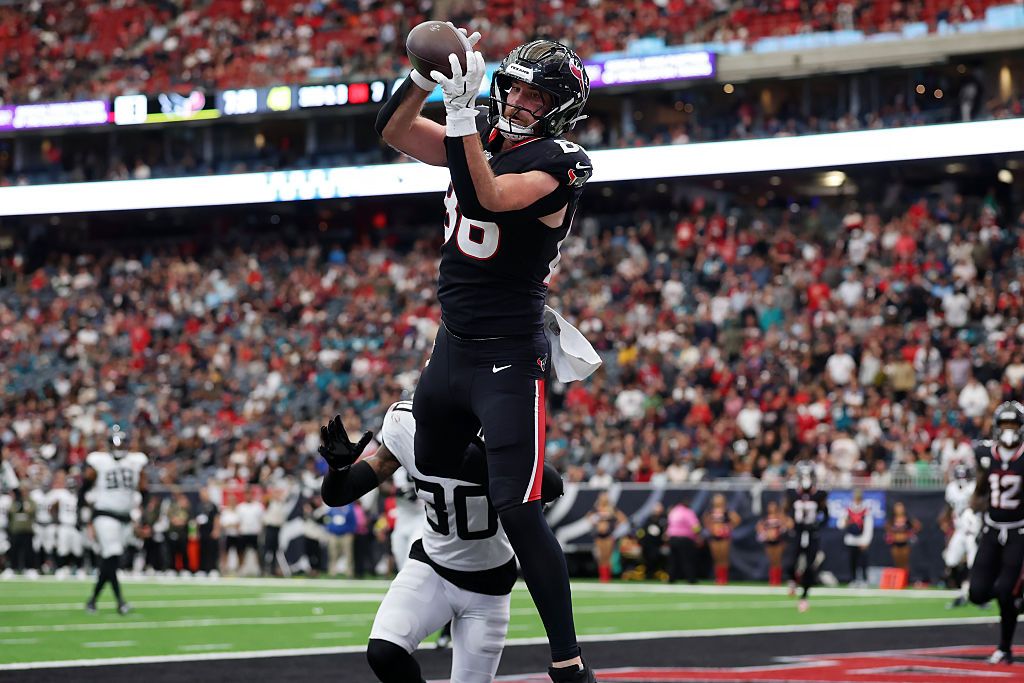
In Week 11, tight end turns on the middle third. Identities are set, so coordinators either feed their Y or hide him. Madrid opens with Commanders–Dolphins on fast turf, where motion and tempo can turn sit/whip into chain fuel. Houston pivots to Davis Mills, which tilts stick, pivots, and flats toward Dalton Schultz and stacks easy PPR. Arizona’s tree narrows to Trey McBride with Marvin Harrison Jr. and Zay Jones out and Jacoby Brissett steering on time—ten targets live. Green Bay’s interior stays viable with Luke Musgrave absorbing Tucker Kraft’s routes, keeping LaFleur’s glance and cross alive. Detroit’s structure makes Dallas Goedert win through contact, not air; Philadelphia must design him free in the red area. The filter is simple this week: stay glued to route rate, first-read weight, and red-zone ownership; fade rooms that rush with four and squat in split safeties. With that said, below I’ve written up my favorite three tight end starts of the week, as well as my two favorite fades.
Follow my handle @dansby_edits for more fantasy football advice, as well as plenty of NFL and college football betting goodies.
Start ‘Em
Trey McBride, Arizona Cardinals (vs. San Francisco 49ers)
Trey McBride is a full-send start because Arizona’s target tree just collapsed onto him. Marvin Harrison Jr. is out after an appendectomy and Zay Jones hit IR with a torn Achilles, stripping perimeter volume from an already thin room. Kyler Murray is on IR, so Jacoby Brissett starts again—his profile favors chain-moving throws and tight-end usage. That confluence funnels opportunities to the one matchup-winner still standing.
The role is elite before the injuries; now it becomes the offense. McBride owns 61 catches for 603 yards and six scores, with routes in the mid-300s and a dominant target share near 29%. His route participation sits north of 95% and he commands one-third of Arizona’s red-zone targets, which is rare territory at the position. Under Brissett, the volume has surged: 13 targets in Week 10, and he has lived at or near double digits when the script asks for patience. With Harrison sidelined, only Michael Wilson has topped 20 catches and 200 yards among the remaining wideouts—more proof of consolidation.
The matchup is workable even if San Francisco leans zone under Robert Saleh. Zone invites option routes, sit/down seams, and Y-cross—McBride’s bread and butter. He has already produced against this defense once, posting 5-43-1 on eight targets earlier this season. Expect 8–12 targets as Arizona lives in 11 and 12 personnel and asks Brissett to play on time. In PPR, that’s a bankable floor with top-three weekly ceiling. Start McBride confidently; he’s the first read, the red-zone plan, and the cleanest way for this offense to stay on schedule.
Dalton Schultz, Houston Texans (at Tennessee Titans)
Dalton Schultz is a start because Houston’s quarterback change tilts the middle third his way. With Davis Mills in, Houston leans quick-game, stick, and play-action flats that feed the tight end. With Mills in Week 10, Schultz drew 11 targets and scored, reinforcing the chain-moving tilt. Schultz already owns route participation north of 80%, with about 130 routes and 21 targets translating to an 18–19% target share. His efficiency sits solid for the position—approximately 1.4 yards per route run with a 0.21 targets-per-route rate—driven by first-read sits and pivots rather than low-percentage seams. That’s the exact profile Mills favors when edges flash and timing matters. On the season, Schultz sits at 59 targets, 45 receptions, 438 yards, and a 6.56 targets-per-game pace.
The Titans invite this usage. They blitz under 20%, live in zone on early downs, and concede completions between hashes to keep explosives capped. Specifically: 18.2% blitz rate, 74.7% zone rate, 71.7% opponent completion rate, and a 104.4 opponent passer rating. That forces patience and third-down precision, which Schultz supplies. He has worked high-leverage snaps all year—two-minute, four-minute, and red-zone calls—where spacing condenses and hands get trusted. He’s logged red-zone usage in four straight games, including a seven-yard TD last week with Mills. Inside the twenty, he leads Houston’s non-backs in targets, and Mills’ red-zone history leans to tight ends on stick-nod and glance.
Houston’s receiver room still stretches the field—Nico Collins wins vertical and intermediate—but that only widens Schultz’s space on crossers and sit-downs. Schultz has logged 107 slot snaps, a usage that helps isolate linebackers in zone. Expect 6–9 targets through layered play-action, RPO glance tags, and condensed splits that isolate linebackers. The floor is bankable PPR volume; the ceiling arrives if Tennessee squeezes outside throws and forces Mills to live on schedule. In fantasy lineups, he’s a locked start. On DraftKings, pair Schultz with Mills for salary relief, or run Schultz solo as a correlation to a Titans bring-back in a patient, chain-moving script.
Travis Kelce, Kansas City Chiefs (at Denver Broncos)
Travis Kelce is a start because Kansas City’s answers condense to him when games compress. Denver invites that script: two-high on more than half of snaps, blitz in the mid-twenties, and elite red-zone denial. That geometry trims quarterback ceiling, but it funnels touches to the first read. Kelce owns route participation above 85%, a targets-per-route rate around 0.27, and a yards-per-route clip near 2.1—top-tier efficiency that survives low-scoring environments. On money downs he’s the governor: third-down target share sits north of 30%, and Kansas City’s RPO/choice menu keeps him isolated on option routes rather than asking receivers to win outside.
The recent usage supports a PPR hammer. Over the last four, Kelce averages 9.0 targets, with three games at seven or more catches and steady intermediate depth that protects catch rate. Inside the twenty he leads the team in looks, and five end-zone targets across the last month reflect how the staff solves condensed space. Denver will rally and tackle, but that plays into Kelce’s economy—pivot, sit, whip, repeat—especially when Kansas City leans 11 personnel in the high-seventies and forces lighter bodies onto the field.
Expect eight to twelve targets, with receptions piling through stick/choice, dagger-adjacent crossers, and chip-release screens when the rush heats. The Broncos can stall drives, but that elevates catch accumulation and preserves a top-five weekly TE floor. If you’re playing props, lean receptions and longest reception unders/median rather than thin deep shots; in DFS, Kelce works as a one-off in cash and small-field GPPs because the volume floor travels even if touchdowns don’t.
Sit ‘Em
Mark Andrews, Baltimore Ravens (at Cleveland Browns)
Cleveland’s defense plays on schedule and erases big weeks: third in defensive EPA/play at −0.09, 37.1% success rate allowed, and 9.8% team sack rate. The pressure shows up without gambling—43% pressure rate with just an 18.4% blitz rate—which lets Jim Schwartz keep split-safety or quarters on more than half of snaps and close windows late. They finish drives, too: opponents score touchdowns on 56.0% of red-zone trips, a top-ten clip that trims tight-end spike equity.
The stress lands where Andrews usually fattens lines. Cleveland allows only 26.1 opponent pass attempts per game, with 66.0% completions, 7.2 yards per attempt, and a 97.1 opponent rating—volume and efficiency both compressed. Money downs are no relief: 35.7% third-down conversions allowed. That’s the exact geometry that turns seam shots into contested stems and kills yards after the catch. Baltimore’s own finishing has wobbled—ninth in red-zone attempts but just 17th in conversion over the last three weeks—so you need either chunk gains or an end-zone throw to beat this matchup.
Andrews remains excellent, but his 2025 ledger reflects the squeeze: 29 catches, 244 yards (8.4 per reception), and five touchdowns. Against four-man heat, Lamar’s eyes hit chips, backs, and quicks; scramble drills get rallied down by Cleveland’s linebackers, and the safeties cap crossers before they unspool. Expect longer possessions, fewer short fields, and a stat line built on traffic—five to seven targets with modest depth and touchdown reliance. In PPR you can chase floor, but I’d pivot to a cleaner matchup that offers first-read sits and shallow crossers without immediate contact.
Dallas Goedert, Philadelphia Eagles (vs. Detroit Lions)
Detroit shrinks the middle and makes you finish outside. They’re top-ten in defensive EPA/play, allow 35% conversions on third down, and hold opponents to a 64% red-zone touchdown rate—tight enough to choke spike weeks for tight ends. The rush wins with four—pressure on 35% of dropbacks with a 23% blitz rate—so the back end lives in split-safety and match-three, passing off crossers without sacrificing bodies in coverage. That geometry turns option routes into contested stems and trims yards after catch, which is where Goedert typically pays.
Philadelphia’s distribution also points away from a ceiling. A.J. Brown and DeVonta Smith combine for over 50% of team targets and dominate first-read throws on the boundary. Goedert’s 2025 ledger is efficient but volume-sensitive—target share in the high-teens, 1.65 yards per route run, and 6.6 aDOT—which plays as chain grease, not explosion, when defenses cap seams. Inside the twenty, Hurts tilts the pie: team red-zone rush rate sits above 55%, and Hurts accounts for more than a quarter of those carries, siphoning the highest-value looks that usually rescue tight-end lines.
Matchup specifics reinforce the fade. Detroit has held tight ends to under 47 yards per game with only two scores allowed over the last month, and they’ve limited opponents to 5.9 net yards per pass during that stretch. When Philadelphia hits long yardage, Detroit keeps seven in coverage and rallies to the flats, closing checkdowns before YAC stacks. The median here is target accumulation without explosives—four to six catches, modest yardage, touchdown reliance.
Bench him. Let someone else chase the helmet; you chase first-read share, red-zone equity, and a defense that actually yields the middle.