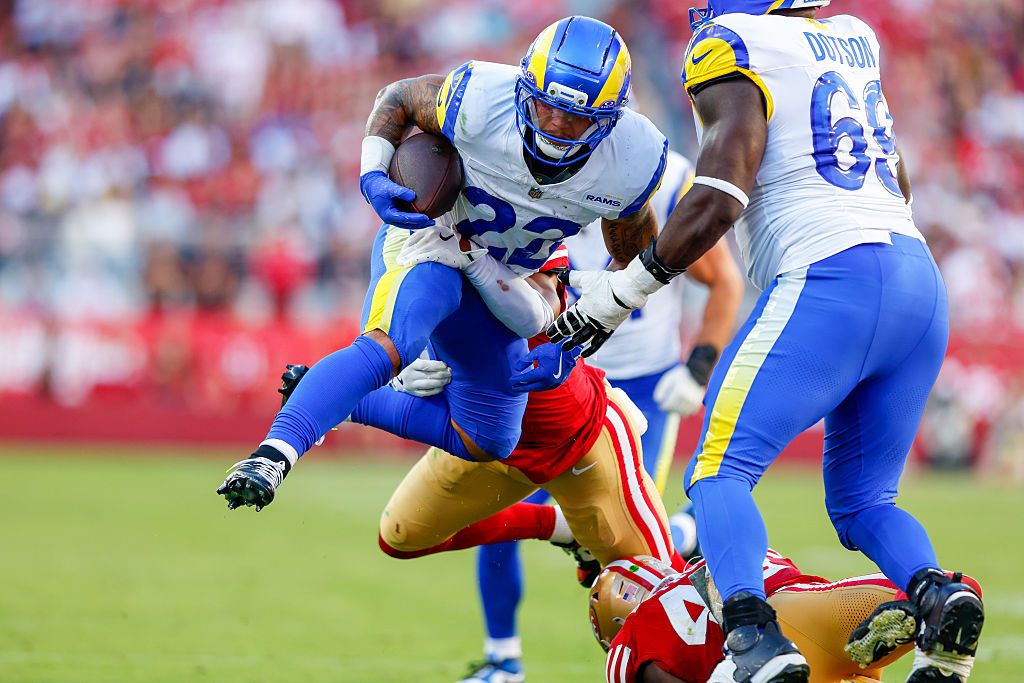
November finds Los Angeles balancing urgency and patience, with the playoff chase tightening and Seattle looming on the schedule. Early months crowned Kyren Williams the tempo-setter; recent weeks introduced Blake Corum as a real, fresh-leg counterpunch. Sean McVay’s offense still leans timing, motion, and ball control, demanding backs who protect downs and finish drives. The question now isn’t flash, but stewardship: whose hands guide the key snaps when the game compresses? That’s the frame for this backfield in Week 11 and beyond.
Below, I break down the backfield split in Los Angeles, and evaluate what it should look like in Week 11 vs. the Seahawks.
Follow my handle @dansby_edits for more fantasy football advice, as well as plenty of NFL and college football betting goodies.
The Rams’ backfield
Early in the season the backfield behaved like a classic feature-and-spell setup: Weeks 1–7 sat at 76.6% of team rushes for Williams to 23.4% for Corum. Since Week 8, that gap has narrowed to 57.3% versus 42.7%, and in two of the past three games they finished within one carry of each other. That is a meaningful redistribution of the early-down pie. What it is not, however, is a redistribution of the snaps and situations that drive fantasy ceilings.
Over the last five weeks of play, Williams has logged 169 snaps across four games (Week 8 bye), averaging 42.3 per game and clearing 60% in three of four. Corum sits at 97 snaps in the same span, or 24.3 per game, with two spike games but two sub-one-third outings. On the ground, Williams carries 64 times for 291 yards at 4.5 per attempt with four touchdowns; Corum stacks 43 for 174 at 4.0 per attempt without a score. The near-parity weeks in carries did not produce parity at the goal line, and they did not erase the third-down and two-minute work that keeps Williams’ weekly floor buoyant.
High-leverage touches are where the hierarchy sharpens. Williams owns four goal-line attempts and has converted two of them; Corum has one attempt and zero conversions. Williams also controls the pass game: eight targets and six receptions for 59 yards in this window, versus one target and one reception for six yards for Corum. Those extra routes become free points in PPR scoring and, just as importantly, keep Williams on the field when the Rams chase conversions, bleed the clock, or enter hurry-up. If you’re ranking touch quality, Kyren’s portfolio remains richer.
The efficiency tape backs the usage. Williams posts +17.95 total rushing EPA, 0.256 EPA per play, and a 54.3% success rate over the recent sample. Corum sits at −1.53 total EPA, −0.035 per play, with a 43.2% success rate. Both protect the ball cleanly, but Williams is the one stacking positive plays at a starter’s rate. Contact metrics point the same direction: Williams has 181 yards after contact at 2.83 per attempt, while Corum sits at 106 and 2.47. That extra half-yard after first contact is the difference between second-and-six and second-and-eight, and it’s often the difference between the huddle calling another run or bailing into a must-throw.
None of this diminishes Corum’s real value to the offense. He has two runs of fifteen-plus yards in the recent sample, brings fresh-leg pop to early downs, and has been trusted enough to reach 12–13 carries in back-to-back weeks. If the Rams string long possessions and reach 30 team rushes again, Corum projects into double-digit volume with reasonable efficiency. That’s viable flex usage, especially in deeper formats or as bye-week cover. It simply isn’t the same as owning the snaps that catch passes and cash touchdowns.
Advanced opportunity metrics – defensive alignment, game state, etc.
Seattle’s fronts toggle between light and standard depending on down-and-distance. Against six-and-under boxes, Williams has ripped 10 carries for 78 yards (7.8 per, 70% success). Corum is solid in that look at 10 for 51 (5.1 per, 40% success), but Williams is significantly more likely to keep the call sheet balanced with ahead-of-the-sticks winners. Against seven in the box, Williams sits at 18 for 66 (3.7 per, 44.4% success) while Corum is 15 for 63 (4.2 per, 40% success). Against eight-man looks, Williams still holds 36 for 147 (4.1 per, 50% success) versus Corum’s 18 for 60 (3.3 per, 44.4% success). The takeaway isn’t that Corum struggles; it’s that Williams sustains efficiency across every picture and keeps drives on schedule when the defense loads the fit.
With the Rams leading, Williams has 50 touches for 221 rushing yards at 4.7 per and a pile of positive EPA; with the score tied, he remains steady and useful. Corum has been fine when leading, but the staff’s closing script favors Williams for salt-the-clock possessions and green-zone carries. If Los Angeles plays from in front against Seattle—and they’ve built plenty of second-half leads this season—the distribution naturally tilts toward Kyren’s touch profile.
Matchup against the Seahawks in Week 11
Expect a patient ground approach that tests edges, then knifes inside when Seattle slants. Expect McVay to keep both backs involved on early downs to preserve tempo and protect the play-action menu. And expect the premium snaps to stick with Williams. My projection lands Kyren around 65–70% of snaps with 18–22 carries and three to five targets, carrying primary goal-line, third-down, and two-minute duties. Corum profiles in the 30–35% range with 10–14 carries and zero to one target, absorbing series relief and some first-and-second-down work between the twenties.
Corum is a growing part of the plan and a mild drag on Williams’ raw rushing share compared to September, but the structure of the backfield still points to Kyren as a weekly RB1. He owns the snaps, the routes, the green-zone touches, and the efficiency edge that turns volume into points. Start Williams with confidence. Treat Corum as a live, volume-based flex whose path to a ceiling week requires either a lopsided script or a rare breakaway plus a short score—outcomes you never project, only welcome when they arrive.