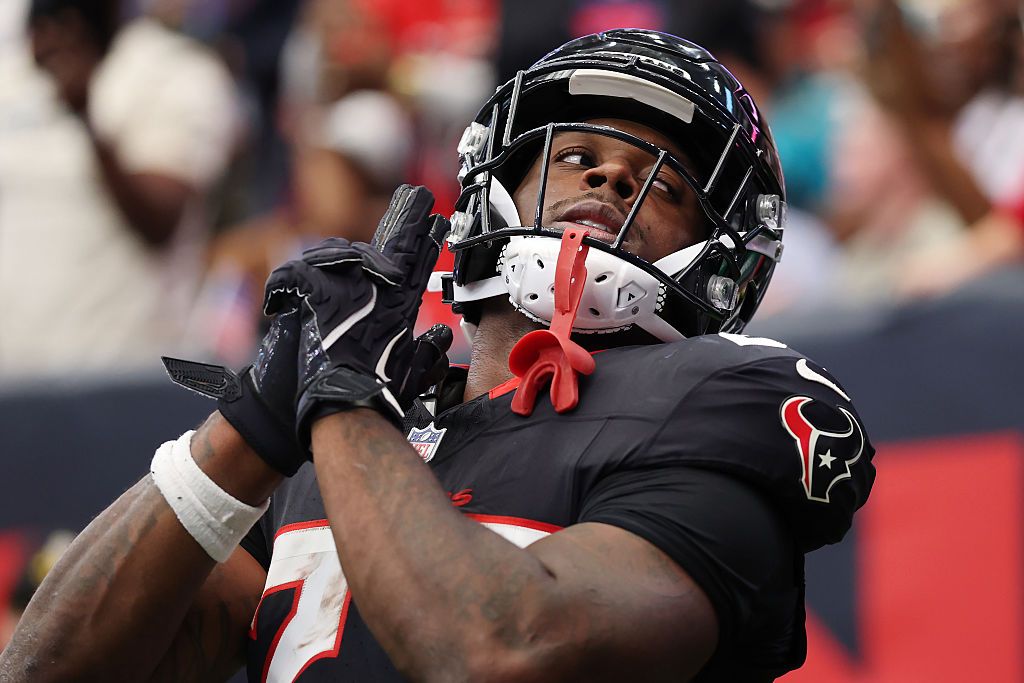
Woody Marks arrived in Houston with tape that pops—vision, balance, and catch-and-go economy built for Sundays. The knock has been workload, not talent, and the year has answered that, thus far, without much urgency. Until last week, that is, when Houston asked him to be spark and ballast, and the usage followed: 60.9% snaps in Week 7, peaking at 78.3% in Week 10. He has turned that trust into real drive value—routes, third-downs, and red-zone touches that actually change sequences. Across the last month, the ball found his hands on money downs, and he answered with conversions and touchdowns. Those aren’t empty splits; they describe a player who wins early, wins through contact, and keeps winning once he’s in space. You may, as of this moment, know him best from the Week 10 takeover, where the snap share and touches told the truth.
Below, I break down the Houston backfield split, and why it so heavily tilts toward lumber.
Follow my handle @dansby_edits for more fantasy football advice, as well as plenty of NFL and college football betting goodies.
Woody Marks’ takeover is real
Houston’s backfield tipped. The film and usage agree. Woody Marks seized the keys while Nick Chubb slid to a change-up. The Week 10 snap split told the story: 78.3% for Marks, 14.5% for Chubb. That wasn’t a blip. It was the culmination of Weeks 7–10 usage climbing toward a true RB1 workload. Across that run, Marks’ snap shares stair-stepped 60.9% → 41.3% → 47.2% before the Week 10 spike, with his rush-attempt share cresting at 63.6% last week after 35.7% and 30.6% in Weeks 9 and 8.
The shape of that workload is sticky. Marks owns money downs, the two-minute, and the four-minute. He has five third-down chances with three conversions and fourteen four-minute touches. He owns thirteen red-zone chances and both rushing scores in that span. The staff trusts him where possessions pivot. That trust shows up in routes, too. Eighty-six routes in four games and 15 targets become real receiving EPA. Your sheet has him at +8.07 receiving EPA and a 42.6% success rate. That is drive fuel, not garnish. Add the hard numbers: nine catches for eighty-seven yards with a red-zone receiving score, a 22.2% red-zone touchdown rate across nine carries plus four targets, and a perfect one-for-one at the goal line. He’s also banked sixteen touches in one-score sequences and converted fourteen rushing first downs at a 31.1% rate.
The scheme context explains why this sticks against Tennessee. Nick Caley’s first season brought more under-center and a multiple run menu, leaning physical between-the-tackles identities from his Rams stop. The Texans doubled down on multiple while living with a rough run-block win rate. ESPN has Houston 32nd in RB run-block win rate, yet 7th in team pass-rush win rate. That tension forces efficient backfield choices. Marks handles it with 132 yards after contact across the sample and 2.93 per attempt. He creates through first contact and keeps Caley’s sequencing on schedule. The calls reflect it: thirteen outside-zone totes, six inside zone, six power, with counter and draw sprinkled (three each). He’s carried from every grouping—sixteen from 11, five from 12, five from 21, and nineteen from heavy—while Chubb’s recent rushing skews toward jumbo looks.
Matchup against the Titans in Week 11
Now the matchup. Tennessee’s defense sits in the bottom tier versus the run by volume. They’re 27th in opponent rushing yards per game at 141.3. That’s not a one-off; it’s a trend through Week 10. The Titans also play lighter boxes than you remember. Their light-box rate is 42.7%, with a low blitz rate at 18.2%. That invites patient doubles and zone with checkdowns ready against static second-level spacing. Jeffery Simmons still wrecks interiors, but the edges and perimeter fits leak.
There’s also fresh, direct evidence. Houston blanked Tennessee 26–0 in Week 4. Marks posted 69 rush yards and caught a red-zone touchdown in that win. Same helmets this Sunday, different tilt on his role. Since then, the Texans have embraced Marks as the all-situation answer, while Tennessee’s offense has continued to drag the defense into long fields. Expect that field position loop again.
We can talk Chubb. The burst still pops on a handful of carries; Week 10’s five for 47 proves that. The problem is volume and leverage. He has six red-zone chances with zero touchdowns over this stretch. His third-down work is almost gone and his routes are thin. The staff keeps him for specific power looks and series breathers. That’s real, but it isn’t lead-back oxygen when games compress. The advanced file matches the eye: forty-two total plays at −0.162 EPA per play, a 40.5% success rate, receiving EPA in the red at −0.30, and just thirty-nine routes over four games (0.8 per).
Bottom line
Marks’ profile checks every box you want for a takeover Sunday. Snap share has stabilized north of 65% with a Week 10 spike. He logged 45 carries to Chubb’s 38 across the window and out-targeted him 15 to six. He converted fourteen rushing first downs to Chubb’s one. He has both rushing scores and the lone receiving score. That blend erases game-script fragility. If Houston leads, he salts. If Houston trails, he catches. Fold in the raw totals—167 rushing yards on 45 carries with two on the ground—and the role reads bankable rather than streaky.
The opponent profile echoes the plan. Tennessee bleeds rushing yardage and doesn’t heat protections. They live lighter in the box and have struggled to finish tackles on the perimeter. Simmons will win reps, but Houston can steer volume outside and into packages that keep Marks in the progression. The Week 4 blueprint is available, now with a higher snap floor.
What I expect Sunday: 65–70% snaps, 15–18 carries, and four-to-six targets. Goal-line belongs to him, and the two-minute answers are his hands. The Texans won’t need explosives to justify the usage; they’ll accept four- and six-yard bites that stack drives. Tennessee’s defense ranks midpack in team run-stop win rate and still yields chunk yardage by volume. That’s the runway for accumulation and scoreboard control.
I’d rather ride Marks’ usage than chase a thin Chubb spike. The takeover already happened. Sunday just broadcasts it in Nashville. And the box score will read like it.