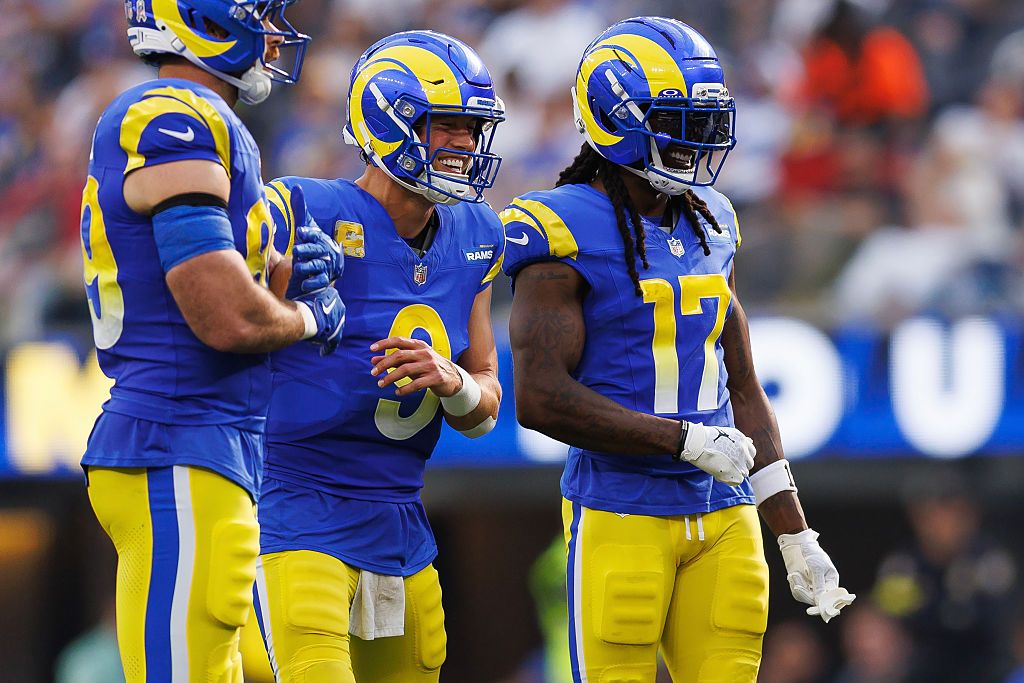
Week 10 rolls in loud and weird, the kind of slate that rattles coffee mugs from Berlin to the Bay. Breakfast football hits Germany with Colts-Falcons on Sunday morning, a jet-lagged window that always flips usage quirks and coaching nerve. By late afternoon the league’s loudest stage lights—Rams at 49ers—promise fireworks; it’s the week’s highest-octane billing and a rivalry that keeps trading haymakers. Miami and Buffalo renew bad blood in the early slot, the Dolphins chasing a streak that’s bitten them too many times since September; the tenor feels personal now, the stakes obvious. Sunday night tilts West as Justin Herbert and a rejuvenated Aaron Rodgers meet under the SoFi glow, a conference barometer draped in primetime gloss. The grindy theater lives elsewhere, too: Browns-Jets arrives with defense, attrition, and a whiff of gallows humor—two proud rooms clawing for traction and field position. The South gives us real news you can set a lineup to: Carolina cleared Rico Dowdle on Friday while Tetairoa McMillan hit the wire as a true game-time watch, a small hinge that swings a lot of touches. And through it all, the bye ghosts tug—Bengals, Cowboys, Titans, Chiefs—forcing managers to hunt leverage, lean on roles, and trust schemes over names. This is November football: travel, weather, and scar tissue shaping game plans, while our edge lives in the living details—who gets the first read, who owns the red zone, and which coordinators can still write answers on third down. Let’s get right to my Five Lists of Five: Week 10 edition, here, and, like the digits in the week, double down on some stashes, dart throws, breakouts, and, probably most importantly, as always, running back sleepers for fantasy football Week 10.
The refrain remains the same—All I want is for you to be better than your friends. You’re going to be surrounded by them on Sunday, probably. How sweet would it be if you could be sure you’ve checked every box possible that might guarantee you a resounding victory this week? Some kick-your-feet-up insights? I’ve got some. And I know my audience. The smoke-break audience. The quick-scan-of-the-phone-on-the-way-to-the-fridge audience. The I-ain’t-reading-all-that-but-good-luck folk. I’m a man of the people.
And so: the Five Lists of Five series. Think of these as byte-sized, two-minutes-to-yourself lists to scan during your weekend as you foam at the mouth for any competitive fantasy edge. As much relevant analysis as I can fit into, like, ~250 words per player.
Below: Top five smash starts for fantasy football Week 10. Must-starters based on matchup and sky-high ceilings.
Here are the other offerings from my 2025 Fantasy Football Five Lists of Five: Week 10 edition:
TK
Follow my handle @dansby_edits for all of my fantasy football content—as well as plenty of NFL and College Football betting goodies—all season long.
Top five smash starts for Week 10 of 2025 fantasy football
Garrett Wilson, WR, New York Jets
Welcome back to what’s left of Gang Green! Garrett Wilson walks back into MetLife with a profile built to cut through the rebuild and trade deadline noise. Across 44 man-coverage routes he’s at 10 receptions for 124 yards, a 31.8% target rate, and 46.4 PPR (1.05 PPR/RR); even in zone he’s banked 166 routes → 26 for 271, 22.9% targets, 53.1 PPR (0.32 PPR/RR). He profiles as a high-end start if active—exactly how I’m treating him. Cleveland’s front is the stressor, but the thrower and context help. Justin Fields posted 244 passing yards in the pre-bye win and now gets Wilson back as the true first-read governor of this pass game.
Cleveland’s defense grades elite and the rush sits near the top of pressure-rate boards. Myles Garrett wrecks plans with a 16.2% individual pressure rate, while the unit pressures 43% of dropbacks and wins 55% of pass-rush reps—first. That demands quick-access throws and isolation answers, which Wilson supplies with stop-start nuance and hard man wins. New York’s line hasn’t gifted many clean pockets, posting a 51.8% clean-pocket rate, second worst. The offense must lean into rhythm, RPO, and Wilson’s slant-over menu to stay on schedule. Jim Schwartz has flashed heavier zone weeks, 86% in Week seven, yet on third down they still heat the pocket and spin into single matchups. Opponents convert 36.5%—and that’s precisely where Wilson’s man profile bites.
This is the picture: Cleveland squeezes explosives with rush; New York answers by moving the sticks through its best separator. Wilson’s coverage-agnostic PPR per route sits at 1.05 vs man and 0.32 vs zone, and Fields will pepper him. That clears the floor and leaves real ceiling in any script. Lock him in as a must-start—volume and leverage live here.
Expect double-digit targets, 6-8 catches, and something in the 80–110 yard band with real TD equity. That’s a locked-in WR1/2 this week, with top-12 PPR in reach on volume and man-win efficiency.
Zay Flowers, WR, Baltimore Ravens
Zay Flowers steps into Week 10 with Minnesota’s shell tilted his way. Against zone he’s logged 158 routes → 30 receptions, 340 yards, a 24.1% target rate, and 70.0 PPR (0.44 PPR/RR); versus man he’s still efficient at 73 routes → 16 for 210, a 28.8% target rate, and 37.0 PPR (0.51 PPR/RR). His individual grade checks 79.9, and recent form reads five targets for 64 yards—steady volume that travels. The Vikings play zone on 75.5% of coverage snaps (11th) and man on 18.1% (22nd), matching Flowers’ stop-start craft on slants, speed-outs, and digs. Expectable scoring juice sits in the backdrop: 26.5 projected points for Baltimore with Lamar forecast around 21.4 fantasy points this week.
Minnesota layers heat. Brian Flores’ group ranks near the top in blitz rate (~42%), and they’ll send five or more from depth to squeeze early windows. That dovetails with Jackson’s current profile: Next Gen Stats has him delivering the league’s highest success rate (58.9%) and highest passer rating (136.4) when blitzed this season. Since the start of last year, Jackson has averaged 12.0 yards per attempt vs zone blitz and 9.7 Y/A vs zone overall, the exact spaces where Flowers lives. The Vikings just allowed 284 passing yards to Detroit, and their coverage mix still trends zone-heavy—inviting quick-game answers and intermediate in-breakers.
Baltimore’s structure layers motion and stacks to manufacture free access, then marries quick game to choice routes; Flowers owns the team’s primary zone share and keeps red-zone relevance via condensed splits and whip/pivot. The usage is coverage-agnostic and quarterback-aligned. Bankable targets, efficient per-route returns, and an opponent mix that rewards precisely his strengths.
Bank nine targets and 60–85 yards against Minnesota’s zone, with added red-zone chances on whip/pivot. He profiles as a high-floor WR2 who can spike into WR1 on blitz answers and YAC.
Davante Adams, WR, Los Angeles Rams
Davante Adams gets Week 10 with volume, leverage, and a coverage look he dissects. Against man he’s logged 86 routes → 12 for 131, a 30.2% target rate, 55.1 PPR, and 0.64 PPR per route; against zone he’s at 169 routes → 24 for 360, a 25.4% target rate, 78.0 PPR, and 0.46 PPR per route. The season ledger adds 21 first downs, 17 explosive gains, and eight touchdowns, with last week’s 5-for-7 for 60 marking the cleanest recent yardage return. His individual weekly grade sits at 81.7, which tracks with the tape: boundary control, option-route patience, and late hands that steal tight windows.
San Francisco plays man at a 15.6% rate (27th), a zone-leaning shell that invites option, glance, and deep outs from condensed splits. The scoreboard context cooperates: Los Angeles ranks fourth in projected points this week at 27.0, and the matchup arrives with the opponent down its top three edge rushers and without Fred Warner—a pressure profile that softens timing windows and expands the red-zone tree. Matthew Stafford’s form underscores the access; he carries an 89.9 overall grade (8th) and has kept the ball on schedule with decisive pre-snap answers.
Expect Los Angeles to stack motion and fast fours to force off-coverage, then marry quick game to play-action. Adams is the first-read tilt when the picture stays static and the isolation answer when the shell spins late. The per-route returns travel across coverages (0.64 vs man; 0.46 vs zone), and the team total gives touchdown equity real teeth.
Pencil in right around eleven targets and 85–115 yards, with multiple end-zone looks in a high-total game. Treat him as a top-eight WR this week, with a clear multi-TD path.
Rico Dowdle, RB, Carolina Panthers
Rico Dowdle starts Week 10 with volume, form, and a clean bill. He sat Wednesday with a quad, returned limited Thursday, then logged full on Friday with no game status. He’s cleared to go (team report). He’s also fresh off a $14,491 celebration fine that he flipped into a charity push, the kind of noise that doesn’t change his role but tells you the week’s context. The recent production is the headline: 206 rushing yards on 23 carries versus Miami and 183 more the next week, powering a midseason surge to 735 yards on 131 carries (5.6 per) and four touchdowns. Since Week five he leads the league with 652 rushing yards on 6.3 per carry—the heater that built this usage floor.
New Orleans profiles as a zone-lean run front that’s sturdy by season-long EPA but leaking lately. On the year they’ve allowed 1,165 rushing yards and eight rushing touchdowns, with −0.08 EPA per rush allowed; last Sunday they yielded 171 on the ground to Los Angeles. That split matters because Carolina’s script stays run-first in neutral and tilts heavier with a lead. The matchup math from our board already leaned ground volume; the opponent’s recent three-game slide reinforces it.
Depth-chart context helps the call. Chuba Hubbard’s calf derailed him for multiple weeks and tightened his role; he was ruled out in early October and only recently worked back in, which keeps Dowdle’s touch share insulated. Dowdle also leads Carolina in touches (146) to Hubbard’s 99, a usage gap that usually survives game mood. If New Orleans heats the edges, Carolina answers with duo/insert and RPO; if the box lightens, they hammer interior doubles. Either way, red-zone sequencing funnels through the hot hand.
Start him with confidence. Injury-clear, lead-back usage, and a defense showing season-good but recent-soft metrics create a sturdy floor and real two-score ceiling. Plan for 20 touches and 90–115 total yards, plus premium goal-line chances. That’s RB1/2 sturdiness with real two-score upside, even after the midweek limitations.
Marvin Harrison Jr., WR, Arizona Cardinals
Week 9’s Cardinals/Cowboys MNF game might just be remembered as MHJ’s first real breakout game. A lot of his damage came in the first half, but I like him to continue his rapport with new QB Jacoby Brissett this week. Seattle brings a zone-heavy picture that tests patience, not talent. The coverage ledger is clear: the Seahawks play man on 15.0% of snaps (28th) and zone on 80.0% (4th). Against zone this year, Harrison has logged 229 routes → 25 receptions, 400 yards, a 17.5% target rate, 83.0 PPR, and 0.36 PPR per route—and his file explicitly notes he’s producing the same PPR/RR vs man and zone. Seattle’s defense squeezes air yards with discipline, holding opponents near 7.1 yards per coverage target and trimming the explosive-pass rate to 13.3%; only two wideouts have cleared 70 yards against them all season. Arizona’s environment is serviceable for volume: Cardinals implied 19.5 at Seattle, with the host side at 25.75, a game state that sustains WR1 routes and third-down access.
The quarterback shift stabilizes his usage. With Jacoby Brissett, Harrison’s intermediate timing sharpened and his per-route output held steady regardless of shell—exactly what you want when the opponent lives in zone and tackles well. Last week’s proof point fits the thesis (Brissett 21-of-31, 261 yards, two touchdowns, zero picks; Harrison 7-96-1). Expect Arizona to layer motion and stacks to buy free access, then marry quick-game slants, speed-outs, and glance to play-action crossers. When the picture compresses, Harrison keeps red-zone relevance via condensed splits and pivot/whip inventory; when rotations spin late, he throttles, finds grass, and converts chains.
The file’s caution—Seattle’s top-five zone rate equals a tougher runway—lands, but the player’s per-route stability answers it. You’re starting an efficiency engine: 0.36 PPR/RR vs zone with matching returns vs man, in a game that should keep him on the field and in phase.
Expect eight to 11 targets and 70–95 yards in a zone-heavy environment that feeds his intermediate wins. That’s a sturdy WR2 floor with WR1 ceiling if the red-zone looks materialize.