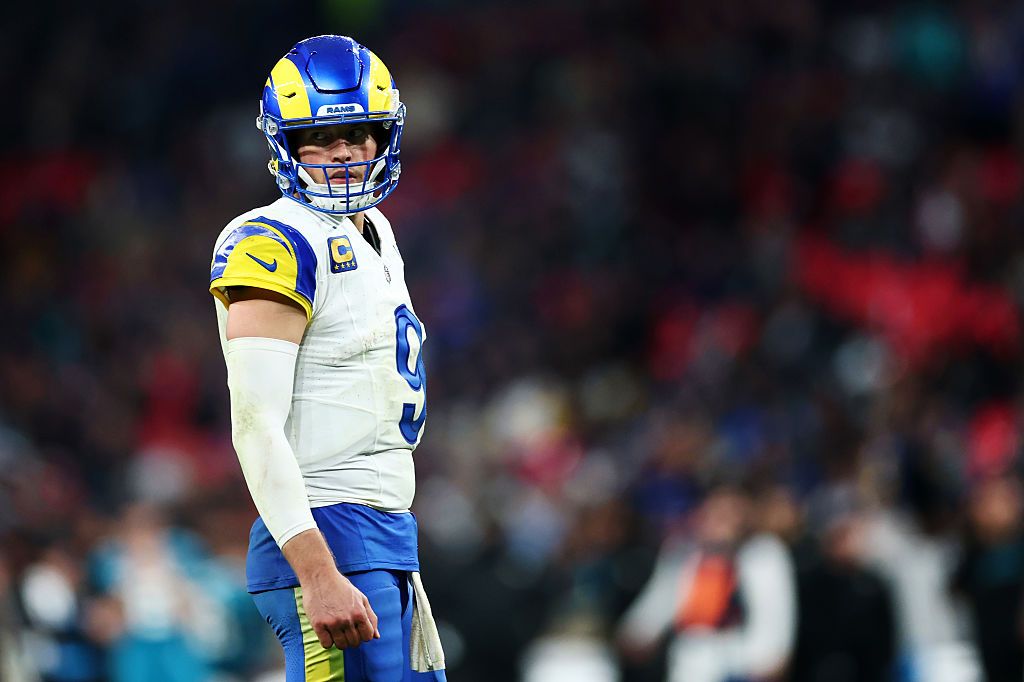
There is no one happier than yours truly that the MVP drumbeat, nine weeks into the 2025 NFL season, follows Matthew Stafford into every huddle now. October killed the age jokes; the Week 7 London game crowned the heater with five touchdowns in rain and jet lag. ESPN’s Peter Schrager—known superficially for his Super-Bowl-predicting foresight, but known to me as the object lesson of integrity and passion in NFL reporting—has since planted an early MVP flag on Stafford’s sol-yellow “9” after the Saints demolition. National rankings boards apparently just needed to see the Rams obliterate the Saints, and not exhibit look-ahead tentativeness with the Niners in Week 10; power rankings shoved the Rams into the top tier. And it’s because, in his seventeenth season(!), Matthew Stafford has kicked the QB1 door open, and he isn’t knocking politely. He’s detonating red zones, erasing blitzes, and piloting a chameleon offense that weaponizes matchups every week. The tape spits flames and the math nods. In a season tilting toward condensed passing trees, he’s the veteran answer with weekly ceiling. He has entered the rest-of-season QB1 circle with conviction. I break down the numbers below.
Follow my handle @dansby_edits for more fantasy football advice, as well as plenty of NFL and college football betting goodies.
Matthew Stafford: 2025 fantasy football QB1 King
Stafford’s 2025 by the numbers
Start with the spine. He’s at 21 touchdowns against two interceptions, paired with a 66.5 QBR and a league-leading touchdown ledger. The Saints game was a clinic in control—24 of 32 for 281 and four—inside a suffocation plan that stole 43:53 of possession. In London, he became the first quarterback with five touchdown passes in an international game, doing it without Puka Nacua and while spreading the ball to 10 different teammates. That combination—surgical patience plus quick kills—is how you sustain scoring without a rushing crutch.
Now fold in the advanced ledger that explains why this heater sustains. He’s at 0.21 EPA per dropback (fifth), 0.11 per play, and a 48.05% success rate—season-long value creation backed by 33.19 total EPA. The core rates purr: 67.2% completions, 7.84 yards per attempt, a 7.66% touchdown rate, and a microscopic 0.73% interception rate. Red-zone control fuels the fantasy ceiling: 17 touchdowns on 55 throws, a 30.9% conversion that turns drives into sixes, not pleas. Third down is the dent—51.5% completions, −0.09 EPA—but the early-down efficiency and low-red ruthlessness keep weeks on schedule.
A lot of it can be attributed to McVay and Mike LaFleur’s emphasis on using 13-personnel in the passing game. McVay’s three-tight-end waves have become identity, not gimmick: 45.5% usage against New Orleans, the decade’s single-game high, after 38.7% two weeks prior. Seven touchdowns from those sets across the last two games tell you why they live there. It’s stress by angles: play-action crossers, rail tags, and bully-ball slants for Davante Adams while Nacua resets rhythm and leverage on glance. This isn’t nostalgia for heavier football; it’s a modern cheat code for cleaner pictures.
Pressure and disguise haven’t slowed him. Terrifyingly—they’ve fed him. Over the last two games he’s thrown nine touchdowns against the blitz, the most by any quarterback in any two-game window of the tracking era; all four against New Orleans came versus pressure. That’s pocket drift and pre-snap plan meeting post-snap poise. Even when pressured, the profile stays positive: 0.05 EPA versus blitz with a 44.3% completion rate, because the ball exits on time to leverage, not panic. The film gives you the reasons: a no-look dig to Adams after holding the post safety, a 39-yard hole shot to Nacua with a 32% completion probability, and McVay calling it “another game where he’s in total command.”
Zoom into coverage and depth, and the answers stay consistent. Against man, he’s at 61.7% completions and 6.6 YPA with an 11-0 touchdown-interception line; against zone he climbs to 70.5% and 8.5 YPA with strong play-by-play value. The aDOT sits at 8.9—balanced, not boom-or-bust—while the intermediate tier (10-19) hums at 10.2 YPA and 0.58 EPA per play. The deep ball is elite efficiency: 47.6% completions, 16.1 YPA, 0.96 EPA, four touchdowns, zero interceptions. Play-action remains a cheat code at 0.32 EPA, with screens adding 0.17; behind-the-line throws don’t pad anything, and the negative EPA there proves this production comes from real quarterbacking, not empty sugar.
How he’s doing it
He’s winning the geometry before the snap and then painting on time. Stafford toggles from kill calls to hot answers without panic, uses short motion to force leverage, and drifts the pocket just enough to keep his base. The film shows eyes as a weapon: he holds the post safety with a half-beat shoulder flash, then rips the dig or hole shot on rhythm. That eye control pairs with aggression into tight windows; in Week 1 his targets averaged just 2.6 yards of separation—near the lowest in the league—yet he still carved cleanly, a marker of trust and ball location rather than scheme training wheels.
He’s stacking “quarterback throws,” not stat-padding throws. The intermediate dagger shows up weekly, and the tape keeps spitting no-look leverage balls and rope-driven outbreakers. Pro scouts call them big-boy windows; the metrics call them big-time throws, and he leads the league with 19 at midseason after logging only 23 all of last year. That’s not YOLO ball. It’s precise aggression that fits how Los Angeles is dictating coverage, and it’s a meaningful proxy for high-value fantasy touchdowns that don’t require volume.
He’s separating games after halftime with control, not chaos. Against Tennessee, Stafford went 14 of 17 after the break for 191 and two scores with a 152.7 second-half rating, adding 10.8 expected points by himself. That’s veteran sequencing: probe the tells for two quarters, then spam the answers when the disguise tires. It’s also the antidote to slow-pace scripts. You still get the spike because the quarterback accelerates efficiency on command.
He’s pairing that aggression with near-zero risk in the red. The Saints tape logged no turnover-worthy plays despite condensed space and heavy traffic, which is exactly where gunslingers usually give one back. That calm in tight quarters is chemistry—Davante Adams winning leverage inside the numbers, Puka Nacua resetting timing but it’s also Stafford’s platform discipline: chest quiet, base loaded, ball out. The room feels it; the headset trusts it; the scoreboard cashes it.
He’s doing all this as the centerpiece of a shape-shifting plan. McVay has made three-tight end looks a weekly club in the bag, then toggles to spread and condensed splits without losing speed. That multiplicity creates simple pictures for the quarterback and impossible math for the nickel; the tape shows free-access glances one series, rail throws the next, and a boundary iso when the defense finally rolls down. The result isn’t volume cosplay. It’s a veteran operating clinic—eye control, pocket drift, throw variety, you gosh-darn name it—with the numbers nodding after the film already told the truth.
And the intangibles? They’re on the tape and in the room. The reworked contract saga could’ve bent the locker room; instead it sharpened the huddle’s trust in the voice with the green dot. The rapport with Adams accelerated at warp speed—two tight-window scores from inside the five against New Orleans—while Nacua’s return re-opened the vertical glance game. PFF’s film grade pins him at 91.7, second among quarterbacks, and the individual play cut-ups show the same: eye manipulation to freeze the pole safety, no-look work through the middle, and the old arm angles deployed with better restraint.
Bottom line
Treat Stafford as a midrange QB1 the rest of the way with real top-five spike weeks. The touchdown rate is built on design, not luck; the red-zone profile is bankable; the coverage and depth splits are scheme-agnostic.
The film backs it with no-look daggers, eye control, and throw-by-throw command that has McVay calling games through him.
If you roster him, you start him through the schedule teeth; if you don’t, you buy before the next multi-score Sunday moves the market again. And if awards really come down to truth on film, the cut-ups have already made the case.