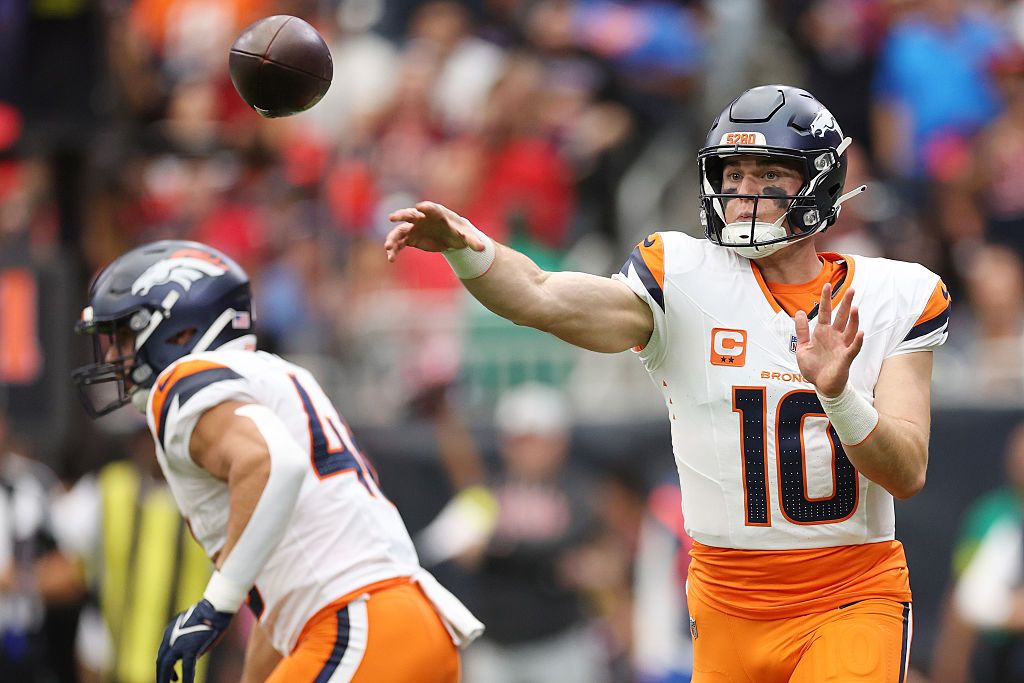
Thursday spotlights Bo Nix and Sean Payton’s reboot, now riding nine straight at home. Las Vegas arrives after trading Jakobi Meyers and leaning into Brock Bowers’ surge under Pete Carroll. Marvin Mims is out, so targets condense to Courtland Sutton and Troy Franklin. Pat Surtain II is out, forcing Denver to adjust its Bowers answers, and potentially enter into a more punchy back-and-forth than if their top defensive man was helming the unit. Maxx Crosby’s motor against Denver’s clean pocket shapes the night’s script, and it’ll test the Broncos’ chip-and-release game off the line. Denver chases separation in the West, so urgency tightens every call. Geno Smith’s Week 9 bounce with Bowers now presses Denver’s bracket answers on a short week. We, however, are most interested in what magic Denver’s quarterback can pull out of his ruffled hat tonight.
To wit—below, check out one of my favorite Bo Nix props to consider from this Thursday night tilt.
Best Bo Nix prop bet for Broncos vs. Raiders
Bo Nix 34+ pass attempts (+110)
Bo Nix 34+ pass attempts at +108 aligns with Denver’s statistical fingerprint and Las Vegas’s structural invites. The target asks for 95% of his 35.8-attempt average, so the bar sits below baseline. Denver’s passing DNA is volume by design: a 3.4 aDOT with a 2.4-second release manufactures snaps instead of stalls. Over 1,000 of his 1,976 passing yards have arrived after the catch, so horizontal stress operates as a primary engine. Protection keeps that conveyor belt pristine—only nine sacks in nine games, with Garett Bolles at 4.9% pressure allowed, Quinn Meinerz at 3.5%, and Mike McGlinchey at 7.0%. That lattice sustains long possessions and stacks throws without exposing the pocket.
Distribution also feeds volume. Nine different Broncos own 10-plus receptions, which compresses reads and speeds ball-handling across the formation. Courtland Sutton holds 566 yards and four touchdowns on 38 catches, while Troy Franklin adds 385 and four more on 37, giving the quick game sturdy, repeatable outlets. Evan Engram’s 26 receptions and RJ Harvey’s 166 receiving yards extend Payton’s perimeter menu with screens, swings, and option routes that all log as passes. Marvin Mims sits, which trims pure verticals and further channels usage to those high-percentage access throws.
Las Vegas points the same direction. The Raiders rank 12th against the run and around league average against the pass, allowing 230.6 air yards per game. They’ve produced 15 sacks, and one-third belong to Maxx Crosby, which concentrates havoc into a single gap. Concentration invites chips and rapid timing rather than fewer dropbacks. Denver’s offense averages 25.9 points and 357.0 yards, with 133.6 on the ground, yet Payton still opens drives through the air to widen leverage and tire edges. Two-minute windows at each half reliably add attempts, and altitude erodes pursuit discipline late, encouraging safe perimeter throws over clock-bleeding into set boxes.
I expect Denver to throw on early downs to stretch width, then layer RPO and screen tags that count as passes. That script pushes attempts past thirty-four without demanding explosives or a track-meet total. I’d play 34+ to +100 given the 35.8 baseline and Denver’s quick-game infrastructure. If the number shortens, 22+ completions at +106 mirrors the same YAC-driven thesis.