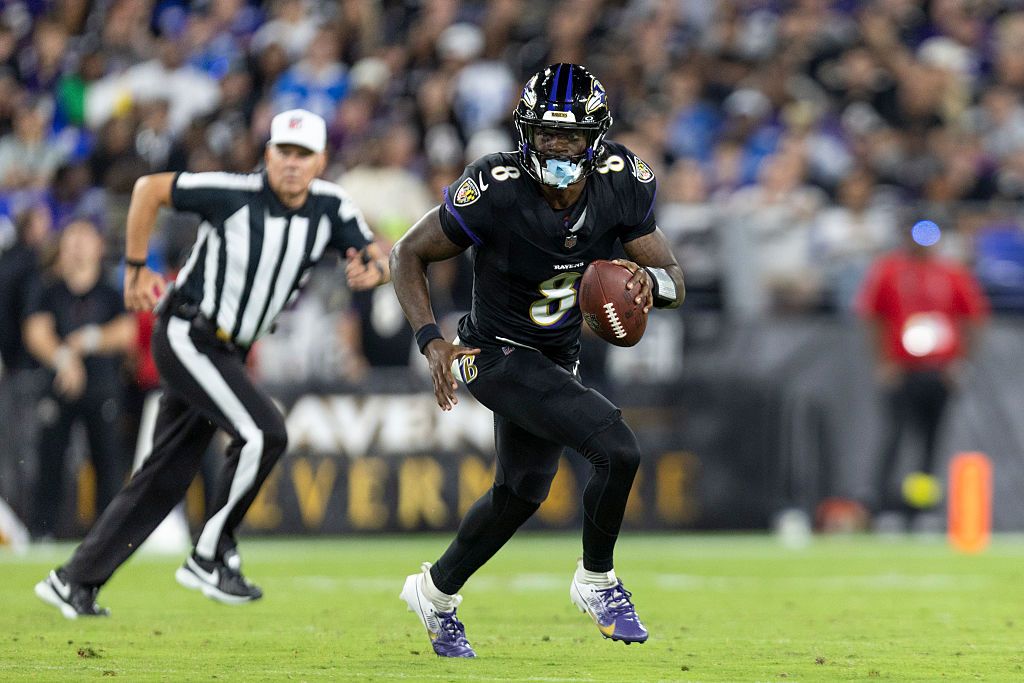
More than a month after leaving the Baltimore Ravens’ Week 4 loss to the Kansas City Chiefs with a hamstring injury, two-time NFL MVP Lamar Jackson is back on a football field. The 28-year-old returned to practice last week and is will play tomorrow when his Ravens, now just 2-5 and second-to-last in the AFC North, take on the Miami Dolphins for a Thursday Night Football clash. He’ll need to get back up to speed in a hurry if Baltimore wants to make a push at its third straight division title: the Ravens are -130 favorites to win the division now that Jackson — and the rest of the 53-man roster — is back in action.
Baltimore was just 1-3 in games that Jackson started, but it was hardly his fault: this season, he’s completed a career-high 71.8% of his passes for 869 yards, 10 touchdowns, and one interception while rushing for a further 166 yards and one score. He’s already the active career leader in rushing yards per attempt and passing touchdown percentage, as well as the all-time career leader in adjusted yards per attempt and passer rating, and his first four games represented a career high in each of those stats. Jackson’s backup, Tyler Huntley, isn’t a bad quarterback, completing 17 of his 22 passes for 186 yards and a touchdown in his lone start in a win over the Chicago Bears, but there’s no doubt that the Ravens are a completely different team with Jackson under center.
While he was injured, his co-star, running back Derrick Henry, had an opportunity to get back on track. Between Weeks 2 and 4, Henry amassed just 115 yards on 31 carries, but he became a focal point of Baltimore’s offense again with Jackson injured and has totaled 45 carries, 193 yards, and two scores over the last two weeks — decidedly Henry-esque production. The three-game blip aside, I wouldn’t expect Jackson and Henry to take away from each other’s production; they tend to draw defensive attention away from each other, and last season was the best of each man’s Hall of Fame career.
Given Jackson’s physical play style, his importance to the franchise, the weak AFC North, and the Ravens’ weak pass blocking unit, there’s no way that John Harbaugh would have thrown Jackson back in the starting lineup if he weren’t close to 100% fit. I wouldn’t expect any drop-off in production, even though muscular issues are a challenge for any mobile quarterback. Even if Jackson chooses to run slightly less, which is possible given that his 5.3 attempts per game this season are already a career low, he’s arguably the best passer in the league and should be a bona fide fantasy QB1 based on his arm alone.
Jackson’s fantasy ceiling is especially high against an awful Dolphins defense. This season, Miami has allowed the 10th-most fantasy points per game to quarterbacks, conceding the 17th-most passing yards on the third-most adjusted yards per attempt, the eighth-most rushing yards, and the most rushing touchdowns. Advanced stats are even less kind to the Dolphins: their passing defense ranks third-to-last in expected points added and their rushing defense 14th-to-last, and by Pro Football Focus’ grading standards, they rank sixth-to-last in coverage and fourth-to-last in tackling. To make matters even worse, Miami also placed starting cornerback Storm Duck on season-ending injured reserve.