Week 9 quarterback is that late-October fulcrum—install tweaks land, bye attrition bites, and coordinators lean harder into answers over arm talent. Pass-rush win rates are creeping up, simulated pressure is back in vogue, and fantasy ceilings tilt toward two archetypes: sub-2.6s distributors who live in the quick game and creators whose rushing equity converts first downs. Trade chatter lingers through Tuesday’s cutoff, but depth charts are already shifting on the field. Lamar Jackson is tracking toward a Thursday return, resetting Baltimore’s QB run/option menu. Joe Flacco is 50-50 with an AC-joint sprain after the Bengals’ Week 8, leaving Cincinnati’s plan for Chicago unsettled. Brock Purdy remains week-to-week with a toe injury, clouding San Francisco’s passing geometry. The indoor track at Ford Field adds pace to Vikings–Lions with J.J. McCarthy expected to start, a clear game-flow lever for volume. Defenses are dictating, too: Atlanta is suffocating air yards to league-low passing totals, while Houston profiles as top-tier by drive-level efficiency—two anchors that can flip otherwise “safe” QB plays into fades. Bye-week crunch trims the pool (Eagles, Browns, Jets, Bucs), so usage levers matter more: early-down PROE, first-read rate, and red-zone pass rate decide spikes as much as highlight throws. And yes, the rookie surge still colors coverage rules—Bo Nix just hung 44 on Dallas—forcing DCs to toggle between two-high answers and late-rotation man, which we can exploit in matchups. With that context, I’ve got three quarterbacks to start this week; two to sit.
Follow my handle @dansby_edits for more fantasy football advice, as well as plenty of NFL and college football betting goodies.
Start ‘Em
Jared Goff, Detroit Lions (vs. Minnesota Vikings)
Detroit gets this in its building Sunday at 1:00 p.m. ET—controlled climate, clean cadence, and a defense coming off a long night. Minnesota is pivoting back to J.J. McCarthy in Week 9, a change that can nudge pace and keep Detroit throwing four quarters. Goff’s 2025 line through Week 8 is steady QB1 math: 1,631 yards, 15 touchdowns, three interceptions, and a 66.9 QBR. Efficiency holds when the reads are clean; it multiplies indoors.
The opponent data opens the runway. The Vikings have allowed opponents to complete 68.3% at 7.7 yards per attempt with an opponent passer rating of 104, surrendering 11 passing touchdowns to only three interceptions. Four days ago, the Chargers averaged 6.0 yards per play and piled 419 yards in a 37–10 win. That’s the recent tape and the season’s profile telling the same story: precision throws are available.
Detroit’s offensive structure fits the crack. The Lions are at +0.10 EPA/play and +0.23 EPA/pass, a top-tier efficiency footprint, and while their Pass Rate Over Expectation sits at −6.8%, it flips situationally when fronts soften or game flow accelerates. Indoors, Goff’s quick-game and play-action rhythm stress Minnesota’s money downs and middle windows, where high completion rates sustain drives. I’m projecting 32–36 attempts, 260–295 yards, and two to three touchdowns, buoyed by Detroit’s passing EPA edge and a Vikings defense that just leaked explosives on national TV. Start Goff confidently as a top-twelve quarterback this week.
Trevor Lawrence, Jacksonville Jaguars (at Las Vegas Raiders)
Both teams come off a Week 8 bye into a fast track under the roof at Allegiant, with Jacksonville 4–3 and Las Vegas 2–5. The setup cleans Lawrence’s environment and tightens sequencing for a staff that prefers scripted, rhythm throws after extra prep. Through Week 8, Trevor Lawrence sits at 1,620 yards, nine touchdowns, five interceptions, and a 41.8 QBR—solid raw volume despite a choppy mid-October stretch. Jacksonville’s offensive profile matches the eye test: −0.01 EPA/play, −0.04 EPA/pass, 0.05 EPA/rush, with an 8.31 aDOT and a 6.83% sack rate—manageable protection paired with intermediate intent. The Raiders’ game context is forgiving for a get-right passing day.
Las Vegas has bled efficient throwing windows all month. They’ve allowed 67.4% completions at 7.1 YPA with a 98.1 opponent passer rating, plus 1,677 passing yards and 11 touchdowns through seven games. Third downs haven’t held, either: opponents are 40-for-89 (44.9%), a quiet driver of extra snaps. The pass rush is middling by win rate at 39% (around league middle), which matters for Lawrence’s timing and for Jacksonville’s play-action/quick-game mix. In short, the Raiders force you to execute, not survive chaos; that’s Lawrence’s lane
Translate it to fantasy: after bye-week corrections, expect Jacksonville to lean first-15 efficiency and isolate Brian Thomas Jr. on outbreakers and crossers, then layer Travis Etienne screens into the same picture. Volume should track with efficiency here; the Raiders’ defensive profile rewards accurate, early-down throws. Add the wrinkle that second-overall pick Travis Hunter has flashed two-way gravity—8-101-1 in London in Week 7 and occasional defensive snaps—forcing defenses to declare leverage early and clearing Lawrence’s intermediate windows. I’m projecting 33–37 attempts, 255–285 yards, and two to three touchdowns, anchored by the 67.4% completion baseline and that 98.1 opponent rating they’ve permitted. Lawrence is a confident top-12 start in Week 9 with a ceiling spike if the third-down leakage persists.
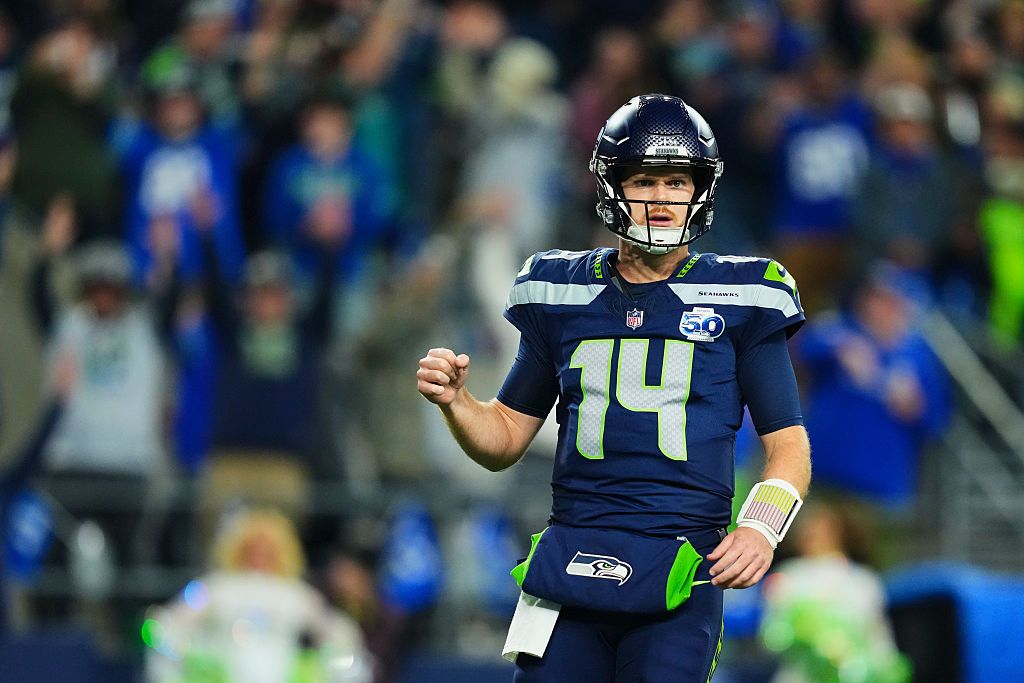
Sam Darnold, Seattle Seahawks (at Washington Commanders)
He’s been hiding in plain sight while discourse chases bigger brands. Sam Darnold brings 1,754 yards, 12 TDs, four INTs, 72.2 QBR into Week 9—top-10 quarterbacking through eight weeks. He’s throwing with 68.2% completions and 9.1 Y/A, a clean efficiency blend inside Klint Kubiak’s timing system. Kubiak’s hire matters here; Seattle’s structure leans play-action, motion, and defined first reads. Four quarters of volume are on the table.
Washington gives you the leverage. They’re 32nd in YPA allowed (7.8) and 29th in opponent passer rating (104.9), with a 65.5% completion rate against. That’s a defense yielding precision windows. The per-play lens agrees: +0.07 EPA/play allowed and 39.2% third-down conversions permitted, both bottom-tier indicators. They’re also vulnerable to motion—8.8 YPA allowed on motion dropbacks, a direct fit for Seattle’s sequencing. Injuries and scheme simplification have thinned the bite up front, further softening intermediate windows.
Context nudges sentiment. Jayden Daniels has been in and out of the lineup; volatility there can hand Darnold extra possessions or a pace bump. And yes, he’s been overlooked—signed to a headline three-year deal that skeptics framed with an “escape hatch.” He’s outplaying that narrative.
The fantasy translation is straightforward. Expect 32–36 attempts, 255–290 yards, and 2–3 TDs if Seattle leans into early-down play-action and motion. Washington’s rating, YPA, and EPA leakage align with Darnold’s efficient downfield aggression. Stream him as a top-12 Week 9 quarterback with spike-week upside under the primetime lights.
Sit ‘Em
C.J. Stroud, Houston Texans (at Denver Broncos)
Denver arrives on a five-game heater with a defense that’s been the story: top-tier by EPA/play (-0.07), No. 1 in sacks, and No. 1 in red-zone defense through eight weeks. That’s the wrong leverage for boom-chasing a quarterback whose 2025 efficiency has sagged. Through Week 8, C.J. Stroud sits at 1,305 yards, nine TDs, four INTs, completing 64.8% at 6.8 Y/A, with a mid-table QBR. Houston just popped for 470 total yards against San Francisco, but the red-zone drumbeat from inside the building is simple: finish better. Those empty trips invite Denver’s specialty—compress spacing inside the ten and force tight-window throws.
Denver’s schedule form includes stomps of Dallas and Cincinnati—games where their rush and late rotations squeezed timing and erased intermediate windows. Houston may also be thin at the top of the tree; Nico Collins’ concussion status is in flux, which caps explosive access if he’s limited. Stroud’s own Week 1 accountability—calling out “lollygagging”—rang true early; the arc since has been steadier, not spiky. This matchup doesn’t offer the runway for a spike.
Fantasy translation: sit the star in managed leagues unless you’re boxed by byes. Denver’s sack volume plus red-zone clamp directly target Stroud’s current pain points (pressure into shallow conversions, stalled finishes).
Daniel Jones, Indianapolis Colts (at Pittsburgh Steelers)
The Colts arrive 7–1 and pacing the league in scoring (33.8 per game), but their Week 9 road script trends conservative by design. Jones has been excellent within structure—2,062 yards, 13 TD, 3 INT, 79.3 QBR, 8.6 aDOT, and a tidy 3.4% sack rate—yet this environment encourages Steichen to lean on the league’s most efficient run phase and Jonathan Taylor’s league-leading rushing yardage. That’s good team football, not ideal fantasy ceiling.
Pittsburgh’s pass defense is a contradiction: bottom of the table by production yet legitimately nasty up front. The Steelers have yielded 67.5% completions, 7.5 YPA, 2,054 yards, and a 97.8 rating, but they’ve also stacked 22 sacks and rank No. 2 in pass-rush win rate (48%). Loud front, leaky back end—exactly the mix that squeezes a timing-based attack outdoors. Add a cool mid-50s afternoon on the river and a crowd that juiced Green Bay to 6.0 yards per play last week before Pittsburgh rallied late, and you get a volatile efficiency picture.
Personnel churn complicates things. Pittsburgh’s secondary has been banged up (DeShon Elliott week-to-week), and they just traded for Kyle Dugger, which helps talent but can dent communication in the short term. Even so, Mike Tomlin’s group is treating Week 9 as a reset after an openly rough defensive start—and the pass rush is the lever they trust. That lever against a run-first road favorite points to fewer explosives and more field goals than fantasy fireworks.