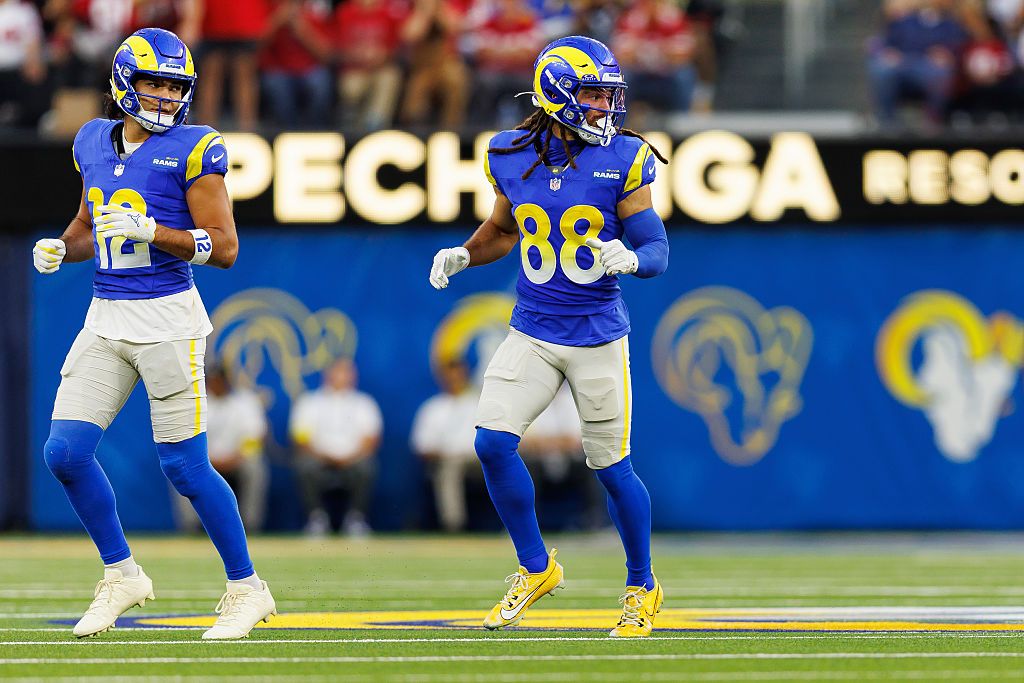
Welcome back to my regularly-scheduled Week 7 NFL programming, in which the Los Angeles Rams’ WR1 (formerly known as Cooper Kupp) is injured and I go digging down Stafford’s depth chart (formerly populated with Demarcus Robinson, Tyler Johnson, etc.). Sure, we could talk about Tutu Atwell. But that’d feel discordant. Continuity year-over-year is important. And I was high on Jordan Whittington’s profile as a wide receiver in this Sean McVay offense. Beyond just his special teams role. In truth, Whittington profiles as the quiet fix in a loud week for Los Angeles and fantasy managers alike. McVay asks for punctuality and balance; he supplies both, then sneaks extra yards after the catch before safeties even roll their hips.
With Puka Nacua (knee) not practicing Wednesday due to his injury, and with his status for traveling to London already up in the air, it’s time we turn our eyes back to Whittington for fantasy perspective. We’ll also check in with our good buddies Davante Adams and Tyler Higbee.
Follow my handle @dansby_edits for more fantasy football advice, as well as plenty of NFL and college football betting goodies.
Jordan Whittington vs. Jaguars in Week 7 (London)
Skillset & 2024 retrospective
As the Rams’ WR3/4 in 2024, he delivered lean, efficient production: 22 catches on 28 targets for 293 yards, a 78.6% hit rate, 2.50 yards per route on 117 routes, and a 23.9% target rate. He stacked 203 yards after the catch (9.2 per grab) and 48 after contact, turning routine throws into breathing room. He posted a perfect seven-for-seven from the slot and added 12-for-18 outside. He also popped a 31-yard catch from a backfield tag and logged credible tight-alignment looks. Crossers led his tree at 20.5% and returned eight on ten for 65. Digs followed at 3.11 yards per route, and screens hit 12.0 yards per route. He converted three of four third- and fourth-down targets. Red-zone volume stayed light at 0-for-2, which leaves room to grow. That profile reads like a reliable WR3/4 who runs on time, breaks tackles, and carries schemed touches without leakage.
He also stacked efficiency by alignment, which matters for how McVay deploys him. Outside, he posted twelve catches for 159 yards at 13.3 per grab. In the slot, he went a perfect seven-for-seven for eighty-four, steady and clean. From tight and backfield tags, he added two catches, including a thirty-one-yard burst that flipped field position. That flexibility lets the Rams keep the same people on the grass while changing the picture.
The situational tape reads just as sturdy. He converted three of four third- and fourth-down targets and kept drives upright. Screens landed with purpose and paid off at 12.0 yards per route. Crossers delivered eight catches on ten targets; digs returned the best rate at 3.11 yards per route. He didn’t cash red-zone volume last year, but his 9.2 yards after the catch per reception kept the offense in striking distance. That’s WR3/4 work you can trust when the ball needs to move without drama.
That’s exactly what made Puka Nacua (and, if you take a look at the Commanders this year, Luke McCaffrey) so effective.
The Rams WR room as of Week 7, 2025 / How Whittington fits
Puka Nacua sets the rhythm when he’s active in 2025, and his knee injury this month doesn’t change that truth—it just redistributes the oxygen. The offense loses its primary tempo-setter and asks the room to absorb that stress without changing the picture. Sean McVay keeps the structure familiar; the ball still arrives on time, and the landmarks stay honest. With Nacua sidelined, the target economy shifts, not the identity.
Davante Adams already owns the boundary this season and now expands it. He’s tracked a 27.1% target rate on 203 routes with 26 receptions for 396 yards and three touchdowns, and most of that work has come outside, where he’s logged 267 snaps and 23 catches for 353 yards at 15.3 per. That usage slides naturally into Nacua’s isolated boundary diet—stops that set up posts, comebacks that set up fades, backside digs that punish rotation—so the expectation follows the projection: Adams rises toward ~35% and sees his per-route output tick up as the offense feeds him first windows by design.
Jordan Whittington supplies the glue in 2025 and scales where Nacua did his interior work. His early-season breadcrumbs—110 routes, 13 targets, 10 catches, 11.2 yards per grab with a clean red-zone finish—fit the throws McVay leans on when he wants schedule, not spectacle. The slot and specialty tags become his avenue because his game prizes economy: crossers that travel on time, digs that punish widened linebackers, screens that bank free yards. The assumed redistribution sketch holds together in this year’s context: Adams toward ~35% and Whittington toward ~30%, not as a clone but as complementary inheritance—Adams commanding the boundary explosives, Whittington converting the short and intermediate volume that keeps drives breathing.
Adams becomes the boundary spine that forces safety depth and dictates coverage. Whittington becomes the interior rhythm—the cross, the dig, the screen—that steadies drives and turns first windows into eight-yard gains. Tyler Higbee reclaims red-zone gravity, which actually clarifies both jobs: Adams draws the iso, Higbee taxes the seam, and Whittington cleans up the pivots and glances that keep the script ahead of the sticks. You don’t replace 79-for-990 across eleven games with one player; you redirect it into roles that already exist. With Nacua sidelined, this offense still holds its shape because the stats you supplied point the same direction: Adams expands at the boundary, Whittington scales inside, and the Rams preserve both the volume and the efficiency that make this passing game hum.
Week 7 matchup: against the Jaguars in London
Whittington’s first big audition arrives against Jacksonville on the international stage, a showcase that rewards precision over pageantry. The London layer presses this case forward. The 9:30 a.m. Eastern kickoff drags body clocks for West Coast teams, and games like this often reward offenses that can script quick answers and live on schedule. Jacksonville’s front reaches pressure in 2.51 seconds on average, and that timeline compresses reads. Their coverage bank makes its best returns from Cover 3 and Cover 6 while leaking in Cover 2 and Cover 1. Their slot ledger allows catch volume at modest depth; their tight end ledger allows catch volume with yards after contact. Those clues point to a plan that trims dropbacks, accelerates progressions, and prizes first-window throws. Whittington already runs the routes that beat that math: crossers against zone landmarks, screens into space, digs once linebackers widen. McVay can lean on his openers, keep the cadence brisk, and let Whittington’s economy turn early throws into manageable downs before Jacksonville’s rush settles.
You also have Tyler Higbee back in the frame, and that matters in the red area. His six red-zone targets in three 2024 games remind coordinators to protect the seams. That gravity doesn’t erase Whittington; it clarifies him. Higbee pulls the hook defender; Whittington steals the glance, the whip, the pivot, the shallow that turns second-and-seven into third-and-two. If Los Angeles pivots run-heavy for ballast—55.4% pass and 44.6% run last year, with Kyren Williams carrying a real load—the pass game compresses toward high-percentage touchpoints. Those touches find Whittington because he catches them and turns them into functional yards.
In this script, he could become the steadying option between the headlines—Adams stretching outside, Higbee taxing the seam—while Whittington strings drives together with quiet, repeatable gains that travel in the early window.
Bottom line
I’d treat Jordan Whittington as a live Week 7 PPR FLEX if Puka Nacua sits. The role expands along McVay’s existing lines, not guesswork. Last year he posted a 78.6% catch rate and 2.50 yards per route run on 117 routes, then stacked 9.2 yards after the catch per reception. This season he’s at 10 catches on 13 targets with an 11.2 yards-per-catch pace and a clean red-zone conversion. He already went seven-for-seven from the slot in 2024 and handled outside snaps without waste, plus tight and backfield tags that McVay uses to disguise intent. That portfolio maps directly onto the snaps Nacua vacates inside and in specialty looks.
The London script nudges toward Whittington’s strengths. Early kickoff compresses rhythm. Jacksonville hits pressure in 2.51 seconds with a 37.8% rate, so first-window throws matter. Their coverage performs best in Cover 3 and Cover 6, then leaks in Cover 2 and Cover 1. Quick game beats that math. Whittington is four-for-four on screens and efficient on crossers and digs (2.71 and 3.11 yards per route, respectively). The Jaguars have allowed 266.2 passing yards per game while clamping the run better, which keeps the Rams throwing to stay on schedule. Tyler Higbee can siphon red-zone looks, but that actually clarifies Whittington’s PPR path: volume and YAC in the middle third of the field.
I expect a tangible bump in opportunity. Alignment and target-rate projections vector to Adams rising toward ~35% and Whittington toward ~30% with Nacua out. Translate that to this spot and you get usable FLEX volume, not cameo noise.
My Week 7 expectation: Conservatively? Six targets, five receptions, 55 yards, 0 TD (smack dab at 10.5 PPR). If McVay leans into quick answers and Whittington’s screen and crosser volume spikes, the ceiling pops to seven receptions, 70 yards, 1 TD (right around 20.0 PPR).
In half-PPR or standard, he’s a viable plug if you need stable usage with some after-catch juice. The bet is simple: McVay leans quick, Adams stretches outside, Higbee taxes the seam, and Whittington cleans up the early windows that keep drives alive.