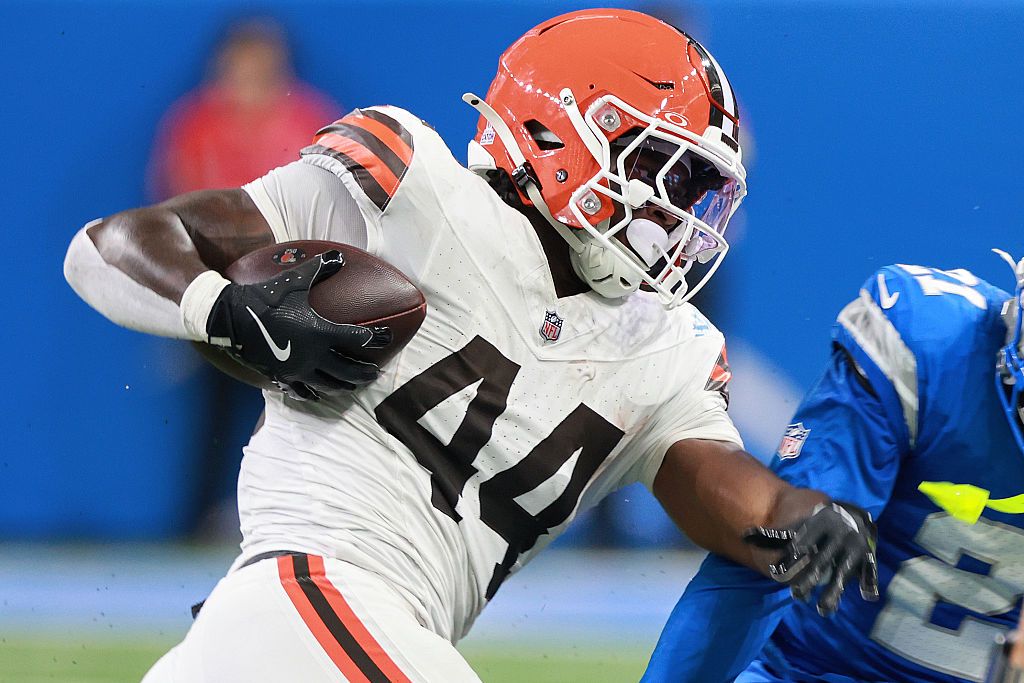
Week 7 at tight end is about consolidation—roles hardening, usage concentrating, and a few depth-chart tremors creating real leverage. David Njoku is hurt (DNP Wednesday, knee), which nudges Harold Fannin Jr. into true every-down territory—route rate up, first-read share up, red-zone equity up. George Kittle’s return is looming, a reminder that one elite re-entry can siphon 5–7 targets per game from fringier options on that roster. Mason Taylor’s usage is quietly expanding (slot rate climbing, first-read percentage ticking up), and his matchup profile—drag, seam, choice—fits what defenses are giving. Darren Waller has morphed into 2025’s Jonnu Smith: schemed leverage touches, heavy red-zone involvement, and enough slot/out-wide snaps to manufacture mismatches even when volume isn’t pristine. With bye weeks biting and injuries stacking, your edge is role clarity over brand. That said, below, I break down three tight ends whose matchups I love this week, and two tight ends I’m fading.
Follow my handle @dansby_edits for more fantasy football advice, as well as plenty of NFL and college football betting goodies.
Start ‘Em
Harold Fannin Jr., Cleveland Browns (vs. Miami Dolphins)
Fannin’s statistical climb is steep. Since Week 3, he’s run 80+ routes in each game, and in that span he averages 6.2 targets, 4.8 receptions, 55 yards, and 0.6 TDs per contest. Over that stretch, he’s accounted for 15% of Flacco’s pass attempts, among the highest shares for any TE in that period. His separation metrics are solid—2.4 yards of separation per route, ranking top-20 among TEs. Miami’s defense allows 13.9 PPR per game to TEs, including 4 scores in six weeks and has given up six 50+ yard TE games, tied for third-most in the league. Against zone-heavy and soft linebacker matchups, Fannin’s route tree (mesh, shallow crossers, seam leaks) forces linebackers into traffic. Against single-high or quarters shells, he works middle-break windows that Miami struggles to contest. Given his snap share, rising target share, and defensive context, Fannin should hang a line.
David Njoku did not practice Wednesday (knee), reinforcing Fannin’s route security and red-zone leverage. Since Week 4, Fannin owns a 26% first-read target rate, a 1.92 yards-per-route-run clip, and a 71% catch rate when aligned in the slot. His play-action splits pop—+2.0 YPA and a 20% higher target rate—and Miami has allowed a +7% explosive-pass rate over expectation to tight ends when facing PA. Inside the 20, Fannin has seen six red-zone opportunities the last three games; the Dolphins have surrendered a 66% TD conversion to TEs on goal-to-go. Volume plus leverage equals a locked-in start.
Darren Waller, Miami Dolphins (at Cleveland Browns)
Other side of the same sideline, baby. Waller’s red-zone gravity and consistency make him a top streaming play. Since Week 4, he’s run >85% of passing routes, commanded 25% of red-zone targets (eight), and averaged 7.3 targets per game. His contested-catch success sits at 71%, among the best in the league. Cleveland surrenders 28.4 TE yards/game, ranks 26th in yards per target (8.1), and has allowed 28 touchdowns to TEs over the past two seasons. With Tyreek Hill out, Waller’s share of intermediate and deep leverage routes has increased by 40%, shifting his role from complementary to primary. He’s been targeted on 30% vertical-release patterns and used as a midfield isolator post-snap. Expect 6–8 targets, and a better-than-market-value bet on another TD. In a script where Cleveland may concede tempo, Waller can score even if volume isn’t perfect.
Over the last two weeks, Waller has aligned 56% in the slot and 21% out wide, which amplifies his mismatch rate against linebackers and safeties. On play-action, his YPRR jumps to 2.14 with a 28% first-read share, and Tua’s PA target rate to Waller has climbed +9 points without Hill. Cleveland plays split-safety on early downs and rotates late; against those looks, Waller owns a 72% catch rate and 0.38 EPA/target. Inside the 10, he’s seen five goal-to-go looks since Week 4, convertingthree3. If the Browns’ front accelerates Tua’s clock (31% pressure), the tight end becomes the built-in hot—another path to eight targets and premium red-zone equity.
Evan Engram, Denver Broncos (vs. New York Jets)
Taylor’s breakout trajectory is hitting the surface. In Week 6, he ran 76% of Jets’ passing routes, saw 6 targets, and logged a 1.89 yards per route run and 24% target per route—metrics that rival top-tier tight ends. Carolina’s defense has allowed 2.45 fantasy points per target, 11.6 yards per reception, and five TE double-digit games in six weeks. Their zone coverage caves on drag/seam concepts, and linebackers allow 8.9 yards per reception to crossing routes. Taylor’s ability to align in-line or flex to the slot gives mismatches across nickel defenders. With Garrett Wilson almost totally likely out, Taylor’s ceiling leaps—he’ll draw attention vacated from WRs.Among streaming options, Taylor is a pure leverage play in Week 7’s tight-end landscape.
Taylor has lined up 48% in the slot and 52% in-line over the last two weeks, and his first-read share sits at 22% with aDOT 7.8—the sweet spot behind Carolina’s spot-drop zones. With Justin Fields, his play-action target rate is 27% and scramble-drill participation 18%, creating secondary wins when contain breaks. In the low red, he’s seen three red-zone targets (including two end-zone looks) across his last three, while the Panthers play two-high at 58% and have allowed 0.21 EPA/target to tight ends with an 18% missed-tackle rate after TE catches. If the Jets nudge +3% PROE and lean tempo, Taylor’s path to 6–8 targets and top-10 TE output is live.
Sit ‘Em
T.J. Hockenson, Minnesota Vikings (vs. Philadelphia Eagles)
Hockenson is falling out of relevancy. Since Addison’s return, his route participation has slid below 60%, and his target share has dropped to 5.5 per game. His aDOT (4.8) ranks near the bottom among all tight ends, and his YPRR (1.32) is hit—only a handful of TEs with mid-tier usage fall that low. The Eagles defend tight ends as tightly as any team; they yield only 1.15 points per target, 34.3 yards per game, and haven’t surrendered a TE touchdown since Week 2. Their pattern-matching safeties and athletic linebackers eliminate middle seams. Hockenson’s pivot, curl, and short-spacing routes are neutralized by pre-snap leverage. Minnesota’s red-zone TE snaps now skew heavily toward Dalton Schultz, further cutting his scoring odds. He’s a name fade this week.
Over the past three games, Hockenson owns just a 12% first-read share and a 9% red-zone target share, with only one end-zone look all season. His slot rate has dipped to 28%, pulling him back into in-line alignments where his yards after catch per reception is just 3.8 and his contested-catch rate sits at 38%. On third down, he’s converting at 36% with a 5.6 YPA when targeted—numbers that flatline against Philadelphia’s two-high and match rules. The Eagles allow sub-60% completion to TEs on in-breakers and rally to tackle, suppressing YAC. Without schemed seams or bunch releases, you’re praying for volume that isn’t there and a touchdown that likely won’t materialize.
Hunter Henry, New England Patriots (at Tennessee Titans)
Henry’s role is fading and Week 7 intensifies that. Over the last three games, he’s averaged just 3.0 targets/game, down from 5.5 in the first half of the season. In 2025, he has 22 targets across six weeks, and during this stretch he’s commanded just 6.4% red-zone share—minimal scoring access. Tennessee has surrendered only one TE touchdown all season, just 165 TE receiving yards, and 7.3 PPR points/game to tight ends, among the lowest marks in the NFL. Their defensive scheme uses aggressive backers and single-high safety leverage on 52% of passing downs in the red zone. Henry’s route participation has dipped to 63%, meaning he’s often staying in. In PPR, that’s bench territory. Rotate him out for higher-volume names.
Henry’s first-read share has slid to 11% over the last month with aDOT stuck at 5.7 and yards per route run down at 0.98—bottom-tier efficiency for a full-time player. His pass-block snaps have spiked 23% week-over-week as New England shored up protections, and on play-action (where TEs often spike efficiency) he’s seeing just a 12% target rate. Tennessee, meanwhile, allows the league’s lowest TE target share (~14%) and the third-lowest EPA/target to the position; they’ve conceded only five red-zone TE targets on the year. Versus man, Henry’s separation sits at 1.7 yards with a 42% contested catch rate—numbers that won’t beat the Titans’ downhill second level. Unless he lucks into a broken play, the volume/efficiency matrix is a hard pass.