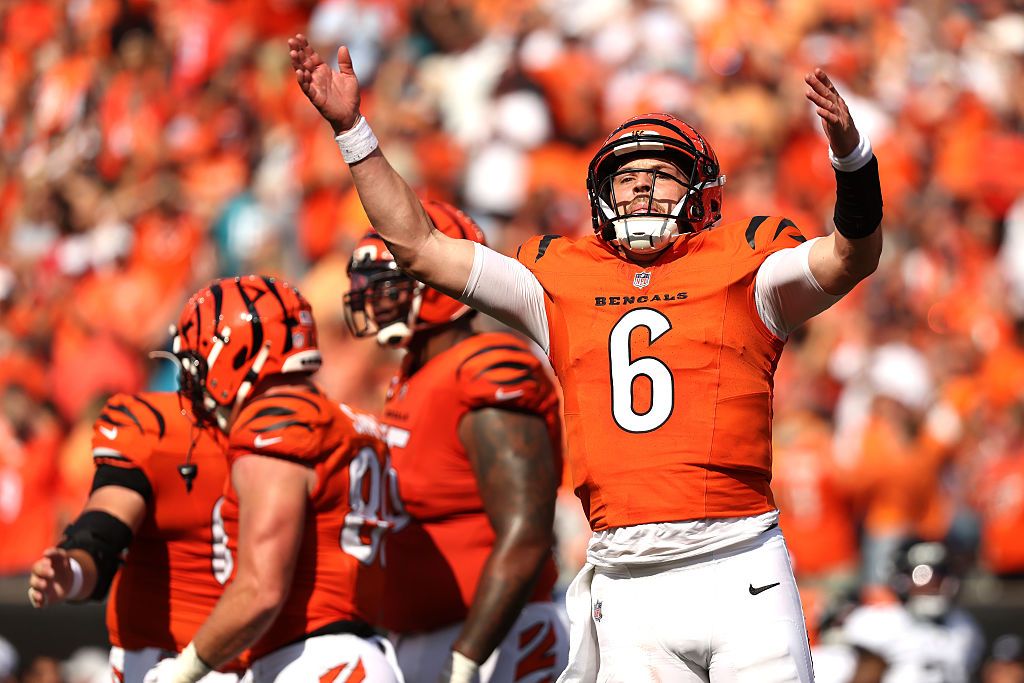
U.S. Bank Stadium hosts a game built on backups: Minnesota’s defense has allowed only 153 passing yards per game with a now-Carson-Wentz-led offense, while Cincinnati’s offense manages just 47 rushing yards per contest and must ride backup Jake Browning’s arm. The Vikings’ pass funnel and Brian Flores’ disguises set up Justin Jefferson for heavy volume, Ja’Marr Chase for constant quick-game targets, and Browning for turnover exposure. Both teams lean on their alpha receivers to survive, but Minnesota’s structure forces the ball into high-leverage spots where efficiency breaks down. Check out how that fits into the prop market for the game by my analysis below.
Here are my favorite player props for this Week 2 NFL game between the Vikings and the Bengals.
Vikings vs. Bengals Best Prop Bets
Justin Jefferson 80+ receiving yards (+100)
Justin Jefferson at 80-plus is a bet on bankable volume in a building where his usage rarely dips. Through two games he owns seven receptions for 125 yards and one TD on 13 targets, a 53.8% share of his targets converted at 17.9 yards per catch, and he returns to U.S. Bank Stadium, where he’s cleared 73+ yards in nine straight. Cincinnati’s defense has tilted softer by air than ground to date—269.5 passing yards allowed per game (28th) versus 94.0 rushing (10th)—and that profile meets a Minnesota offense that has logged 127.0 passing yards per game with room to grow under Carson Wentz. The Bengals’ corner room is dinged (Cam Taylor-Britt doubtful; DJ Turner limited), which boosts Jefferson’s isolation rate on dagger, glance, and slot fades.
Kevin O’Connell will scheme him into stacks and motion to defeat press and hunt Minnesota’s best leverage—especially on second down, where the Vikings have struggled to stay on schedule (offense 30.4% third-down conversion overall). Expect 10–12 targets, 7–8 receptions, and 95–110 yards as a median, with play-action shots off 99.0 rushing yards per game baseline keeping explosives live. Pressure could compress route depth, but Jefferson’s slants and glance RPOs generate YAC-friendly yards that still push him past the 80+ rung.
Ja’Marr Chase o6.5 receptions (+125)
Seven-plus at plus money fits the volume story, and Chase’s profile, even better than Jefferson’s, maybe. With Jake Browning under center, the funnel tightens to Ja’Marr Chase, who sits at 21 targets, 16 catches (76.2%) for 191 yards and 1 TD through two, including a 14-catch avalanche after Joe Burrow exited. Cincinnati’s run game is stuck at 47.0 rushing yards per game (32nd), so Zac Taylor leans into quick game—slants, sticks, speed-outs, bubbles—where Chase is the first read. Minnesota under Brian Flores is allowing 153.0 passing yards per game (5th) while encouraging underneath completions and swarming; that coverage personality suppresses depth but inflates catch counts for true WR1s. Project 34–36 Browning attempts with 28–32% of targets to Chase, a 9–11-target window that has historically produced 7–9 receptions in this role.
Third-and-medium and two-minute work stay sticky, and negative script only raises attempt volume. The main risk is pressure forcing boundary shots—yet Cincinnati can mitigate with RPO glance and quick perimeter screens that preserve efficiency. A fair median is eight receptions for 80–95 yards, which prices 7+ close to 55–58% in this matchup; plus money at +115 clears that edge. If Minnesota jumps early, the catch pace accelerates; if it’s a slog, Chase’s chain-moving routes still stack receptions one by one.
Jake Browning 2+ interceptions (+215)
This is a volatility bet with ladder-climb teeth. Jake Browning’s Week 2 relief line is the clearest tell: 21-of-32 (65.6%) for 241 yards, two touchdowns, and three interceptions. Small sample size, but that’s an interception rate of 9.4% that dwarfs league average. Now he steps into U.S. Bank Stadium against Brian Flores’ defense, a unit that sits fifth in passing yards allowed (153.0 per game) and thrives on disguises. Flores layers simulated pressure and late safety rotations, forcing quarterbacks into throws they believe are safe until the robber or hook defender materializes underneath. That structure does not just invite one mistake—it compounds risk across four quarters.
Cincinnati’s run game is broken, generating just 47.0 rushing yards per game (32nd in the NFL), which means the Bengals can’t protect their backup quarterback with balance. Browning projects to 34–36 drop-backs, and with Cam Taylor-Britt and DJ Turner questionable on the other side of the ball, Minnesota should play with enough leverage to press him into trailing script. That’s where turnover opportunities multiply. Each third-and-medium or two-minute sequence adds two or three chances for tips, forced throws, or disguised rotations. Even in a clean pocket, Browning’s tendency is to predetermine a window; when defenders hold leverage and break late, those balls hang for safeties to snatch.
Minnesota’s disguise game plus his forced volume makes this plus-money ladder leg worth the swing. That’s where the edge sits: you’re playing into the structure of a game where Cincinnati will likely chase, possessions will lengthen, and the margin for error shrinks. A fair projection: 34 attempts, one touchdown, two interceptions.