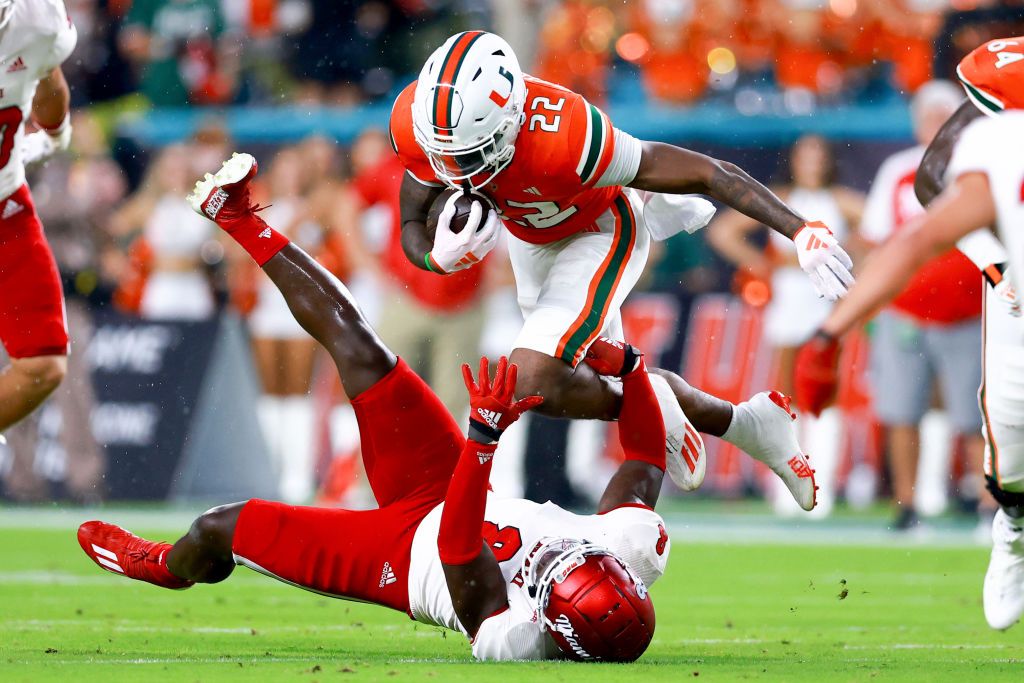
Hard Rock Stadium hosts one of the fiercest September showdowns on the calendar: Miami versus Florida, a rivalry that still hums with bad blood. The Hurricanes have leaned on balance, leaning into a bruising run game while keeping the defense fresh and disruptive. Florida enters with volatility—raw quarterback talent, playmaking wideouts, and a defense that bends but still looks for turnovers. The heat, the crowd, and the stakes make this more than just a non-conference tilt; it’s a statement game for both programs. Below are my top college football player props to consider at DraftKings Sportsbook for the Week 4 matchup between the Miami Hurricanes and the Florida Gators.
Miami FL vs. Florida best prop bets
Mark Fletcher 75+ rushing yards (-115)
Fletcher’s workload, efficiency, and game script all tilt over. He leads Miami with 42 carries, 272 rushing yards, and four rushing touchdowns through three games, a 6.5 yards-per-carry clip. He just posted 120 yards on 16 attempts last week, and Miami leaned on him to salt a blowout. Florida’s defense has allowed 4.3 yards per carry and 87.0 rushing yards per game overall, but that per-carry number matters when projecting a featured back with 14–18 attempts. If Miami plays from ahead at home, late-game run volume spikes and the floor rises. Fletcher owns the early-down work, red-zone preference, and chunk-run profile that punishes light boxes. I expect Miami to set doubles at the point of attack and force smaller safeties into tackles. Give him 16 carries at his current efficiency and you’re already in range. Even with modest regression to 5.0 yards per carry, 15–16 totes land in the mid-70s. I’m projecting 18–20 attempts, 95–110 yards, and at least two runs of 12+ yards.
Malachi Toney 72+ receiving yards (-110)
Toney’s usage is bankable and the route inventory keeps expanding. He’s produced 18 receptions for 228 yards and one touchdown in three games, with lines of 6-82, 6-80, and 6-66. That’s a clean six-catch baseline with an average of 76.0 yards per game. The slot and motion looks manufacture free releases and isolate him on safeties and nickel corners. Miami’s passing structure funnels first reads to Toney on slants, glance, digs, and slot fades, with yards-after-catch juice when he’s uncapped. His depth of target is moderate, which helps consistency and elevates catch rate, while Beck’s ball placement boosts in-breaking efficiency. Florida’s pass defense has produced more interceptions than touchdowns allowed, but it has yielded 7.19 yards per opponent pass attempt and 261 opponent passing yards per game. This is the profile you want for an over: reliable targets, schemed leverage, and multiple explosives per game. My projection lands at seven to nine targets, six to seven catches, and 75–90 yards.
DJ Lagway under 229.5 total passing yards (odds vary based on regional DK market, but right around +100)
Lagway’s distribution points under. He sits at 629 passing yards, five touchdowns, and six interceptions across three games, averaging 209.7 yards per game. His logs include 120, 222, and 287 yards, with the 287 spiked by throw volume and negative script. Expect Florida to flatten the passing rate after a five-interception outing last week and lean on designed runs and quick game. Miami’s defense tightens windows and compresses explosives; opponent passing output has lived in one-read, underneath structures. Lagway’s 53.2 QBR reflects accuracy volatility and turnover risk against disguised rotations. If Miami controls trenches and limits explosives, Florida’s drives shorten and total attempts drop. Pressure also matters; Miami’s front generates hits without blitzing, forcing checkdowns and throwaways. Cap him at 28–30 attempts at roughly 7.0 yards per attempt and you’re still hovering under. With a couple of drive-killing sacks or penalties, the median tightens. I’m projecting 18–22 completions, 195–215 yards, and a conservative red-zone approach.