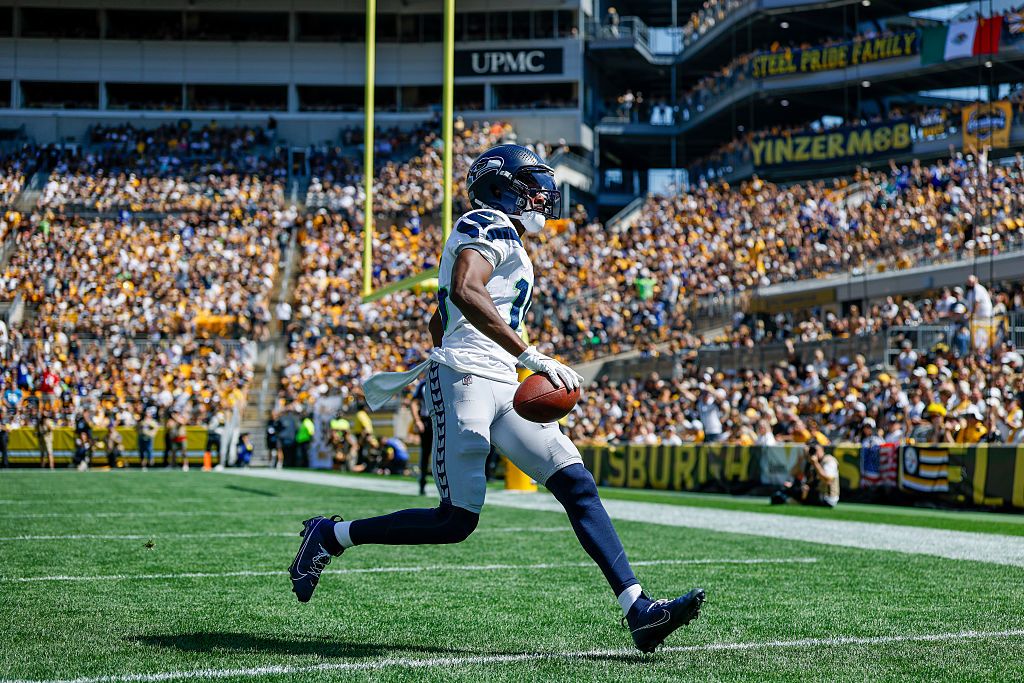
The Seattle Seahawks majorly shook up their skill position corps during the offseason, dealing for Los Angeles Rams star Cooper Kupp and sending DK Metcalf to the Pittsburgh Steelers. They also signed quarterback Sam Darnold to a three-year deal to be their starting signal-caller, trading incumbent starter Geno Smith to the Las Vegas Raiders. The last shake-up to the offense was the least notable: they drafted Tory Horton with the 166th overall pick.
So far, Horton has done well to make the roster, and he made a huge impact in the Seahawks’ Week 2 win over the Pittsburgh Steelers, making two catches for 32 yards and a score. He wasn’t targeted in Week 1 against the San Francisco 49ers, but the fact that he also played 53.8% of the team’s offensive snaps in that contest was a plus. The 22-year-old had a productive five-year college career at Nevada and Colorado State, amassing 27 receiving scores, and he combines elite speed with solid ball skills. In his first two career games, 44 of his 54 snaps came out wide, but his lone touchdown came on a slot route.
Based on his current trajectory, he isn’t worth starting, but he could be worth stashing on the bench. His score came on a play-action play, which should continue to be effective as long as Kenneth Walker III — who’s been Pro Football Focus’ top-rated halfback through the first two weeks — continues to excel. Opponents will also have to pay attention to Jaxon Smith-Njigba, whose 17 catches and 228 yards both rank second league-wide, which should open up the offense further. Horton can easily become a fantasy asset if Kupp, who hasn’t played a full season since 2021, misses any time. Kupp was mostly invisible in Week 1 before turning back the clock with a seven-catch, 90-yard performance in Week 2, and Horton could also prove valuable on a night that the 32-year-old doesn’t have it going.
As Horton continues to get healthier after the knee surgery that ended his 2024 season early, he should continue to earn a bigger role in the offense, although his ceiling could be limited by scheme, since Seattle has run the ball the eighth-most frequently in the first two games. New Seahawks offensive coordinator Klint Kubiak is known for his outside-zone runs: his New Orleans Saints ran it at a league-average clip last season, and Darnold’s Minnesota Vikings also ran at a similar cadence in 2024. Horton is a more capable run-blocker than Kupp is, which he could parlay into more trust in the passing game if he excels within that limited role. He’s worth keeping an eye on.
Seattle’s schedule could also help Horton moving forward: the Seahawks already faced the 49ers, who have the division’s best secondary, and the Los Angeles Rams and Arizona Cardinals were both mediocre on that side of the ball last season, though Cardinals rookie Will Johnson has proven to be a star early on. Seattle also plays the NFC South and AFC South, which are filled with below-average secondaries, and non-divisional opponents include the Minnesota Vikings and Washington Commanders. It could be a big season for Darnold and all of his pass-catchers.