The new NFL season lies just around the corner, meaning the fantasy football news cycle cranks up and hype trains begin to leave the station.
The Houston Texans won their second straight AFC South title last season with 10-7 finish, earning their way into the NFL Playoffs. They downed the Los Angeles Chargers in an upset victory in the Wild Card but ultimately fell to the Kansas City Chiefs in a near-upset during the Divisional Round. By most measures, that season qualifies as a success — Houston’s front office felt less than satisfied, however. After hiring a new offensive coordinator, the franchise hopes they can recapture some magic and once again roll out a high-scoring attack.
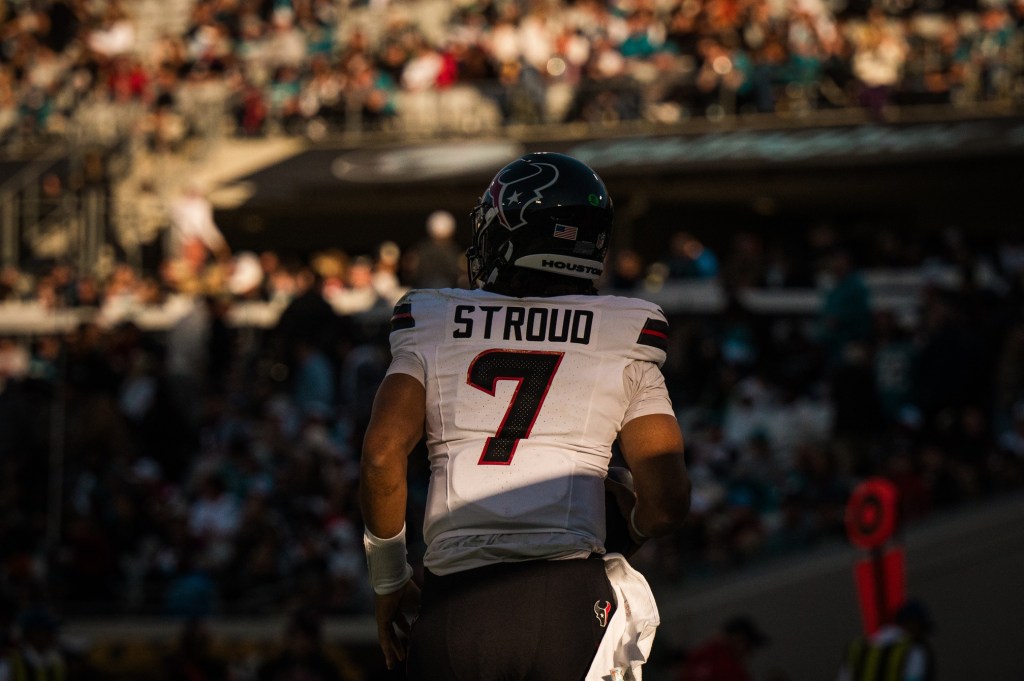
Can C.J. Stroud bounce back to his rookie form in his third season? Will Nico Collins finish as a fantasy WR1, and what’s the deal with Joe Mixon? Find all the answers below!
How will a new offensive coordinator impact the Texans?
Following a short rebuild after the trade which sent disgraced quarterback Deshaun Watson to the Cleveland Browns, the Texans burst back onto the scene in 2023 with a top-12 offense and playoff victory in C.J. Stroud’s rookie campaign. Their attack had all the makings of a high-flying one despite their signal-caller’s inexperience and a general lack of top-end weapons for him to throw to. The early success set expectations high, but the franchise experienced some bumps in the road to follow it up.
In 2024, Houston still won 10 games along with their division, but they did so while riding in the proverbial backpack of a very strong DeMeco Ryans-led defense. The offense, once again under the direction of Bobby Slowik, fell from 13th in scoring to 19th and 12th in total yardage all the way to 22nd. While sophomore slumps are fairly common for young quarterbacks, Stroud and the overall attack regressed more than expected due to a variety of factors.
Part of the issue may have been due to the quarterback’s own struggles to adapt and deal with defenses which suddenly could study a full season’s worth of tape on his tendencies. However, the offensive line experienced issues all season as Stroud suffered 52 sacks behind lackluster protection with little time to throw. On the plays he did remain upright for, his arsenal of pass catchers suddenly looked very thin due to various injuries to Nico Collins, Stefon Diggs and Tank Dell, the latter two of whom suffered season-ending ailments.
Still, something needed to change in Houston, so Slowik — who received serious consideration for head coaching jobs around the league during the preceding offseason — saw his contract terminated. The Texans proceeded to hire Nick Caley as the franchise’s new offensive coordinator, who brings a decade of NFL experience to the table but assumes the most high-profile position of his career.
Caley began his coaching career at the collegiate level and bounced between various programs from 2005-2014. In 2015, he earned his first pro-level gig as an offensive assistant for the New England Patriots. The franchise promoted him to tight ends coach two years later, then added fullbacks coaching duties to his plate in 2020. Three years later, Caley left and took a position as tight ends coach for the Los Angeles Rams under Sean McVay in 2023. Last season, he took on pass game coordinator duties for McVay’s offense as well.
While Caley doesn’t yet possess experience calling plays at the NFL level, there are plenty of reasons to feel excited about what he brings to the Texans’ offense. The 42-year-old spent the formative years of his professional coaching career working under Bill Belichick with an offense still led by Tom Brady, so he’s seen firsthand what it takes to win at the highest level. The same goes for his time under McVay with the Rams — Caley learned from a guru with a system renowned for offensive production, particularly in the passing game. Los Angeles finished top-eight in scoring and yardage in 2023, and while they ranked 20th in points and 15th in yardage last season, they still ranked 10th in passing yards despite Cooper Kupp missing much of the season as Puka Nacua and Matthew Stafford nursed injuries of their own.
Yes, Caley’s system remains relatively unknown, but the McVay coaching tree boasts plenty of successful offensive minds. Kevin O’Connell, Matt LaFleur and Zac Taylor all turned their respective teams into successful scorers, and there are some encouraging signs for Raheem Morris, who also comes from the same tree. If Caley can adapt what he learned at his past destinations to Houston’s personnel, the potential for a top-10 offense feels very real — he certainly has the talent to engineer a bounce-back campaign.
Fantasy star fallout
Quarterback
C.J. Stroud
The sophomore slump for NFL quarterbacks is very, very real. Unfortunately, C.J. Stroud didn’t prove invulnerable to that trend last season and regressed in several ways. As a rookie in 2023, the Ohio State product produced electrifying stat lines over the course of the year with 4,108 yards and 23 touchdowns to just five interceptions, completing 63.9% of his passes and also rushing for three more scores. He averaged 18.4 FPPG that season and saw his ADP skyrocket going into 2024, but those who drafted him suffered serious disappointment. Last season, Stroud kept up the completion percentage at 63.2%, but threw for 3,727 yards and 20 touchdowns while tossing more than twice as many picks with 12 on the year. He also took 14 more sacks (not that that matters in most fantasy formats) and his yards per attempt dropped to 7.0 from 8.2. Those stats earned Stroud just 13.0 FPPG along with an overall QB18 and per-game QB33 finish, though there are a handful of spot-starters in that latter sample.
Entering year three, Stroud must show that last year was merely a fluke brought about by offensive line play, injuries to teammates and his former coordinator’s play calling. We’ve seen quarterbacks in the McVay system succeed in the past — Joe Burrow, Jordan Love, Kirk Cousins and Sam Darnold among them — so similar schematic concepts and an emphasis on the quick passing game could allow Stroud to regain his rookie form. Even if the offensive line still performs poorly, he can negate some of that impact by decreasing his time to throw in his own release or using his legs a little bit more. He’s still going to be a pocket passer, but even a handful of rushing yards and touchdowns could ensure his fantasy production doesn’t fall too far and keep defenses honest. With a healthy collection of weapons, Stroud can see success this year if Caley puts him in position to succeed and he performs up to past expectations.
Running backs
Joe Mixon
Ever hear the phrase “volume is king?” Joe Mixon proved that theory correct in his first season as a Texan last year, but there are some slight concerns heading into his second campaign with the franchise. The team ranked 22nd in rush attempts in 2024 and Mixon himself handled 245 of those carries. He rushed for 1,016 yards and 11 touchdowns with that volume while averaging 4.1 yards per attempt, which really felt like a fine mark for a player who never hung his hat on efficiency. As Houston’s bell-cow back, Mixon also hauled in 36 passes on 52 targets for an additional 309 yards and one touchdown to add to his PPR-format appeal. Over his 14 games, he averaged the third-most FPPG of his career with 17.2 to finish as the overall RB17 and per-game RB9 — not bad at all behind a poor offensive line.
Those numbers do look genuinely good, and with improvement to the offense, Mixon could definitely produce at a similar level this season. However, he’s never been the most durable player with just two full seasons under his belt and 14 or fewer games played in his other six campaigns. He’s also reaching the running back age cliff having just turned 29 and is dealing with an unspecified foot injury that landed him on the NFI list for training camp. A return date remains unknown and the Texans also brought in multiple backs with free agent Nick Chubb and draftee Woody Marks. If Mixon keeps getting volume, he’s a high-end RB2 with serious RB1 appeal. If those other players mix in more though, he may drop lower in the rankings.
Wide receivers
Nico Collins
Every quarterback needs their alpha wideout who they can trust to find their timing and come down with the ball on any given play. Stroud absolutely has his in Nico Collins, the big-bodied Michigan product who emerged as one of the NFL’s elite receivers two seasons ago. In 2023, his third year in the NFL, Collins saw 109 targets and caught 80 balls for 1,297 yards and eight touchdowns. He averaged 17.4 FPPG during that campaign and finished as the overall WR12 despite playing just 15 games. Last season, he posted similar numbers with 68 catches for 1,006 yards and seven scores but appeared in just 12 contests. Collins finished as the overall WR23 but his 17.6 FPPG placed him firmly at the per-game WR8 slot.
It’s not hard to see why the 26-year-old remains the top target in this Texans offense. After all, who doesn’t love a 6-foot-4 receiver with fantastic ball skills and the ability to win downfield with both size and speed? He’s also a great route runner though and just finished second among wideouts in PFF receiving grade. As Collins enters his fifth season, he feels primed for yet another standout campaign as the No. 1 option in this receiving game. The biggest question mark isn’t usage but rather health since he’s played 14, 10, 15 and 12 games across his four NFL seasons. Collins unquestionably qualifies as a WR1 in fantasy football averages the most points per route run of any wide receiver over the last two seasons per PFF. After averaging 19.0 FPPG in games he didn’t exit early last season, he could access his ceiling on a more regular basis under Caley — he just has to hope his body doesn’t betray him.
Jayden Higgins
What’s better than one Nico Collins? How about two of them! If you love players of that big/fast/physical archetype, you’ll probably like Jayden Higgins as well. The Texans drafted the Iowa State product in the second round of the 2025 NFL Draft and immediately improved their receiver room with the addition. At 6-foot-4 with a 4.47 40-yard dash, Higgins posted a 9.87 RAS grade during the pre-draft process — the 46th-best score of 3,408 wide receiver prospects since 1987.
In two seasons with the Cyclones, Higgins posted receiving lines of 53-983-6 and 87-1,183-9. During that senior season, his 87 catches ranked 10th among all FBS players, so he’s already proven his ability to earn targets at a high rate. To top that off, he averaged at least 2.7 yards per route run over his two years with Iowa State. Higgins brings another big, dynamic target on the outside opposite of Collins and should have the opportunity to produce right away. The main question asks what the passing volume looks like on this team, especially since Houston’s pass catchers not named Nico Collins seemed to rotate usable fantasy weeks with some inconsistency in between over the last couple of years. However, the McVay offense did support multiple high-volume pass catchers over the last two seasons. Higgins may share No. 2 duties with the next wideout on this list, so he’s a player with high upside we’ll need to see proven before calling him anything more than a FLEX.
Christian Kirk
This wideout faded over the last couple of years but could bounce back in a big way in 2025 if health permits. Christian Kirk spent the first four seasons of his career with the Arizona Cardinals and emerged as a borderline fantasy-caliber option during his final year with the team in 2021 with 12.2 FPPG and an overall WR26 finish. He signed with the Jacksonville Jaguars the following offseason and posted 84 catches for 1,108 yards and eight scores on 133 targets during his first year there. Those numbers resulted in 14.2 FPPG to finish as the overall WR11 and per-game WR19. He averaged 12.5 FPPG in 2023 but played just 12 games, then appeared in just eight contests last season before injuries ended his season with 8.9 FPPG.
There are serious question marks regarding Kirk’s health, but there’s a reason he makes this list. He showed he can produce at a starter-worthy level in the past and now steps into the best offensive situation of his career as the Houston Texans’ primary slot receiver. Stroud may spread the ball around quite a bit and new offensive coordinator Nick Caley’s play-calling abilities are an unknown, but if Kirk is healthy again, who’s to say he can’t gobble up targets on the inside like Tank Dell did two years ago and score a handful of touchdowns if the offense looks good again?
Tight end
Dalton Schultz
The Texans’ passing game does feel like one fantasy players should want shares of. Who emerges as the second option is a question worth asking, and while it doesn’t seem like Dalton Schultz is the answer, he still has a little bit of appeal later in drafts. The veteran enters his eighth NFL season and third with Houston having averaged double-digit fantasy points just twice — he posted 12.3 FPPG with the Dallas Cowboys in 2023 and 10.0 FPPG during Stroud’s rookie year here. Last season, Schultz posted just 7.0 FPPG, the third-lowest mark of his career. While he did see similar target volume to his first couple of campaigns in Battle Red with 85 looks, he produced just two touchdowns instead of the five he saw in his first two campaigns in Houston.
Schultz is a perfectly fine pass-catching tight end with at least 50 grabs and 532 yards in each of his last five seasons, but he doesn’t have the same upside other options at the position do. With a somewhat-loaded receiver room if all pans out, Schultz feels a little bit like the odd man out here. As the overall TE10 in 2023 and TE20 last year, Schultz likely falls somewhere between those two marks and has more value as a depth option than a guy you really count on any given week.
Fringe names to watch
Backfield backups
With Mixon’s health a question mark, the Texans invested in multiple backs this offseason. They initially traded up in this year’s draft by sending a future third-rounder with the No. 179 pick for No. 116 and No. 224, the first of which they used to select Woody Marks in the fourth round. A former Mississippi State recruit who transferred to USC for his fifth collegiate season, Marks racked up 4,562 scrimmage yards and 36 touchdowns in his NCAA career. His lone campaign at USC was his best, posting 1,133 rushing yards (5.7 Y/A) and nine scores on the ground while hauling in 47 receptions for 321 additional yards. At 5-foot-10 and 207 pounds, Marks’ build doesn’t stand out, but he ran a 4.54 40-yard dash with a 4.24 shuttle. If Mixon misses time then Marks could see a chance to start, but it seems the team has a long-term vision for the rookie regardless.
However, Houston also signed Nick Chubb to join this running back room. The former Cleveland Brown averaged at least 12.2 FPPG over his first five NFL seasons before suffering a brutal knee injury in 2023. Chubb rehabbed the issue and returned last season but averaged just 7.9 FPPG, rushing 102 times for 332 yards and three touchdowns. He clearly didn’t possess the same athleticism that once made him a bowling ball of a runner with home-run potential, and averaging 3.3 yards per carry really killed much hope for the remainder of the veteran’s career. At 29 years old, he’s at the age cliff and the injury history doesn’t look encouraging. In the event that Mixon misses time throughout the year, Chubb likely takes the majority of the early-down and goal-line work with high, yet inefficient volume. Still, he’d fall into the end zone a couple of times. Redraft fantasy players can pick their poison between him and Marks, the latter of whom would likely get receiving work.