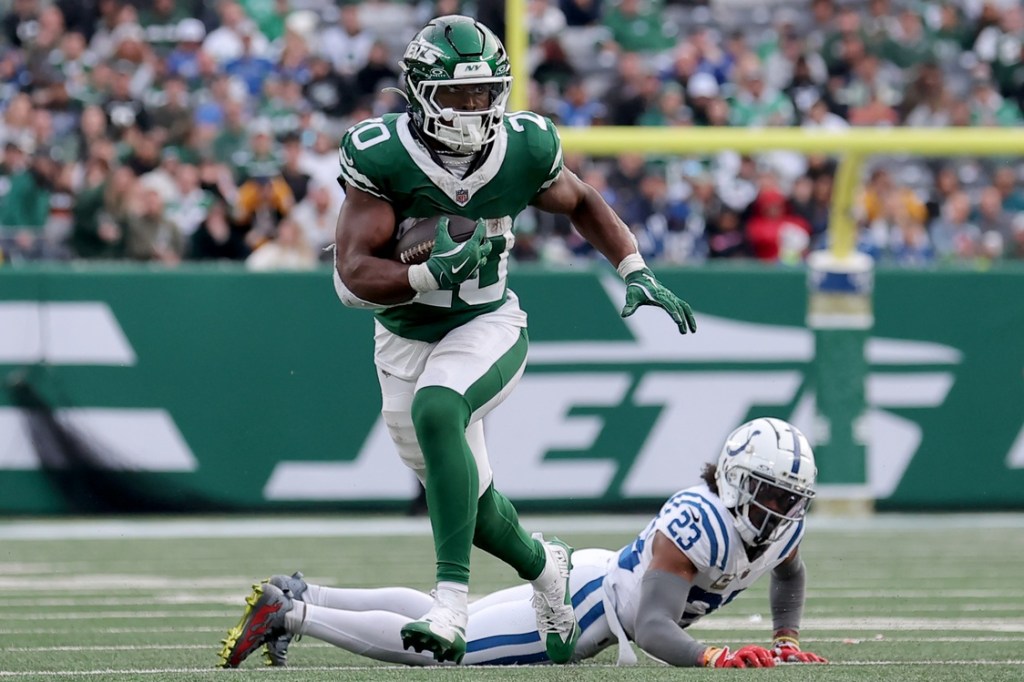
The new NFL season lies just around the corner, meaning the fantasy football news cycle cranks up and hype trains begin to leave the station.
The New York Jets didn’t deliver on expectations last season as the Aaron Rodgers experiment fell flat en route to a 5-12 finish. After hiring one of the top candidates on the coaching market to take over as the lead voice in the locker room and acquiring a new quarterback via the free agent market this offseason, can the Jets’ offense take off and support multiple fantasy football contributors?
Will Justin Fields finish as a top-12 quarterback? Will Breece Hall and Garrett Wilson live up to expectations as fantasy stars? Find all the answers below!
How will a new head coach impact the Jets?
The Jets were supposed to make waves last season with a healthy Aaron Rodgers at quarterback. Even though he was clearly past his prime at the ripe old age of 41, a washed version of the legendary signal-caller still had the makings of an all-time great quarterback compared to past gunslingers to suit up for the franchise. Instead of an efficient offensive season and a playoff berth, New York instead saw plenty of drama both on and off the field along with a head coach fired by Week 6. The Jets finished the year ranked 24th in both offensive yardage and scoring, a far cry from preseason predictions set for Rodgers at the helm of an attack with Breece Hall, Garrett Wilson and Davante Adams, who was acquired midseason via trade.
The firing of former head coach Rob Saleh was, in retrospect, likely an overreaction by higher-up decisionmakers with the franchise. Yes, two 7-10 finishes served as the highlights of his three-and-a-quarter years at the helm, but Saleh’s coaching probably wasn’t the biggest issue preventing the Jets from ascending to altitude. After all, this team hadn’t finished with a winning record since 2015, nor made the NFL Playoffs since making back-to-back appearances in 2010. The offennse hadn’t finished better than 23rd in yards gained or 24th in scoring since that 2015 campaign, either. The root of New York’s perpetual mediocrity feels more like structural organizational shortcomings at this point, or perhaps a legitimate curse, than the fault of particular players or the previous head coach.
Still, a change is gonna come — the Jets lured former Detroit Lions defensive coordinator Aaron Glenn to take over as their skipper. The 53-year-old began his NFL coaching career in 2014 as an assistant defensive backs coach with the Cleveland Browns, then spent five seasons as the primary defensive backs coach for the New Orleans Saints before taking the Lions’ defensive coordinator job back in 2021. Over the last four seasons, Glenn helped oversee a transformation of a rebuilding organization into a Super Bowl contender as the Detroit defense improved every year and still finished seventh-best among defenses despite nursing a laundry list of injuries last season. Glenn’s resume certainly earned him this promotion as he enters his 12th season in the league and first as the lead voice in a team’s locker room.
Projecting what the Jets’ offense looks like in year one under its new head coach can feel a little bit difficult since after all, he’s spent his entire career on the defensive side of the ball. However, we can look at factors such as interviews, personnel and Glenn’s offensive coordinator pick to get an idea of the concepts he might bring over to install in New York.
Glenn poached Tanner Engstrand, a former colleague from Detroit, to serve as his offensive coordinator. The 43-year-old came to the NFL in 2020 and worked his way from an offensive quality control position to tight ends coach, then served as the Lions’ passing game coordinator from 2023-2024. His coaching career goes much farther back, though, having spent significant time on staff at the University of San Diego and later the University of Michigan. In an interview given back in March 2025, Glenn specifically mentioned how Engstrand did well working under Jim Harbaugh’s run-installed offenses at those prior stops, as well as working on the passing game under former Lions offensive coordinator Ben Johnson to ensure it coincided with the rushing attack.
During that same interview, Glenn gave the following quote, too:
“When it comes to the type of offense we’re going to run, and defense, it’s built around the personnel that you have,” Glenn said. “I don’t want to sit here and say this is who we’re going to be. Tanner is going to do a really good job of figuring out everybody we have in totality of the offense.”
The Jets’ head coach doesn’t want to give up too many hints before the season begins, but those comments along with his and Engstrand’s history suggests the team may run-oriented attack that emphasizes the ground game as the primary chain-mover but also a means of setting up the pass. Plus, Glenn himself said the personnel on the roster will shape the scheme. Well, the Jets invested in a rushing quarterback and offensive line help via free agency and the draft, they roster a star-caliber halfback and boast just one high-end threat at pass-catching positions. Sometimes a depth chart can convey intentions more than coach-speak can — a ground-and-pound mindset seems imminent.
Fantasy star fallout
Quarterback
Justin Fields
There aren’t many quarterbacks in this league who public opinion is more split on than Justin Fields. About 50% of fans love him and believe he’s still a top talent in the NFL while the other 50% believe he’s nowhere near a starting-caliber signal-caller. The truth lies somewhere in the middle — Fields is a scheme-dependent player who can win games and provide some eye-popping statistical production and highlights, but he needs the right support on both the field and the sidelines.
The No. 11 pick in the 2021 NFL Draft, Fields began his career with the Chicago Bears and flashed tons of upside in 2022 during his first full season as the starter there. He averaged 19.7 FPPG, fifth-most at the position just behind Joe Burrow and just ahead of Lamar Jackson, and to finish as the overall QB7 in 15 games. The then-sophomore completed just 60.4% of his passes for 2,242 yards with 17 touchdowns and 11 interceptions, but none of that mattered thanks to his rushing production. He ran for 1,143 yards and eight touchdowns while picking up 7.1 yards per attempt. Fields fell off the following season to 17.7 FPPG and finished as the overall QB18 in 13 games before a trade sent him to Pittsburgh.
While he only started through the first six weeks of the Steelers’ season ahead of an injured Russell Wilson, Fields still put up fantasy points thanks to his rushing production of 289 yards and five touchdowns. He averaged 18.9 FPPG over those six games, which would’ve slotted him in as the per-game QB9 behind Bo Nix and ahead of Sam Darnold. It’s worth noting the former Steeler did complete a career-best 65.8% of his passes for a modest 1,1106 yards, but he also threw five touchdowns with just one pick during his time under center. Fields already showed enough to convince the Jets to gamble on him with a two-year, $40 million deal — if that completion percentage and TD/INT ratio stick for the most part, he may save his career. The raw passing stats will likely look pedestrian since he doesn’t have many weapons to throw to, but if Glenn’s staff can maximize his athleticism with designed RPOs and a read option game, Fields can sneak into a borderline top-12 fantasy season with his new team.
Running backs
Breece Hall
The NFL moves fast and human memory tends to favor recency bias, so it’s not shocking to see how polarizing of a fantasy asset Breece Hall became over the last couple of months. How quickly people forget though — just two seasons ago, this talented halfback averaged 17.1 FPPG and finished as the overall RB2… all while coming off a major ligament tear on a pretty poor team.
Sure, Hall’s scoring average dropped to 15.1 FPPG last season and he disappointed relative to ADP (that was inflated due to Rodgers hype), but there’s context to consider. The Jets’ offensive line suffered a couple of major injuries including one to All-Pro left tackle Tyron Smith, so Hall didn’t have a ton of support in the trenches by the year’s end while playing through some minor knocks of his own. It didn’t really matter too much in the end though as Hall still racked up over 1,300 scrimmage yards and eight total touchdowns to finish as the overall RB16 in PPR formats. He rushed for just 876 yards but caught 57 passes for 483 receiving yards, finishing fourth among all halfbacks in each stat with the third-most targets (76) and routes run (384) as well.
Now that Hall’s ADP has fallen some amidst tempered expectations for the Jets’ offense, he looks like a real steal in fantasy drafts as a candidate to produce at an RB1 level. The fourth-year back should run behind an improved offensive line, and while Fields’ presence means they’ll both see plenty of stacked boxes, a rushing quarterback can actually draw defensive attention off the halfback (and he worked alongside Zach Wilson during his career-best year, for what it’s worth). Hall also brings such ability in the passing game that he can easily bounce back to elite status. Beyond Garrett Wilson, Hall is the team’s second-best pass-catcher and brings a dynamic presence to the backfield alongside a quarterback who likes to throw the checkdown, and two coaches who saw Jahmyr Gibbs and David Montgomery get plenty of receiving work in Detroit. Hall could earn nearly 100 targets this season and may even finish second on the team in that stat, so there’s plenty reason to feel bullish about his outlook even if the offense continues to underperform as a whole.
Wide receivers
Garrett Wilson
The trend of love-them-or-hate-them fantasy names on the Jets continues with Garrett Wilson. The Ohio State product’s talent is simply undeniable, but the situation has been less-than ideal over his three seasons in the NFL. Still, we’ve seen some very memorable catches and performances from the wideout as he enters his fourth year, and it’s not all doom and gloom in his case this season, even with a somewhat-unpredictable presence throwing to him.
Over his three NFL seasons, Wilson’s caught passes from Zach Wilson, Tim Boyle, Mike White and Aaron Rodgers. What does he have to show for it? All he’s done is rack up at least 83 catches and 1,000+ yards in each of his campaigns despite the revolving cast of quarterbacks. Wilson’s fantasy production over his first two seasons didn’t look like a true difference-maker with 12.7 and 12.5 FPPG, but he set a new career-high with 14.8 FPPG last season to finish as the overall WR10 and per-game WR21. He set career-bests across the board with 101 receptions for 1,104 yards and seven touchdowns while finishing 23rd in PFF receiving grade. He played half the season alongside Davante Adams who has since left via free agency, and in six games before that acquisition Wilson posted 41 catches for 399 yards and three scores while seeing 11.2 targets per contest.
Heading into 2025, the argument for Wilson feels similar to that of Hall as a highly-talented player in line for high volume. With Josh Reynolds, Allen Lazard, Malachi Corley and rookie Arian Smith rounding out the rest of the depth chart at wideout, the target share should be very condensed. “Targets are earned, not given” is an adage to live by when it comes to elite fantasy players — even if Fields doesn’t throw the ball a ton, Wilson has shown he can gobble up looks at a high rate and will likely get peppered as such. He’s a volume-based play with a WR2 floor and WR1 upside if he can score some touchdowns. Plus, he reunites with his college quarterback, so perhaps some of that chemistry remains intact from Ohio State.
Tight end
Mason Taylor
Wilson and Hall should lead this team in targets, but there’s a sneaky third candidate to rank up there alongside the Jets’ top two talents. Rookie tight ends don’t typically burst onto the scene with quality fantasy numbers since the position traditionally takes a couple of years to really learn the NFL game — after all, these guys are learning a route tree in addition to their blocking responsibilities in the run game and pass protection.
However, Mason Taylor looks like he could step in as the day-one starter and a safety blanket for Fields in this offense. The Lions turned rookie Sam LaPorta into a sensation who broke the first-year receptions record at the position, then followed it up with a high-quality second half of his sophomore campaign. The hope is that Glenn and Engstrand, a former tight ends coach himself, can do the same with this second-round talent. Taylor has NFL bloodlines as the son of Hall-of-Famer Jason Taylor and set the LSU single-season record for receptions by a tight end with 55 catches in his third season. The 21-year-old earned Third-Team All-SEC honors with 546 yards and two touchdowns on those 55 receptions and amassed 1,308 yards and six scores on 129 catches over his three-year college career.
His production wasn’t wildly eye-popping but it’s easy to see how the 6-foot-5, 251-pound tight end can earn a role from the season’s beginning. He’s well-built for his age and scored an 8.88 RAS grade during the pre-draft process with a 4.68 40-yard dash and a quality 7.06 three-cone time. As a plus-athlete with soft hands and size, Taylor can get on the field sooner rather than later and step up as the second or third option in the passing game if things break his way. Realistically, he may not end up an every-week starter in fantasy football if this offense’s pass volume ends up on the low end, but he can still put up some quality performances and is worth a stash later in drafts.
Fringe names to watch
With a pretty clear pecking order in what likely becomes a run-heavy offense on a defense-first team, not many names stand out among the remainder of the depth chart. The one which is most worthy of a spot on fantasy rosters is Braelon Allen, a second-year halfback who averaged 5.0 FPPG as a rookie with 334 rushing yards and 148 receiving yards with three total touchdowns on the season. He may eat into Hall’s workload some, but probably not enough to emerge as a weekly lineup option unless this running back room develops into a full-blown committee. Allen posted double-digit fantasy points just twice last season, but he’s still worthy of a stash as a higher-end handcuff late in drafts.
Otherwise, Josh Reynolds and Allen Lazard are each unexciting names who may see a spike week or two but won’t provide consistent production you can trust in any given matchup. Lazard was the incumbent for the WR2 role but it sounds as though Reynolds may take that job during training camp, plus the latter has worked with the new staff in Detroit before. His top fantasy finish was just 7.8 FPPG while Lazard’s top seasons were 11.7 and 10.5 FPPG, the latter of which came last season alongside his friend Aaron Rodgers. In all likelihood, one of these guys ends up playing the sacrificial X-receiver role and the passing volume doesn’t support this team’s WR2 for fantasy purposes anyways, especially if Wilson, Hall and possibly Taylor eat up the majority of the targets.