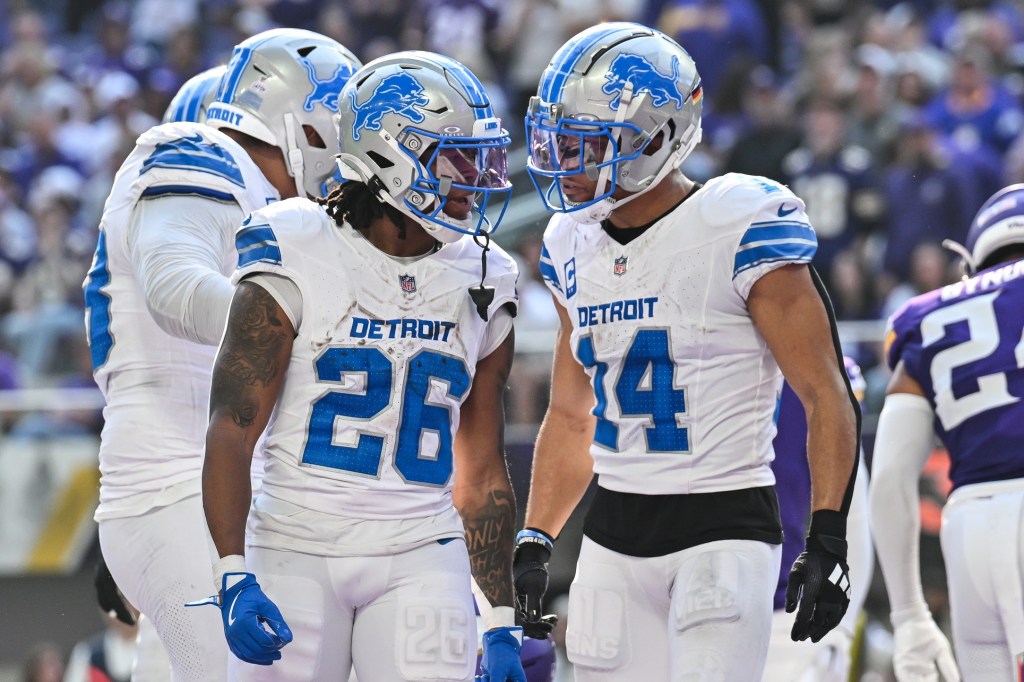
The new NFL season lies just around the corner, meaning the fantasy football news cycle cranks up and hype trains begin to leave the station.
The Detroit Lions emerged as one of the NFL’s top offenses over the last couple of seasons, posting absurd scoring numbers and one of the league’s best point differentials. Former offensive coordinator Ben Johnson departed for a head coaching job with the NFC North rival Chicago Bears over the offseason, leaving some huge shoes to fill at the helm of one of football’s most talented attacks. Now that John Morton steps in as the wunderkind’s replacement, what does the fantasy football impact look like for the Lions stars?
Will the Lions continue producing a deluge of points? Can Amon-Ra St. Brown remain a star? Could Jahmyr Gibbs repeat as the overall RB1? Find all the answers below!
How will a new offensive coordinator impact the Lions?
Let’s make one thing clear before diving in — Detroit’s offense still employs more talent than just about any other team in the NFL. With Jahmyr Gibbs and David Montgomery in the backfield, Amon-Ra St. Brown and Jameson Williams in the receiver room, plus Sam LaPorta lining up at the tight end spot, Jared Goff still finds himself in the perfect situation to orchestrate a league-leading attack. This team is loaded and that certainly hasn’t changed.
What has changed, though, is the man in charge of the play-calling. Ben Johnson was regarded as one of football’s brightest minds and an innovative scheme guru who designed an offense which ranked top five in both offensive points and yardage over each of the last three seasons. There’s no denying that losing him hurts, especially to another team in Detroit’s own division. With that said, it’s fair to feel bearish about the Lions heading into 2025-26.
As for the man who replaces Johnson, the team hired John Morton to fill those shoes. His resume is an extensive one having bounced between the NFL and college football at a grocery list of different stops. Looking at Morton’s major roles, he was offensive coordinator for the New York Jets in 2017, then spent a couple of seasons with the Raiders as a senior offensive assistant from 2019-2021. In 2022, he served in a similar role with the Lions before spending the last two years as the Denver Broncos’ pass game coordinator. These are roles we can hone in on a little bit for a better picture of what Morton brings to the table, but with the exception of that lone season as the Jets’ OC, it’s best to take each with a grain of salt since he served in somewhat-lesser roles.
During that season with the Jets, New York’s offense finished the season at 24th in scoring and 28th in total yardage, far from the marks you’d like to see. However, some context is needed since Josh McCown was the team’s leading passer, Bilal Powell its leading rusher, and Robbie Chosen its leading receiver. The Jets were bad enough to finish 5-11 and earn the No. 3 pick in the following draft, so the results were probably destined given the group of talent Morton was working with.
It’s more difficult to glean much from the years which followed with the Raiders and Lions since he served in an assistant role rather than calling the plays, and the same rings somewhat true for Morton’s Broncos tenure over the last couple of seasons. It should be noted that Denver actually did tie for the sixth-most passing touchdowns in each of Morton’s seasons as pass game coordinator with 28 in 2023 and 30 last year, which seems interesting when considering how the team generally leaned run-heavy over that span.
One key point with Morton is that he’s worked alongside some great coaches over the last few years with Jon Gruden and Sean Payton, so in a perfect world he’s learned from those guys and brings insight that a less-experienced hire would not. The biggest pro in the case for Morton with Detroit is that he also brings familiarity with their system having spent a year with the team already. Having both been there and watched from afar, the new offensive coordinator should know this attack doesn’t need many changes — fans and fantasy managers should just hope Morton doesn’t try and put his own spin on what the Lions do. That’s where things get a little bit scary given the history involved at past stops.
It’s very possible, if not outright likely this offense takes a step back in 2025-26. Morton doesn’t necessarily seem like a great offensive coordinator, though it’s been quite a while since he served in that role with a team and he may have improved since that last stint. Anything could happen, but it’s best to project a downtick in touchdowns for the Lions this year since last season’s mark of 70 scores was the highest of any team since the NFL moved to the 17-game format in 2021. The next-closest team was the ’21 Cowboys with 64 total touchdowns, which feels feasible given Detroit’s talent, but even then a smidge unlikely without Johnson’s mad-scientist scheming.
Fantasy star fallout
Running backs
Jahmyr Gibbs
The reigning overall RB1 in fantasy football doesn’t typically repeat their performance two years in a row. If anyone’s a candidate to break the mold and do so, Jahmyr Gibbs fits the bill. The speedster took over the backfield last season, especially once backfield mate David Montgomery went down, earning 250 carries on the year for 1,412 rushing yards and 16 touchdowns on the ground. Gibbs also hauled in 52 of 63 targets for 517 receiving yards and an additional four scores, bringing his grand total to year 2,000 scrimmage yards and 20 total TDs.
It’s not shocking to see Gibbs finished as the overall RB1 with 21.3 FPPG in PPR formats, good for the per-game RB2 behind only Saquon Barkley. The breakout was imminent since he handled a new career-high in touches (including a workhorse’s share with at least 18 rush attempts in Week 16-18 when Montgomery was injured), scored plenty of touchdowns and caught over 50 balls. Gibbs also showcased an incredible ceiling once he became the primary back with at least 25 PPR points in every game without his backfield mate down the stretch. It tantalized fantasy players, but can he recapture the magic even if the offense regresses?
Signs point to yes. Gibbs averaged a very efficient 5.6 Y/A on the season while generating 41 explosive plays, the third-most among all running backs. His 0.12 EPA/C also ranked third among all halfbacks with at least 50 carries, so he added plenty of value on the ground. We know Gibbs can succeed on relatively few touches thanks to his efficiency metrics and he also finished fourth on the Lions in targets, the key to fantasy RB ceiling. Even if the offense takes a step back with fewer touchdowns, Detroit should continue to play smashmouth football like Dan Campbell loves to do and Gibbs can rack up plenty of yards and catches even if his rushing volume decreases. He doesn’t need many touches to maintain a high floor, and with his skill set and athleticism, the ceiling remains sky-high.
David Montgomery
Gibbs’ backfield mate feels like a polar opposite in many ways. Rather than an agile speedster with blazing breakaway ability, David Montgomery brings the boom at 5-foot-10, 225 pounds and loves to run headfirst into the throng of linemen. He didn’t run the ball particularly efficiently at 4.2 Y/A, but that’s never been Monty’s strong suit. Instead, he gets the ugly gains on early downs and short-yardage situations, breaking down the defense so that the offense can pick up big gains later on.
The one-two punch of Montgomery and Gibbs still looks like one of the NFL’s most formidable duos. There’s no doubt they can continue to rack up touchdowns at an elite rate so long as the offense keeps performing well, and while it does seem the team may regress a bit as a whole, it’s more likely the passing game a downtick than the ground attack. Montgomery picked up 775 yards and 12 touchdowns on 185 carries over the course of 14 games, which feels about right for a player of his caliber.
It’s possible he takes a step back physically after a torn MCL suffered late last season, but even then, Monty should continue to get short-yardage work and vulture touchdowns from his backfield mate (much to the chagrin of Gibbs managers). Admittedly, the changes on the offensive line following the retirement of Frank Ragnow feel like a larger issue for the the bruising back since he’s less explosive than Gibbs. He likely won’t match his 15.8 FPPG finish as last year’s per-game RB16 and overall RB18, but Montgomery should still put up solid RB2 numbers as a touchdown-dependent play.
Wide receivers
Amon-Ra St. Brown
Few players eat up targets the way Amon-Ra St. Brown does. The Lions’ top wideout saw an elite 141 targets last season, a total he’s hit or surpassed in three straight campaigns, while totaling 1,263 yards and a career-high 12 touchdowns. He averaged 18.6 FPPG and finished as the overall WR3 for the second consecutive season as well as the per-game WR5. The 25-year-old continues to put up impressive numbers as the main cog in a well-oiled offensive machine with a 26.6% target percentage and doesn’t show signs of slowing down.
There are myriad reasons why people may worry about St. Brown in 2025-26. He had a minor knee surgery done over the offseason but it seems to have just been maintenance-related. Some folks are nervous Jameson Williams will eat into his target share more. He also doesn’t see many deep balls, instead thriving on short pickups as an ever-reliable option near the sticks. The touchdowns probably won’t come at such a high rate which means St. Brown may indeed take a slight step back, but he’s not going to drop out of the elite options in fantasy football. He’s shown one of the game’s safest floors over the last few seasons with just five games below the 10-point threshold, three of which came in 2022.
Even if his ceiling doesn’t look quite like that of, say, Ja’Marr Chase or CeeDee Lamb, St. Brown still deserves his flowers as a top wideout. Simply put, the Sun God is a player you can trust, even if the offense regresses — he’s just too important to what the Lions do on a weekly basis to predict otherwise.
Jameson Williams
This is where things get truly interesting. On one hand, Jameson Williams finally showed his game-breaking talent on the field that was held in check beyond brief flashes over his first two healthy seasons in the NFL. The former Alabama star caught 58 of 91 targets for 1,001 yards and seven scores while averaging some eye-popping efficiency metrics — his 11.0 yards per target ranked sixth of all players to run at least 200 routes while his 17.3 yards per reception ranked second. With 14.1 FPPG, Williams finished as the overall WR22 despite missing two games and the per-game WR26.
That’s consistent WR2-worthy production from the speedster, but that’s the deal with Williams. There are concerns his role doesn’t allow for much better results on a consistent basis, concerns which are valid at that. He saw double-digit targets just one time in Week 2 and only caught more than five passes once in Week 18. If Williams hauls in those deep looks, he can win fantasy players their week. If he doesn’t though, it can get ugly. The good news is that Jamo only finishes with fewer than 8.3 points once when active and he hit double-digit totals in 10 of 15 games, so he brought more consistent value than a lot of field stretchers do. Plus, he did command at least five targets in Week 10 through the end of the year with seven or more looks in six of those games.
There’s some hype around Williams after Morton said he’d like to get him more involved in the offense, but the wideout would probably find himself in a more advantageous position were Johnson still around. He could truly break out as a star, but it may be difficult to get him the volume required to do so since we don’t know how creative Morton’s play-calling is. Williams remains a player to watch, there’s just some risk involved here if they just lob him deep balls all year.
Quarterback
Jared Goff
The Lions ranked right in the middle last season with the 16th-most pass attempts but delivered the second-most passing yards of any team. That trend mostly aligned with the prior two years as well — Detroit threw the ninth-most and 10th-most passes in 2023 and 2022 but finished with the fourth and seventh-most passing yards. While the Lions threw more passes in each of those seasons, it still indicates that they’re efficient through the air, largely a product of Johnson’s scheme.
Despite shifting to a more run-heavy approach this past year, Jared Goff still averaged 19.1 FPPG to finish as the overall QB6 and per-game QB8. As great as the production was with 4,629 yards and 37 touchdowns, that passing score tally was a career-high and will likely regress in the first season under Morton. Now, that doesn’t mean Goff throws for just 20 touchdowns or otherwise drop off drastically. There’s still far too much talent on this team for that outcome to occur and the Lions will find themselves in the red zone plenty. However, around 30 touchdowns feels like a much more realistic outcome since that’s in line with some of the better seasons earlier in his career. He’ll likely fall down to around 17 FPPG as in 2022 and 2023.
That doesn’t feel like exciting play at quarterback, especially in fantasy football where quarterbacks with rushing ability thrive. Goff’s upside remains capped since he’s a pocket passer, and with a lower touchdown rate he slides to more of a high-end QB2 or depth option than a starting option for winning teams in one-QB formats.
Tight end
Sam LaPorta
Finally, we look at Sam LaPorta who enters his third NFL season. The Iowa product took the league by storm as a rookie in 2023 with an overall TE1 finish on 86 catches and 10 touchdowns. With high expectations heading into last season, the sophomore didn’t quite deliver until later in the year. He didn’t break 9.3 fantasy points until Week 6, but he did rally down the stretch to finish with 60 catches for 726 yards and seven scores on 83 targets.
Here’s the thing with LaPorta — he may have disappointed for much of last year but he also dealt with a hamstring issue in preseason, then an ankle injury in September and a shoulder issue which caused him to miss a game in November. With some likely-lingering effects from those ailments and a slow start to the campaign, LaPorta’s 10.9 FPPG actually feels more impressive with context. That mark was enough to finish as the overall TE8 and per-game TE9, so he still delivered TE1 value on the season.
With that said, LaPorta still feels like a borderline-elite option at one of fantasy football’s thinner positions. He saw at least six targets in every game from Week 10 onwards with seven or more from Week 14 until the end of the season. As a great blocker, he won’t come off the field often and can make an impact at all three levels as a receiver. He may actually see a few more targets this season, and unlike Williams, LaPorta’s touchdown numbers probably won’t decline much thanks to his red-zone prowess. Don’t overthink this one too much.
Fringe names to watch
There’s really just one sleeper to watch for on this roster. While Khalif Raymond and Tim Patrick have each flirted with some starting-caliber weeks, it’s Isaac TeSlaa who stands out as a potential late-season breakout. Barring a major uptick in pass attempts, the WR3 on this team won’t demand enough targets for weekly consideration in lineups. Still, TeSlaa looks like he could become something.
The Lions traded their 2025 third-rounder along with two future third-round selections to move up on draft night and select TeSlaa. That capital invested signals just how highly the front office valued getting their guy. The Arkansas product stands a tall 6-foot-4, 214 pounds and graded out with the top Next Gen Stats athleticism score among all wideouts in this draft class. His RAS came in at 9.97 out of a possible 10, ranking him 11th out of 3,441 receivers graded based on their athletic testing, too.
With a 4.43 40-yard dash and a 39.5″ vertical at his size, it’s not hard to visualize the big-bodied wideout succeeding in the NFL. He played three seasons at Division II program Hillsdale College before transferring to Arkansas, where he posted a 34-351-2 receiving line in year one followed by a 28-545-3 line last season. He wasn’t a target-earner but his 19.5 yards per reception stand out as an elite trait. He’s raw and needs to develop his route running, but if he does the right things to earn the staff’s trust, he may be a sleeper to roster in case he can get on the field late in the fantasy season.