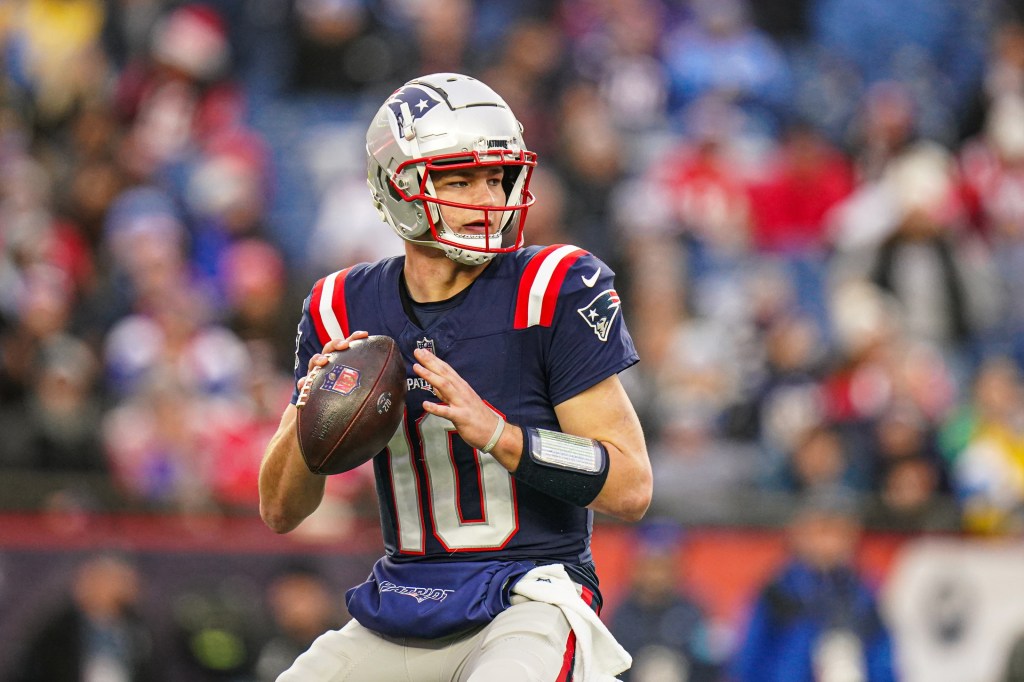
The new NFL season lies just around the corner, meaning the fantasy football news cycle cranks up and hype trains begin to leave the station.
The New England Patriots weren’t expected to win many games last season and finished the year with a 4-13 record. Head coach Jerod Mayo quickly got the boot and was replaced by Mike Vrabel, a home-run hire for a team in need of an experienced leader on the sidelines as they navigate the early days of a rebuild. With the new voice in the locker room and added talent, what will the offense look like in 2025-26?
Will Drake Maye emerge as a true stud at the sport’s most important position? Will TreVeyon Henderson break out in his rookie campaign? Find all the answers below!
How will Mike Vrabel impact the Patriots?
The Patriots’ offense ranked 31st in total yardage and 30th in points last season. It’s tough to ignore the circumstances of how thin the depth chart looked on that side of the ball, but those marks clearly weren’t going to cut it moving forward. The NFL moves quickly — the team cut their losses with their previous leader and brought in an established name in Vrabel who probably shouldn’t have been taken off the sidelines to begin with.
Vrabel’s NFL coaching resume began with one season as the Houston Texans’ defensive coordinator in 2017. He was given the keys to the Titans’ franchise in 2018 and amassed a 54-45 record over his six seasons there, making the playoffs three times and advancing to the AFC Championship Game in 2019. With a .545 winning percentage and four winning seasons with Tennessee, including a 11-5 and 12-5 campaigns, Vrabel showed he can build a team from the ground up and compete with the best.
First and foremost, the 49-year-old boasts a reputation as a culture-setter who elevates his players. Vrabel never had a star quarterback, nor did his offenses deploy true top-end talent outside of Derrick Henry and A.J. Brown when the latter was healthy, but that didn’t stop him from getting the most from the talent on his rosters. The head coach loves to run the ball and control the clock — the Titans finished below 11th in rush attempts just once during his tenure — and his defenses are typically respectable at worst and elite at best, keeping games competitive even when the offense doesn’t click.
While many NFL fans may see Josh McDaniels’ name on the Patriots’ staff page and shudder (in his third stint with the team), reputation doesn’t match reality for Vrabel’s offensive coordinator. McDaniels is a capable play-caller with plenty of experience and can excel when working within a coordinator role rather than taking on the responsibilities of a head coach. Between he and Vrabel, there’s hope New England can begin unlocking New England’s upside.
Fantasy star fallout
Drake Maye
As mentioned in the intro to this article, the fantasy football hype trains are boarding and about to leave the station as the season approaches — the Drake Maye Express may run out of tickets sooner rather than later. Few quarterbacks bring the combination of a cannon arm and game-changing athleticism the second-year signal-caller packs in his 6-foot-4, 225-pound frame. In 12 games as a starter during his rookie campaign, Maye completed 66.97% of his passes for 2,254 yards and 15 touchdowns while adding 409 rushing yards and two scores on the ground. That passing production may sound a tad modest at 187.8 yards per game, but keep in mind that Maye was throwing to one of the thinnest collections of pass-catching talent in the NFL.
He did struggle with some injury issues and didn’t see a full share of snaps even in his starts, but Maye averaged 18.7 FPPG when starting which would have qualified him as the PPG QB11 right behind Sam Darnold and just ahead of Brock Purdy. Those guys were definitely fantasy-worthy assets last season, so it’s safe to say Maye should take a step forward in year two with the improvements to the wide receiver room like Stefon Diggs and Kyle Williams. Vrabel earlier this year about wanting to design the offense around his quarterback and the rest of the team’s roster, so how exactly that plays out should be interesting to watch.
It’s worth noting that McDaniels actually designed an offense which a rookie Mac Jones led to a playoff appearance and the sixth-ranked offense in terms of points back in 2021. If the offensive coordinator could make that situation work, he should have a blast working with Maye here in New England. McDaniels also significantly altered the Patriots’ offense in 2020 to fit the strengths of an aging Cam Newton, who couldn’t throw the ball very well but still rushed for 592 yards and 12 touchdowns in 15 games. Maye finished third in scramble percentage among quarterbacks with multiple starts last season, so he’s unafraid to use his legs and more designed concepts in the RPO game as seen under McDaniels during that Newton year feels like a foregone conclusion.
In short, the Patriots’ young star finds himself in good hands under a staff which doesn’t shy away from tinkering to complement their signal-caller’s strengths. With the improvement to the situation in New England, Maye feels like a rocket ship that’s fueled and primed for blast off.
Running backs
Rhamondre Stevenson
The Pats’ incumbent starter experienced a slight downtick in production last season with an average of 11.7 PPR points for an overall RB28 and PPR RB29 finish. Now, Rhamondre Stevenson has shown in past campaigns that he’s a good running back, and the positive news is that he signed a four-year, $36 million extension last June which indicates he’s part of the team’s long-term plans. The bad news? He was benched multiple times last season due to a case of the fumble bug and played fewer than 50% of snaps in five games (not including Week 6 and Week 18, both of which he missed). Fumbles are actually more random than one might think, so just because he dropped the ball seven times last season doesn’t mean Stevenson will continue to do so during the upcoming campaign.
The guy came close to recording 1,000 scrimmage yards and eight total touchdowns with 801 yards on the ground plus another 168 through the air on 33 catches. Stevenson struggled with injuries in 2023 but racked up 1,461 scrimmage yards and six scores last time he played a full 17 games in 2022. He won’t reach that level of production again now that TreVeyon Henderson joins him in the backfield, but reports of Stevenson’s demise feel greatly exaggerated.
At six-foot, 227 pounds the back remains the better option for a large share of rushing work than his counterpart, especially in short-yardage situations and on the goal line. The veteran likely still slots in as the run game’s 1A and will get his fair share of opportunities in a run-heavy Vrabel offense, though Henderson looms in the background and will siphon off much of the receiving work that made Stevenson an attractive fantasy option in years past. He can still start in fantasy, especially with the upgrades to New England’s offensive line, but his upside is likely capped.
TreVeyon Henderson
Stevenson’s backfield partner was selected with the sixth pick of the second round during the 2025 NFL Draft, nearly first-round capital. The Ohio State product spent four years in the NCAA, tallying 1,248 rushing yards and 15 touchdowns as a freshman in 2021 before an injury-shortened sophomore season. In 2023, he burst back onto the scene with 962 rushing yards and 11 scores before sharing the backfield with fellow draftee Quinshon Judkins last season. During his senior year, Henderson rushed for 1,016 yards and 10 touchdowns en route to a national championship. The most impressive part of his game was his efficiency, leading the Big 10 in rush Y/A twice with marks of 6.8 as a freshman and 7.1 as a senior.
Henderson isn’t exactly tiny at 5-foot-10 and 202 pounds, but he never handled a truly massive workload throughout his college career with 183 carries in his freshman season and no more than 156 in any of the three seasons that followed. While operating in a timeshare last year, he took just nine carries per game on average, which may be somewhat indicative of how his workload will be handled at the pro level alongside Stevenson.
However, his efficiency stands out and means Henderson can succeed even as the second option on the ground thanks to his standout efficiency due to his vision and breakaway speed with a 4.43 40-yard dash. As alluded to earlier, he’ll probably become the primary third-down back and the best option as a pass catcher out of the backfield after catching 77 balls for 853 yards and six touchdowns throughout his college career. He’s simply electric and brings the lightning to Stevenson’s thunder as one of the sport’s better halfback duos.
Wide Receivers
Stefon Diggs
The Patriots added a splashy name via free agency by signing former All-Pro wideout Stefon Diggs to a three-year, $63.5 million contract. On paper, the veteran brings some star power to a group of pass catchers that desperately needed an influx of talent after how thin the position group looked last year. He caught 47 of 64 targets for 496 yards and three touchdowns last season as a member of the Houston Texans but appeared in just eight games after tearing his ACL. He did average 15.2 PPR points a game which ranked him as the WR18 in per-game production, so he still brought value from a fantasy perspective.
Health remains the biggest concern heading into the 2025-26 campaign. If Diggs is fully healthy, he can definitely contribute as one of the top options in the receiving game — the resemblance to how he was brought in to speed along Josh Allen’s development in Buffalo feels a little bit uncanny. However, Diggs is 31 years old and turns 32 in November, so concerns about his recovery and physical abilities are valid. When coupled with how his production faded in 2023 as well, Diggs’ best years do seem to be in the rearview mirror. It’s not all doom and gloom though since even if his athleticism fades, the former star’s route-running ability won’t go anywhere and can still earn him plenty of looks. He should still be a valuable piece in the receiving game and one of Maye’s top targets once he’s healthy enough to take the field.
Kyle Williams
Counting on a third-round rookie to become an instant contributor may be a slight stretch, but if anyone in this draft class can make an immediate impact, Kyle Williams can. Taken with the No. 69 pick of April’s draft, the former Washington State Cougar somewhat quietly finished along the NCAA’s elite wideouts in several statistics last season. Williams caught 70 passes for 1,198 yards and 14 touchdowns. That yardage total ranked eighth among all college pass catchers while the touchdown total ranked third-best overall.
Williams posted a 4.42 40-yard dash and brings some field-stretching ability to the table that holds serious appeal catching passes from Maye. The Patriots will almost certainly favor the run, which means that defenses may stack the box a little bit more often if the pairing of Stevenson and Henderson work out as anticipated. If that ends up being the case, watch for this rookie to haul in some impressive receptions in the medium and deep passing game.
While Williams may not earn a high target share from the jump, he can ascend the depth chart fairly easily due to the talent ahead of him and probably settle in as the team’s second receiver by midseason if he earns the staff’s trust. He profiles on the outside but did line up in the slot nearly 25% of the time, so perhaps McDaniels can scheme up some creative looks for the 22-year-old. In most cases, Williams looks like a great draft-and-stash option with more upside than most other Patriots pass catchers.
Tight ends
Veteran Hunter Henry is the only tight end who looks fantasy-worthy heading into the upcoming season. The 30-year-old averaged 9.1 FPPG and led the Patriots in targets (97), receptions (66) and receiving yards (674). He played 16 of 17 games and was an underrated asset in fantasy as the overall TE12 and PPR TE16. He probably didn’t win managers many weeks, but he was starting-caliber in a pinch and a a very reliable target for Maye.
Henry’s upside stays lower than top options at the position, but it wouldn’t be shocking to see him trade some of those points from receptions for a greater touchdown total this season after scoring just two last year. The offense should improve and Henry provides a big-bodied target in the end zone with at least four scores in all but two of his eight seasons. With some positive regression in the red zone, he can flirt with fringe TE1 value and settle in as a very steady option for benches.
Other names to watch
Two less-rostered players to watch are DeMario Douglas and Kayshon Boutte. The former averaged 8.7 FPPG in PPR and finished as the overall WR47 while operating as New England’s slot receiver. The best-case scenario for the 5-foot-8 wideout is probably a low-end WR2 or high-end WR3 season, and with the addition of mouths to feed in this offense, that doesn’t feel particularly likely. However, the speedster showed value as a depth stash and McDaniels knows how to utilize his slot guys as evidenced by former Patriots Julian Edelman and Wes Welker.
Finally, fellow wideout Kayshon Boutte finished as the overall WR65 with 8.1 FPPG. His numbers were unimpressive through most of the season despite snap percentages of 80% or higher from Week 6 and beyond, but he emerged down the stretch with 20.5 and 24.7 fantasy points in Week 16 and 18, each against the Bills. He’s going to see some work on the outside and also holds appeal as a field-stretcher, so he’s the guy Williams must beat out for snaps. If the rookie doesn’t perform as promised, Boutte should remain in a boundary role and catch a few deep balls from Maye, though predicting the spike weeks in fantasy feels nearly impossible.