The new NFL season lies just around the corner, meaning the fantasy football news cycle cranks up and hype trains begin to leave the station.
The San Francisco 49ers finished their 2024-25 season at 6-11, last place among the NFC West. It wasn’t really indicative of a lack of talent or poor coaching, instead a string of injuries to key contributors ultimately limited the team’s upside and doomed them to a last-place finish in the division. With a new offensive coordinator at the helm in Klay Kubiak and a hopefully-healthier season, they’re well-positioned to bounce back in the upcoming 2025-26 campaign.
Will George Kittle put up another elite tight end season for fantasy managers? Can Christian McCaffrey recapture his superstar magic? Find all the answers below!
How will a new offensive coordinator impact the 49ers?
Much like the Eagles and their promotion of Kevin Patullo into the offensive coordinator role, the 49ers handed the keys to an internal candidate with experience. Klay Kubiak enters his fifth season in San Francisco after spending three years as assistant quarterbacks coach before a promotion to offensive passing game specialist last year.
Of course, his last name implies a bloodline of borderline NFL coaching royalty — Klay is indeed the son of Gary Kubiak, who won Super Bowl 50 as head coach of the Denver Broncos. There’s reason to believe the 49ers’ new offensive coordinator isn’t just riding the coattails of his father, though. Klay helped develop Brock Purdy as the team’s newly-extended signal-caller set a single-season record for passing yards in 2023 and helped orchestrate an offense which ranked fourth in passing yards per game.
Both of those accomplishments feel impressive — Purdy rose in meteoric fashion from the last pick of his draft class into the most recognizable Mr. Irrelevant of all time with a five-year, $265 million extension, plus the team was missing some top-end pass catchers for significant time last season. It’s unlikely that the offense changes in major ways since Kyle Shanahan remains head coach (and one of the best in the NFL, at that) so a return to past form feels more realistic than a real overhaul of the systems at play. The Shanahan system works and Kubiak knows how to run it, so why try and fix what isn’t broke to begin with?
Instead of big changes to the scheme, better health will help bring the 49ers back into contention. If the stars are healthy, there’s much reason for optimism.
Fantasy star fallout
Christian McCaffrey
How could we not begin with one of the best players in fantasy football history? Halfback Christian McCaffrey boasts two RB1 and two RB2 overall finished to his name over the course of his eight-year career. He’s just a season removed from 2023’s 391.3-point finish in PPR formats during which he led the NFL with a fitting 2,023 scrimmage yards and 21 total touchdowns while hauling in 67 passes, the key to RB ceiling in fantasy football. He averaged 24.5 PPR points per game that season, the fourth 20+ FPPG campaign under his belt.
McCaffrey was a monster in fantasy football… until he wasn’t. He played just four games last season while dealing with Achilles tendinitis and a PCL sprain which ended his year early. Injuries are largely random in the NFL, but McCaffrey’s history does suggest he may not need to handle a full workload moving forward. While McCaffrey said he’s operating with “zero restrictions” back in April, it’s fair to operate with a hint of trepidation in drafts this season.
Still, we’ve seen CMC create league-winning fantasy production in recent memory. It’s not a question of talent or scheme, just health at this point. As long as he’s on the field, he’s going to look like a star with his rushing ability and pass-catching prowess both out of the backfield and at the line of scrimmage, so Kubiak shouldn’t hurt him whatsoever.
Brock Purdy
The 49ers’ 249.1 passing yards per game ranked fourth in the NFL despite the team falling 22nd in pass attempts with just 31.4 per contest. They finished the year third in Y/A (8.3), sixth in AY/A (8.6) and seventh in success percentage (49.4%). The team’s 23 passing touchdowns tied for 11th-best, but when considering that Brock Purdy missed two games, Deebo Samuel missed multiple contests and Brandon Aiyuk missed essentially the entire season, the lack of scores makes some sense.
Purdy did the best with what he could, throwing for 3,864 yards and 20 touchdowns while completing a career-low 65.9% of his passes. The efficiency felt a tad concerning, as did his interception totals of 12 last season and 11 in 2023, but the kid can clearly play. Shanahan and Kubiak’s offense puts him in position to succeed, and a mostly-healthy Aiyuk should benefit the team’s passing game as well. Expecting a slight uptick in touchdown production makes some sense, though maybe not the 31 scores he tossed in 2023. Purdy averaged 17.8 FPPG and finished as the overall QB14, though he actually ranked a bit higher than that at the QB12 line on a points-per-game basis. His five rushing touchdowns and 323 yards on the ground may have inflated his numbers slightly, but he should put up another solid campaign regardless.
George Kittle
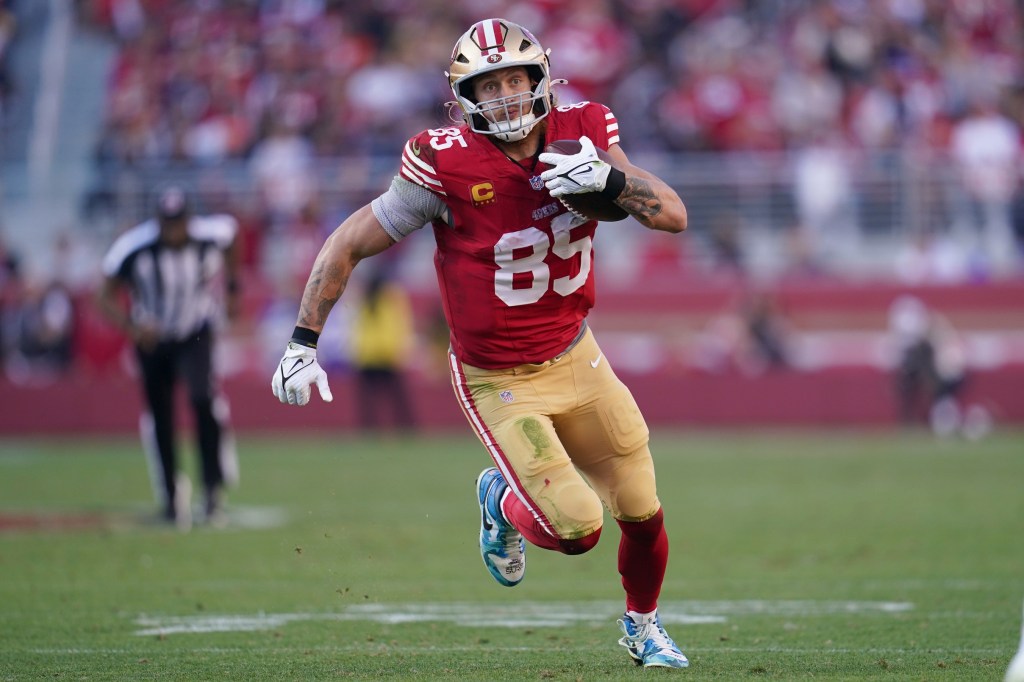
With the success we’ve seen from the 49ers’ offense, George Kittle should truly excite fantasy players heading into the season. He averaged a cool 15.8 PPR points last year en route to TE3-overall finish but he actually ranked first at the position in points per game. Everyone realizes Kittle is a monster on the field and remains one of the NFL’s premier tight ends; exactly how he achieved last year’s success looks even more interesting though.
The Iowa product finished second on the team with 94 targets and first in catches with 78. He tallied 1,106 yards over his 15 games and led the 49ers with eight receiving touchdowns too. Here’s the wild part — Kittle actually ended the year with the seventh-most targets and fifth-most catches among tight ends, and while his PPG TE1 finish was partially held up by the second-most scores at the position, his end result still feels remarkable given the target volume compared to others.
Somehow, it actually does feel like Kittle could put up an even better campaign in 2025-26. At the very least, he’s primed for another top-five finish at his position and keeps playing efficiently even though he turns 32 in October. His 21 plays of 20+ yards were the most among tight ends by a six-play margin and his 14.2 YPC ranked second among all players at the position to catch at least 10 balls. Kittle should lead this team in targets as a locked-in elite weapon.
Wide receivers
Deciphering this wide receiver room feels nearly impossible — which player emerges as the leader is anyone’s guess, which makes Kittle even more attractive in fantasy.
Jauan Jennings
Still, someone here has to catch some passes. On one hand, Jauan Jennings emerged as a legitimate playable option with 14.0 FPPG and finished as the overall WR24 and PPG WR28. However, 22% of his points came in a massive 46.5-point performance in Week 3 after which he recorded greater than 13.7 PPR points just three times. Jennings did pace the Niners with 113 targets, catching 77 for 975 yards and six touchdowns, but three of those scores came in that Week 3 game alone.
Jennings should see opportunities, but he’s a somewhat uninspiring play in fantasy overall given what we saw from him in essentially a featured role last year. While solid on the real football field, he’s just not a player to love in most formats. Now, he could put up better numbers if Brandon Aiyuk isn’t healthy through the start of the season, but once the latter returns to most two and three-WR sets then Jennings may take a backseat.
Brandon Aiyuk
Following a training camp holdout in the leadup to last season, Brandon Aiyuk signed a four-year, $120 million extension with San Francisco. He deserved it after posting a 75-1,342-7 receiving line on 105 targets in 2023-24, earning the NFL’s second-highest receiving grade via PFF in that season and finishing as an AP Second-Team All-Pro. After that 15.6 FPPG campaign in which he ended as the overall WR14 (and was WR15 the year before), Aiyuk was highly-drafted in fantasy. He didn’t deliver on expectations last season, catching just 25 balls for a scoreless 374 yards in seven games before rupturing his ACL. When he went down, he averaged just 8.9 FPPG with only one game above 9.8 PPR points.
We know players can take a while to round back into form following a major ligament injury, so banking on Aiyuk to hit the ground running doesn’t feel right. He’s somewhat of an X-factor though since we’ve seen him excel in multiple seasons. He probably won’t be deployed as an elite field stretcher like he used to this year, but he could very well earn a respectable target share around the midseason mark and later into the campaign. Aiyuk brings more of a draft-and-stash vibe than anything else, but once he gets healthier, we know he and Purdy have an established connection.
Ricky Pearsall
Finally, we’ve got Ricky Pearsall. It’s very tough to get a true read on the former first-rounder since he was shot in the chest to begin last season and understandably didn’t play until Week 7. Really, it’s a miracle he even returned at all. When he did arrive on the scene, Pearsall averaged 8.5 FPPG despite only playing 70% or more of the snaps in four of 11 games.
His 31-400-3 line was respectable, but the young wideout showed what he could do over the last two contests of the season. He scored 28.7 PPR points with eight catches for 141 yards and a touchdown against the Lions, then closed the year with 18.9 PPR points on six catches for 69 yards and another touchdown. He’s a guy who came into the NFL as more athlete than receiver, but with some development, he can potentially become a fantasy-worthy piece. If Kubiak can find creative ways to put the ball in Pearsall’s hands, he may end up one of the best breakout candidates for his second season.
Other names to watch
Of course, backup halfback Isaac Guerendo should end up drafted everywhere due to McCaffrey’s health concerns. If the starter goes down, Guerendo can absorb plenty of touches and put up fantasy-worthy numbers in a lead role. He doesn’t have much wiggle to his game but can pull away from defenses in a hurry with great straight-line speed and one of the best RAS grades of last year’s draft class, so he remains one of the highest-value handcuffs in the game. He could also see a decent amount of work behind McCaffrey if the team makes protecting their star’s health a priority.
Jacob Cowing and Demarcus Robinson each saw a little bit of hype this offseason, but Cowing is WR4 at best when the team looks fully healthy and Robinson is a journeyman with replaceable production. Neither are in line for much of a role barring injuries elsewhere.
The biggest concern among pass catchers is the target share, but the offense was efficient enough last season to sustain multiple fantasy-worthy players despite falling in the lower half of the league in pass attempts. All in all, this is Kittle’s receiving game and Purdy may spread the ball around enough among receivers to be effective in the real NFL but limit the upside of a top-12 finish from any individual wideout. Still, one or even two of the starters will probably end up solidified in the WR2 range as perfectly serviceable fantasy options while McCaffrey soaks up plenty of targets.