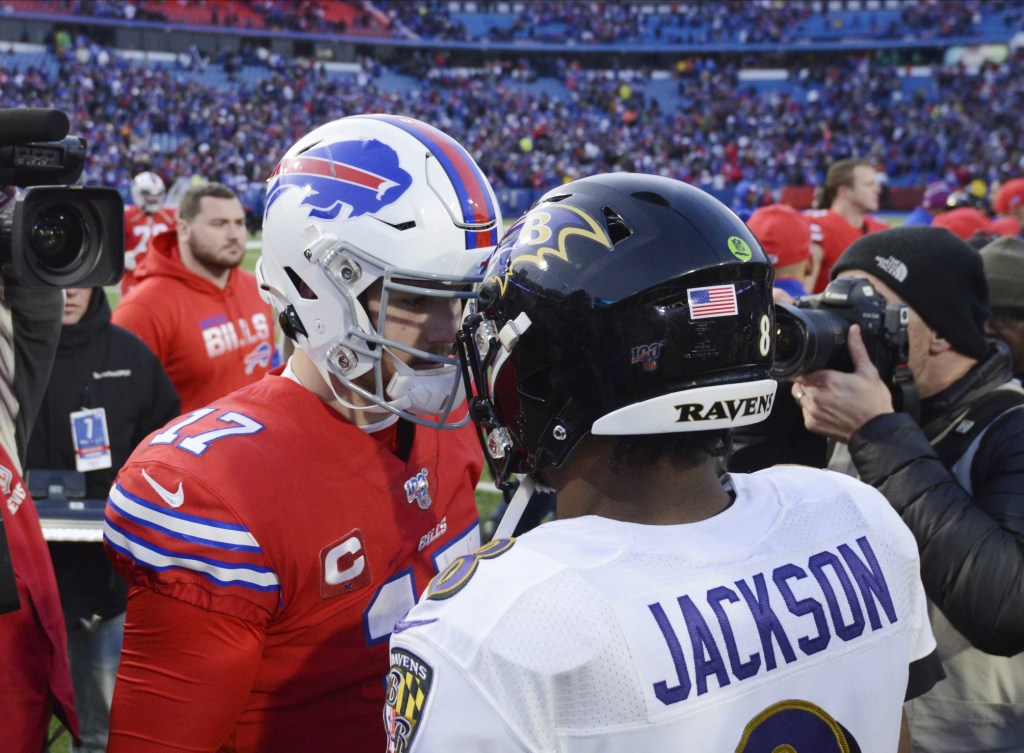
Betting NFL Awards over the summer leading up to the season is a very popular form of futures betting, but you need to make sure you’re doing your homework before investing. It’s easy to say “I think Josh Allen is going to win MVP this season,” and then go place a bet on him at +550 on DraftKings Sportsbook. Winning 5.5 times your money is always appealing, but is that actually a good wager?
Well, there are a lot of factors to consider when betting any award in sports, particularly before we even play any games. Let’s break down some strategy to consider when betting NFL Awards, focusing solely on making preseason wagers.
Before I give out some tips that apply to each award individually, let’s go over some general strategy that we can apply to all awards:
- Awards are voted on by humans. You can only put so much stock into the numbers with some of these awards, because it ultimately comes down to betting these markets how we believe the media will vote. The media will create narratives towards certain players, and it’s important not to bet against how these media members are leaning with their votes.
- Team success versus individual success. We’ll break this more down for each individual award, but the easy example is ROY vs. MVP. With an MVP, you obviously have to heavily factor in team success. With ROY, team success has almost zero impact. Know the market you’re wagering on.
- Know the historical trends. What position generally wins the award? Does a player ever win this award consecutive seasons? What stage of their career is the player generally in?
- Will this wager be available at a better number during the season? This one is very specific to preseason betting. Are you buying too much into public preseason hype? If so, you are probably playing a bad number. It’s a long season, and generally, most players will be available at a better price during the season.
- You don’t always have to pick the winner to make a good bet. When playing long odds like this, sometimes you want to reward yourself with a payout, even if you aren’t 100% right. A player might have a terrific season, but finish second in the voting. Getting nothing out of that stinks. If it’s a two-man race late in the season, consider hedging (we’ll get to this in another article). You could also break your wager up into two bets and considering using the “cash out” button on half your investment to get your money back, and let the other half of the wager ride. There are different ways to get creative and make sure you win some money for being on the right track, even if you aren’t 100% correct.
Check out more NFL Preseason betting, fantasy and season long advice on DraftKingsNetwork.com.
MVP
Last season, Lamar Jackson closed a heavy favorite to win his third MVP award. It would’ve been his second consecutive season winning the award, and perhaps voter fatigue played a factor. In the end, Josh Allen wound up taking home the award for the first time. Back-to-back MVP’s are pretty rare — Aaron Rodgers did it in 2021, but prior to that is was Peyton Manning in 2009. In my mind, that makes Allen tough to back as a +550 co-favorite with Lamar Jackson.
That said, we want to stay within reason here and not go too far down the board. The MVP has been awarded to superstar quarterback play recently. In fact, Allen, Jackson, Rodgers, Patrick Mahomes and Tom Brady are the only names to win the award since 2016. Still, the award belonged to franchise quarterbacks that were high draft picks, with Matt Ryan winning in 2016 and Cam Newton in 2015. Prior to 2015, Manning, Brady and Rodgers won seven of the eight years, which takes us all the way back to 2006.
Prior to 2007, MVP was obtainable for the running back position. Shaun Alexander won in 2005 and LaDainian Tomlinson in 2006. Since then, there’s just one outlier — Adrian Peterson in 2012. AP had a historic season, much like Tomlinson in 2006. However, we still see those types of seasons from running backs. But while their odds shorten throughout the season, they never actually threaten to win the award. Just look at Saquon Barkley last season — he was tremendous, but never an MVP threat.
In short, there’s only one way to bet the MVP market. It has to be a superstar quarterback on one of the best teams in the NFL. If you bet on any other position, it would just be to create a cash out option later in the season. However, I’d say Offensive Player of the Year is a better way to invest.
OPOY
OPOY has essentially become the offensive MVP that isn’t a quarterback. However, this trend is only about six or seven years old. Newton (2015), Ryan (2016) and Mahomes (2018) all wound up winning OPOY during their MVP season. The outlier in there was Todd Gurley winning during Brady’s 2017 MVP season. But since 2018, it seems clear that voters are now committed to voting for the best RB/WR that season.
Here are the last six OPOY winners: Barkley (2024), Christian McCaffrey (2023), Justin Jefferson (2022), Cooper Kupp (2021), Derrick Henry (2020) and Michael Thomas (2019). So, the criteria here becomes the NFL’s most elite offensive weapon on at least a very good team. I’d argue the worst of those six teams was Henry’s 2020 Titans, who finished 11-5. Still pretty good, and Henry put up mammoth rushing numbers, eclipsing 2,000 yards with 17 touchdowns.
The key here is to fade quarterbacks and target the playmaker that you think has the biggest season for a playoff team.
DPOY
Defensive Player of the Year opens up a bit wider of a field than the other awards, both in terms of position and wins. You probably want to focus on pass rushers here, as only two defensive backs have won the award since 2010. That was Stephon Gilmore in 2019 and then Patrick Surtain II just last season — so with a cornerback winning in 2024, I can’t tell you to ignore the position.
If you can identify a corner at long enough odds that you think has a chance to win the award, go for it. That said, the award currently places more of a focus on pass rushers. Generally, you still have to be at least on a playoff team to win the award, and it helps if your team is elite. Going back over the last 15 winners or so, the floor to win the award is being on a nine-win team.
That makes 2025 a particularly interesting board, because three of the top four favorites are projected to be on losing teams. Aidan Hutchinson (+650) is the favorite, but after him is Micah Parsons (+750), Myles Garrett (+850) and T.J. Watt (+950). The win totals for those teams are 7.5 on Dallas, 4.5 on Cleveland and 8.5 on Pittsburgh. The Steelers are right there, and we know Mike Tomlin tends to find his way over .500. But having Parsons and Garrett near the top of the board on what we project as losing teams could create some value.
Might be a good year to look for some long shots on playoff teams. Surtain was an extremely surprising winner last year.
ROY
I’m lumping the Offensive and Defensive Rookie of the Year Awards together, mostly because the formula here is the most simple. The best player is going to win the award, regardless of team performance. Now, yes, we can throw out offensive lineman (and probably tight end too), but every other position is live to win. And of course, team performance isn’t held against the player, since the best rookies are generally drafted to poor teams (although, you can certainly be on a good team and win). In the cases of C.J. Stroud and Jayden Daniels — the last two OROY winners — leading their teams to the playoffs absolutely helped, but they were also the best rookies.
In general, you just want to bet on the most productive player here. Who’s going to earn a starting job and make the largest impact. Anybody that isn’t an OL or TE is fully capable of winning the award if they are the best in the field.
COY
First rule of betting Coach of the Year: You should not simply bet on who you think the “best” coach is. Bill Belichick only won COY three times in his career, and he essentially had to have his team play a perfect season — the Patriots went a combined 44-4 in the regular season in the three years he won the award.
Sure, if a team losses one game or goes undefeated, that coach will have a good chance. However, the award has recently gone to a coach that helped his team exceed expectations the most. And if there isn’t an example of that, then sure, it can just go to a coach of an elite team. Now, Kevin O’Connell did win 14 games last season to win the award, but the Vikings also had a win total of 7.5.
Kevin Stefanski has won two of the last five COY Awards for getting the Browns to 11 wins. Brian Daboll even won the award for getting the Giants to nine wins just three seasons ago. So, betting COY is kind of like picking your surprise team of the season. Find a team that you feel will exceed expectations due to solid coaching, and there’s your play.
CPOY
I saved the murkiest for last. Comeback Player of the Year is very open to interpretation. We had a wild one a couple of seasons ago when Joe Flacco played in just five games for the Browns and won the award over Damar Hamlin — who didn’t make much of an impact on the field, but just being out there felt like a miracle.
This is the most narrative-driven award, and that’s how we have to bet it. Putting up big numbers is great, but what you are coming back from plays equally as large of a role. Joe Burrow has won two of the last four awards in more of a classic sense of what CPOY means — he suffered season-ending injuries in the previous season, then returned to put up massive numbers the following year. But there are plenty of other paths to CPOY.
Flacco is a pretty unique one, as was Alex Smith, who essentially won the award in 2020 just for stepping on the field after a gruesome leg injury. I think the Burrow and Smith’s recent wins are the current blueprint to betting a winner. Mostly because they actually came back from something. You have to use judgement here, though. If there’s a storyline like a Smith or Hamlin, that player is worth a bet. If that narrative doesn’t exist, then it becomes the player returning from injury to have the best season.
There is one type of narrative that we’ve learned we can now fade. Geno Smith won the award in 2022, but what did he actually comeback from? Smith just struggled throughout his career, and then finally found the right situation. The same thing happened to Sam Darnold last season, and voters went away from that candidate. Smith and Darnold had more of a “breakout” season, which isn’t what this award is about.