Amidst the quiet of the NFL offseason, some fascinating news emerged this morning: next week, NFL owners will discuss a proposal to allow the league’s top players to participate in the 2028 Summer Olympics in Los Angeles, where flag football will be played for the first time.
The rules for the tournament will look a little different than what NFL players are used to. The competition will be played on a 50-by-25-yard field (excluding the end zones), and teams will start on their own five-yard line before having four downs to reach the midfield line and, subsequently, the end zone. Running plays are also barred within the opponents’ five-yard line, and there will be two 20-minute halves instead of four 15-minute quarters. Furthermore, interceptions that do not result in pick-sixes will see the intercepting team return to the five-yard line, regardless of where the ball carrier is brought down. There will only be 12 players on the roster, with five-on-five in game action.
It’s hard to predict which 12 will ultimately make the roster in three years if the resolution to let NFL players participate gets approved, but today, I’m going to give it my best shot.
QB Lamar Jackson, Baltimore Ravens
It was difficult to pick against Kansas City Chiefs quarterback Patrick Mahomes, given that he has previously expressed interest in playing in the tournament, but he’s a year older than Jackson and is far less mobile. Jackson has made the AP All-Pro first team each of the last two seasons, posting the fourth-highest single-season passer rating of all time while rushing for more than 900 yards in 2024. Although quarterback runs won’t be allowed in the Olympics, he’s still pretty good at throwing outside the pocket, and maybe he’ll catch a pass or two on a trick play and his speed and elusiveness can take over.
RB Saquon Barkley, Philadelphia Eagles
In this vision, Barkley plays a triple role, as a running back, receiver, and center. In flag football, the play starts with the center snapping it to Jackson, and while there is a slot for a pass rusher on defense, the center is also an eligible receiver. Barkley can squat nearly 600 pounds and ranked in the league’s top 11 at both pass blocking and run blocking among running backs, should he need to play the center role. That’s more than good enough to make him indispensable after he had one of the greatest individual seasons in NFL history, rushing for 2,005 yards in the regular season and 499 more in the playoffs.
RB Jahmyr Gibbs, Detroit Lions
Gibbs may not be quite the runner that Barkley is — although he’s pretty incredible in his own right — nor quite as strong, but he makes the team due to his pass-catching ability. This season, he caught 52 passes — the sixth-most of any running back — and turned those receptions into 517 yards, third among running backs. As a true tailback, he posted 5.6 yards per carry — the fifth-best mark in the league, behind Jackson, Jayden Daniels, Derrick Henry, and Barkley — and also led the league in rushing touchdowns with 16. Plus, at just 22, he might reach a new level over the next three seasons.
WR Justin Jefferson, Minnesota Vikings
Jefferson has been absolutely unstoppable through the first five seasons of his NFL career, making four All-Pro teams and winning Offensive Player of the Year in 2022 after recording 1,809 receiving yards that season. He has sure hands, having never recorded more than five drops in any season despite being targeted more than 100 times in every campaign, and he’s also averaged nearly five yards after the catch for his career. Plus, unlike some other receivers that I considered for this spot — including the Miami Dolphins’ Tyreek Hill, who has also expressed interest in participating — he’s still just 25 years old.
WR Ja’Marr Chase, Cincinnati Bengals
Chase — who should have chemistry with Jefferson dating back to their college days at Louisiana State — won the NFL receiving Triple Crown in 2024, leading the league in receptions, receiving yards, and receiving touchdowns. Compared to Jefferson, he’s even more dangerous as a ball-carrier, averaging 6.1 yards after the catch per reception, thanks to his elite speed. Perhaps some of his production can be tied back to the fact that he plays with his college teammate Joe Burrow, the most accurate quarterback in NFL history, but I can’t see him taking too much of a step back catching passes from Jackson.
WR Puka Nacua, Los Angeles Rams
Nacua might also be eligible for the Samoan and Portuguese national teams, should they qualify, but we can only hope that he chooses the United States. Although his counting stats aren’t quite as gaudy as Jefferson’s or Chase’s — thanks to an injury that cost him five games — he was Pro Football Focus’ top-ranked receiver ahead of either of them. Nacua is as sure-handed as they come — he only dropped one pass in 2024 — and despite being just six-foot-two, he’s one of the best contested-pass catchers I’ve ever seen. He also has some rushing experience, having taken 23 carries so far in his NFL career, should that be needed.
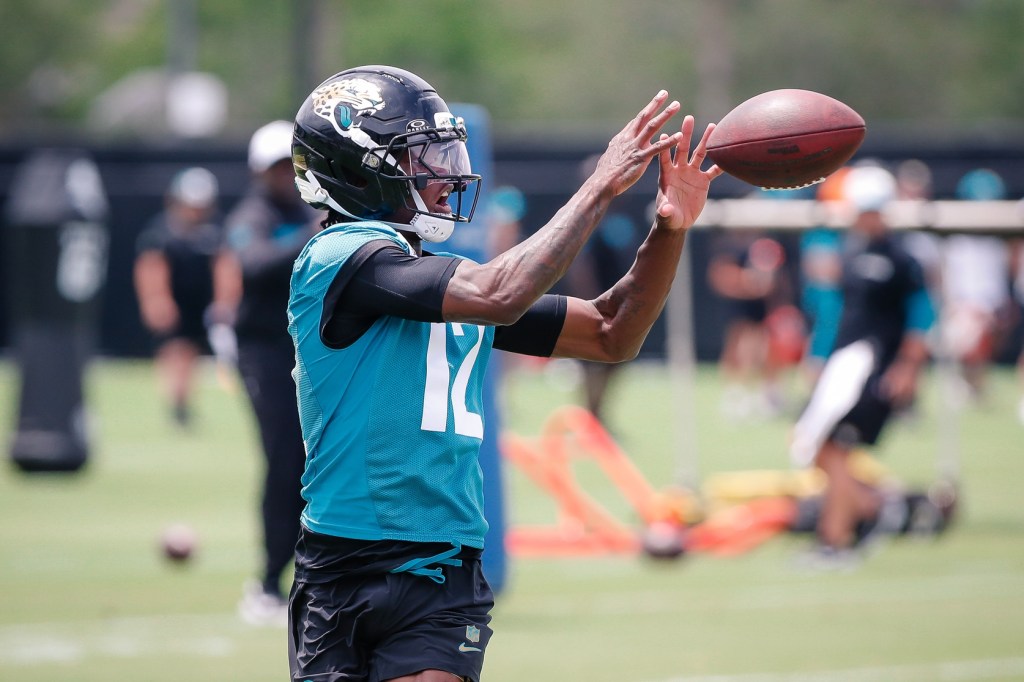
WR/CB Travis Hunter, Jacksonville Jaguars
Given that there are only 12 players on the roster, having an athlete who can play both sides of the ball is a massive asset. Hunter’s presence can allow for three of the league’s best wide receivers and two of its most versatile running backs without the fear that any of them will get fatigued because the 2024 Heisman Trophy winner can play any role he needs to. It’s unclear how much Jacksonville will use him on both sides of the ball during his rookie season, but regardless of where he plays, Hunter has the combination of speed, ball skills, and agility to make a huge impact.
Rusher Will Anderson Jr., Houston Texans
I could go for the Dallas Cowboys’ Micah Parsons here, and I’ve seen a lot of other writers pick him in similar thought exercises, but Olympic flag football is about versatility, and only two edge defenders grade as better than a 75 in pass rushing, run defending, and coverage by PFF’s grading system: Anderson and Khalil Mack. Mack’s age is a non-starter, even if he received Defensive Player of the Year votes in 2023. Anderson recorded 11 sacks, 29 pressures, and 37 total tackles this season while also allowing just an 82.6 passer rating the three times he was targeted. Parsons received just a 65.5 run defense grade, which might be important on earlier downs.
CB Patrick Surtain II, Denver Broncos
Last season, Surtain became the first cornerback to win Defensive Player of the Year since Stephon Gilmore in 2019, and for good reason. Not only did he allow just a 58.9 passer rating on 62 targets, he also led the league in interception return yards, notching a 100-yard pick-six in a Week 5 win over the Las Vegas Raiders. Given that interceptions are taken back to the five-yard line unless they score, having a player with a proven track record of finding the the end zone on defense is critical.
CB Trent McDuffie, Kansas City Chiefs
I mentioned Hunter’s versatility earlier — what if Team USA wants to go small, remove Anderson, and start five secondary players between Hunter, Surtain, McDuffie, and the two safeties I’ll mention later? Thanks to McDuffie’s pass-rushing ability — he received an 88.6 pass rushing grade on Pro Football Focus, the sixth-best of any cornerback — and his run defending, he can man the front and rush or defend at a high level in case the opposing center chooses to be an eligible receiver. In 2023, McDuffie recorded three sacks and 14 pressures while also allowing just a 94.4 passer rating on 76 targets.
S Xavier McKinney, Green Bay Packers
Unfortunately, several of the top safeties, including Kerby Joseph and Kyle Hamilton, are ineligible because I already have Jackson and Gibbs on the team. But McKinney is an excellent player — he was named to the All-Pro First Team in 2024, recorded 88 tackles out of a possible 91, and nabbed eight interceptions, the second-most of any player in the league. He also finished second in interception return yards behind Surtain and recorded a pick-six in 2021. Per PFF, he was the second-best coverage safety in football, so Team USA should have no problem trusting him to lock it down in man coverage.
S Jessie Bates III, Atlanta Falcons
Bates, a two-time former All-Pro honoree, should bring veteran experience to the squad, as well as versatility on the field. He received better than an 80 grade both as a coverage defender and as a run defender, and he has recorded more than 100 tackles in five of his seven seasons so far. Like all of the players on this list, his malleability is an asset; he’s recorded four or more interceptions, forced at least three fumbles, and scored at least one touchdown in both 2024 and 2025. At six-foot-one, he’s also a larger-than-average safety, so he can play tough with bigger wide receivers. He’ll be 31 by the time the Olympics roll around, though, so we’ll have to see how his form maintains over the next three seasons.