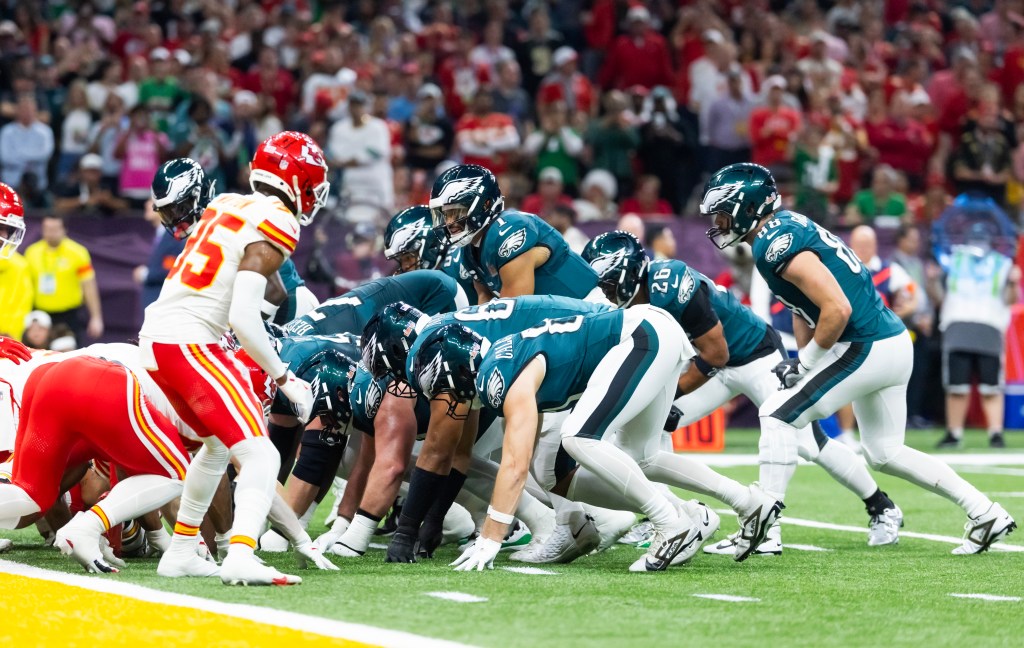
The NFL offseason is in full swing leaving plenty of time for draft preparation, free agent news, and perfecting the rules of the beautiful sport. Front and center at the attention of the NFL this offseason has been the status of the “Tush Push” made famous by the Super Bowl Champion Philadelphia Eagles. At League Meetings between owners and coaches, it’s gone so far as being put to a vote as to whether or not it should be banned altogether from the NFL. There are people who believe the Tush Push is bad for football.
While the Eagles are not the only team to lean on this technique, they do it better than any other team in the NFL which has raised some eyebrows in organizations across the league. Over the past three seasons, they have scored 27 touchdowns and tallied 92 total first downs while running this unique play. They picked up 32 first downs and scored 11 touchdowns this past season which ended in the Super Bowl victory.
The success has only grown the passion of the play’s opponents and caused some interesting conversations about its place in the NFL. Held up by fallacies such as it not being a “football play” or the illusion of player safety, teams have campaigned for this play to be taken out of the NFL. The Green Bay Packers led the campaign and there is just about an even split of opinion across NFL teams.
Will the Tush Push be Banned?
Conversations regarding the tush put were put front and center when the Annual League Meeting occurred in Florida. Those in favor of banning and keeping the play both made their case to those in attendance. NFL rules require 24 of the 32 votes to be made in one side’s favor before a change can be made. With there not being 24 teams in favor of the play being banned at this point, the NFL elected to table the discussion for a later date. Conversations will pick up again regarding the subject in May.

Up until 2004, there was phrasing in the NFL rulebook that prohibited players from pushing or pulling in a way that aided the ball carrier. With it becoming difficult to officiate downfield, this was removed from the rulebook and opened the door for this type of play to occur.
Adding this back and banning players from pushing or pulling the ball carrier are the only true logical grounds the league could stand on for banning this play. At its simplest form, the Tush Push is nothing more than a quarterback sneak which has been a foundational play in football. The origins of the play and the first record of it occurring date back to 1912 before the NFL was even in existence. While having a player behind the quarterback changes its optics a bit, it is naive to act like it is an outright different play.
Regardless, it is fair to read the tea leaves and gather that momentum is building toward the Tush Push being taken out of the game.


If there was not an interest in this being changed this vote easily could have been pushed off until next year or closed shut entirely. The fact that the vote will be revisited is noteworthy and expect the anti-Tush Push crowd to return to center stage with a more legitimate pitch for why it should be removed when the moment arises. The current argument held some significant flaws and both sides seemed to take note of this.
Why this logic is flawed:
At this current point, there simply is not a legitimate argument for why the Tush Push should be banned from there NFL. The two primary reasons teams have made arguments have been either safety or it not being an aesthetically pleasing football play.
Is the Tush Push safe for players?
Safety has climbed to the forefront of the NFL’s decision-making process at a much higher rate in recent years and for good reason. But after pouring through the great lengths of data for injuries that occurred due to this specific play there have been- ZERO injuries that occurred during a Tush Push. That is right there has not been a single injury recorded on this specific play according to the NFL.

Bills head coach Sean McDermott has voiced that it is important to be “proactive” in making changes before there is a track record of injuries. Aside from the fact that the Bills ran the tush-push at the second-highest rate in the NFL, it is important to remember this is still football. Injuries are an inherent risk that will happen at some point and this is not a play that is unique to this. But is there more injury risk in this specific play compared to a typical QB sneak, a QB draw, or handing the ball off to the running back? McDermott and the Bills were not proactive in limiting their $330 million quarterback from running this play 55 times over the past three seasons, and logic would say the answer is no to there being more risk in the Tush Push compared to a standard QB sneak.
Eagles owner Jeffrey Lurie took it a step further to say safety is one of the reasons they utilize the tush push. He argued there is more protection for the quarterback compared to a traditional QB sneak and questioned why there is no data to suggest how dangerous it is:

Is the Tush Push a “Football Play”?
The debate over whether or not it is a football play tends to come off as an argument of whether it belongs in football or if it requires skill. There was a time when forward passes were foreign to the sport of football. Just a few years ago it would have been stunning to see quarterbacks running with the football at the rate that is now commonplace. What is or isn’t a football play changes throughout the years but at its core the Tush Push has to be recognized as a quarterback sneak. That makes it one of the foundational plays in football and one that has been on record for more than 100 years.
As far as the skill conversation, Eagles head coach Nick Sirianni has playfully quipped on several occasions, “If everyone could do it, everyone would do it,” when asked about the play. The Bills and Eagles were the only teams to attempt the Tush Push more than five times this season. It is a timing play that requires the quarterback and offensive line to be on the exact same page to be effective. Some teams experimented with it more than others, but there seems to be a common denominator for why Jalen Hurts and his 600-pound squatting ability is the only player capable of being successful regularly.
Packers: Ban the tush push because of “player safety” and “pace of play”
— Bryan Cameron (@BCameronNFL) March 19, 2025
Also the Packers:
pic.twitter.com/wGNaovQNGV
Why banning the Tush Push sets a bad precedent
The NFL should constantly be working to improve the on-field product and make the game better for players and fans alike. But taking a specific play out of the game as a targeted attack on one team because no other team can be successful at it is nothing more than a case of sour grapes. One has to wonder if the NFL will vote for Lamar Jackson’s running plays, Tyreek Hill’s fly routes or Derrick Henry’s stiff arms could be up for a vote next by the competition committee.
The writing seems to be on the wall that the league will put together a better case for why the play should be taken out and it will be interesting to see what is presented next. It also will be quite entertaining when Jalen Hurts has plenty of success in traditional QB sneak opportunities with his lower body strength and elite offensive line in front of him still set to be there. Hurts finished last season with 14 rushing touchdowns- which is tied for the fifth-most in the NFL. He also had 15 the season prior which was tied with Josh Allen for the second-most in the league. The reigning Super Bowl MVP will forever be linked to the Tush Push due to the success he has had with it, but he has had plenty of success with both his arm and legs outside of this.
With or without the Tush Push, Philadelphia is considered the Super Bowl favorite to repeat at +650 odds on DraftKings Sportsbook. Jalen Hurts also holds the sixth-best MVP odds at +1700, and Saquon Barkley holds a season-long future of over/under 11.5 rushing touchdowns on DraftKings Sportsbook. It will be interesting to monitor if there is any line movement on these depending on the NFL legislation with Barkley adding 13 rushing touchdowns in addition to Hurts’ 14 last season.