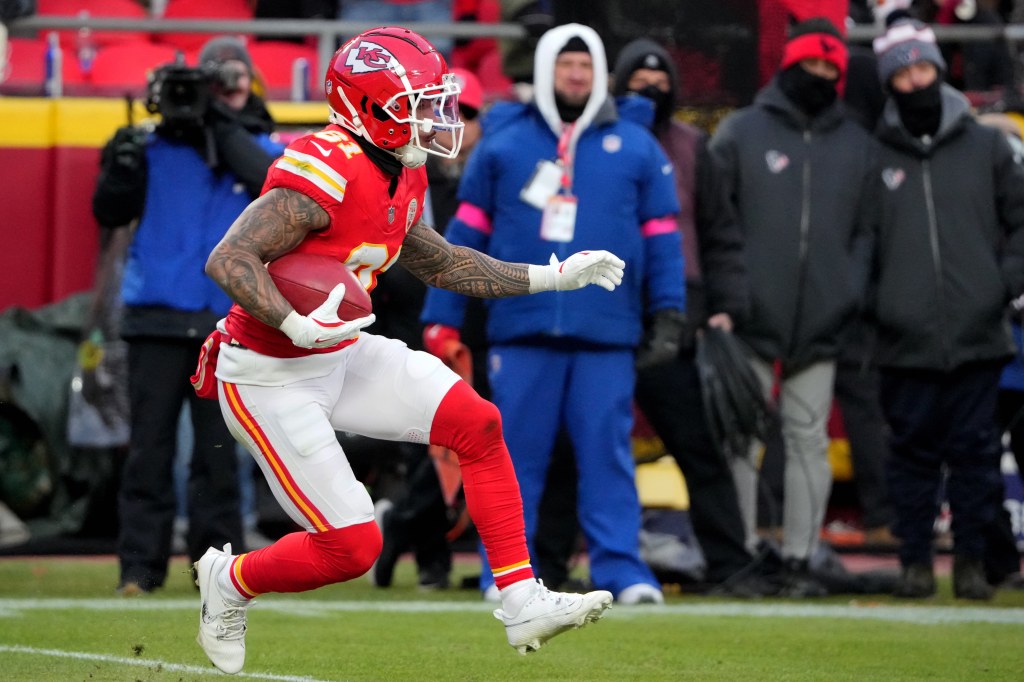
Prior to the 2024-25 season, the NFL made a drastic change, introducing the Dynamic Kickoff, where kicking team and receiving team members — with the exception of the kicker and two returners — must line up within five yards of each other on the receiving team’s 35- and 40-yard line, respectively and can’t move until the ball has either hit the ground or a returner. If the ball lands in between the receiving team’s 20-yard line and the goal line, it must be returned, and if it bounces into the end zone after that, a touchback would only bring it out to the 20-yard line instead of the 30, incentivizing kickers to leave it short of the end zone. The league’s goal was to increase returns and decrease injuries.
Before the rule change, a record 77.6% kickoffs in Week 1 of the 2023 season resulted in touchbacks, and there were just four kicks returned for a touchdown in the entire 2023 season. As part of the rule change, touchbacks now bring the ball out to the 30-yard line instead of the 25, making it a more risky proposition for a kicking team to simply boot it out of the back of the end zone.
Despite the new rule, betting on the opening kickoff of Super Bowl LIX to be a touchback carries just -280 odds, or a payout of just $135.71 on a hypothetical $100 bet. Is fading the teams’ kickers (+205) a good bet?
Bet on Super Bowl LIX kickoff specials at DraftKings Sportsbook, including Will the Opening Kickoff Be a Touchback?, here.
The numbers say it is.
Despite the rule change, 64.3% of kickoffs resulted in a touchback, and while that was some 10 percentage points lower than the same figure in 2023, it was still the second-highest rate since 2000. There were seven kickoffs returned for a touchdown, 75% increase compared to 2023, including the Dallas Cowboys’ KaVontae Turpin, who recorded both a kickoff return touchdown and punt return touchdown, being named to the All-Pro First Team for his exploits. Dallas led the league in kickoff return average and was the only team to score twice on the play.
Still, the teams in action on Sunday have both taken advantage of these rules in the postseason.
The NFC champion Philadelphia Eagles returned kicks relatively frequently in the regular season, taking 33 returns for 875 yards from 75 total kickoffs, and in the playoffs, they increased their rate to 11 of 14 kickoffs for 301 yards. The AFC Champion Kansas City Chiefs, meanwhile, were more conservative, returning only 29 of 78 total kicks for 785 yards in the regular season, but they have been even more aggressive in the postseason, returning eight of 10 kickoffs for 238 yards.
Although Chiefs kicker Harrison Butker had a 79.0% touchback percentage in the regular season, it has dipped to 69.2% in the postseason. Meanwhile, Eagles kicker Jake Elliott had an 81.8% touchback percentage in the regular season and just a 52.2% mark in the postseason. Both Kansas City and Philadelphia have historically opted to defer after winning the coin toss, so it’s a 50-50 proposition as to which team will receive the ball first.
Averaging Butker’s and Elliott’s postseason figures leaves us with a 60.7% chance of a touchback, which would already be a mathematically-sound play at +205 odds even before considering both teams’ aggression returning kicks in the postseason so far.