

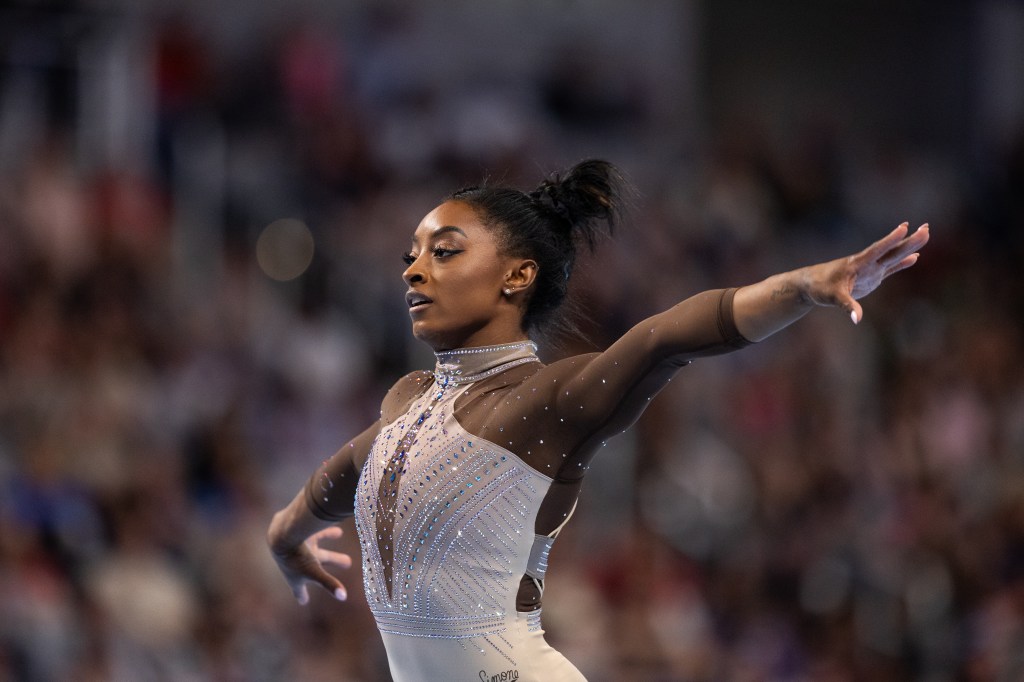
Simone Biles shocked the world three years ago when she pulled out of the COVID-delayed 2021 Tokyo Summer Olympics with the “twisties,” a gymnastics term for something akin the yips, or the jitters, or just a plain old mental block. However, the twisties come with a much higher risk of bodily injury than, say, putting or pitching yips that affect other professional athletes.
Biles, who was widely expected to win gold in the All-Around and in multiple individual events — as she did in 2016 in Rio, when she cemented her legacy of greatness — could not continue competing. Now, at 27 years old, the greatest gymnast of all time is attempting to make her way back to the Olympic Games in the hopes of rising to the top of the mountain once again.
In an April interview with Alex Cooper on the podcast Call Her Daddy, Biles opened up in-depth for the first time about the events that happened leading up to Tokyo that culminated her shocking departure from the Games. After she pulled out, the U.S. went on to win the silver, a disappointing result after two straight team golds in 2012 and 2016.
Let’s take it back to 2016 for a moment. Biles came onto the scene as a 19-year-old and recalled seeing her social media follower count grow by the tens of thousands each day in Rio as she pulled ahead as the early frontrunner. She won gold in the individual all-around, led the United States to a team gold, and took home golds on floor and vault as well as a bronze on balance beam. She was almost immediately dubbed an American Olympic legend. And she hadn’t even turned 20.
“I thought that’s where it ended,” she told Cooper on Call Her Daddy. “I was like oh my gosh, how have I reached my greatest achievement in life at 19? I was scared for the rest of my life. How can I beat this? Most people don’t get to go to more than one Olympics.”
Biles continued to compete on the elite circuit, and in 2018, she was one of the many athletes to come out against United States gymnastics team doctor Larry Nassar. She told Cooper that she was diagnosed with anxiety and depression during this time as she reckoned with her abuse and her success. Nevertheless, she continued on her path back to the Olympics, which were delayed until 2021 due to the pandemic.
That’s when all hell broke loose in Biles’ mind. For those who don’t recall, she pulled out of both the individual all-around and the team competition after losing herself in the air on a vault.
When asked to describe what the twisties physically feel like, Biles told Cooper, “It’s basically when your mind and your body are at a disconnect. Your body is going to try to do something, and your mind is like, no you’re not doing this. It’s the same as if one day you woke up and had no idea how to drive a car. Your legs are going crazy, you have no control over your body. It’s terrifying. I am my car.”
Biles also said on the podcast that she knew something was coming. “The [worst] part of all at the Olympics… was that I knew something was going to go wrong. I couldn’t pinpoint what it was, or when it was going to happen, but I just had this feeling deep down — this is not going to go the way I want it to, and I don’t know why.”
She added that she nearly broke her leg on the vault that went sideways, but when she landed, her first thought was not about her own health. Instead, it was about the American’s public reaction.
“As soon as I landed, I was like oh. America hates me,” she said. “The world is going to hate me. That was my first thought :what are they going to say about me? I knew I couldn’t recover.”
She told her coach that she was pulling out, and she was not entirely wrong about the public’s reaction to her choice. When an issue is mental rather than physical, she said, it can be hard for those on the outside to grasp what is truly happening.
“There were so many narratives thrown around, so many different excuses pushed on me,” she said of the aftermath. While some naysayers thought it was pride that sidelined her, or the realization that she would not be able to win gold, Biles said that she had to overcome her pride to step away and give her teammates a fighting chance. The forfeiture itself is not a regret in her career, but rather, in the way that it affected her teammates.
“That’s something that I will never forgive myself for,” she told Cooper. “I wish I could have been in there with them in the way that I was supposed to.”
After Tokyo, she took a long break from elite-level training, but stayed in the gym and worked on basic skills with her coaches. When she told them she wanted to aim for a third Olympic appearance, they told her “no.” But after re-committing to her training, the world’s best gymnast is ready to return to the event that nearly ended her career.
For those unfamiliar with the sport, 27 is virtually geriatric in the world of gymnastics. Few athletes over the age of 22 participate, particularly when representing the highly competitive countries. With an age minimum of 16 — an age often considered the peak of a gymnastics career — few gymnasts see more than one Olympic appearance, let alone two, as their aging bodies compete for a spot against young up-and-comers.
Biles, always the overachiever and record-setter, has her sights set on a third straight Olympic appearance. The seven-time Olympic medalist and six-time World Championship gold medalist will be competing for a spot in the six-gymnast team heading to Paris this July.
The team will be determined at the Olympic Trials in Minneapolis at the end of June, and Biles will be going up against former teammates including Sunisa Lee, who won the gold in the All-Around in 2021, and Jordan Chiles, a member of the 2021 silver medal team in Tokyo. She will also be competing against new faces on the scene, including Evey Lowe and Zoey Molomo, both of whom will be 16 years old when the 2024 Olympics begin.
When we look at the last few Olympics U.S. gymnastics teams, a 27-year-old competing seems like an unrealistic fantasy. Biles and teammate Mykayla Skinner were the two oldest competitors on the 2021 team at 24 years old. All the others were between the ages of 18 and 21. In 2016, Aly Raisman headed up the team in age at 22 years old in her second Olympic games, and Gabby Douglas clocked in as the second-oldest at 20. In 2012, when the Fierce Five came onto the scene, not one gymnast on the team was over the age of 18, with Raisman again the eldest. And when the U.S. began its journey toward international powerhouse status in 2008, silver and gold medalists Shawn Johnson and Nastia Liukin were 16 and 18, respectively.
Suffice it to say, there has not been a success story — let alone an appearance — of an American gymnast past the quarter-century mark in the modern era of the sport. The 27-year-old Biles will be competing against girls who had not yet hit middle school when she competed in her first Olympic Games. But “it hasn’t happened yet” is an entirely futile argument when Simone Biles’ name is in play — in fact, “hasn’t happened yet” is the operating standard for her. If anyone can shatter the mold, it is Biles, who has done just that time and time again throughout her career.
She is set up for success already. Last week, Biles won the all-around gold medal at the U.S. Championship and swept the individual events, winning gold in floor, bars, beam, and vault. This all-around gold marked her ninth U.S. Championship title — Biles won the tournament for the first time in 2013, and the only two times she hasn’t won the tournament since then were the two times she didn’t participate in the tournament.
Given both her status and talent — her starting point values are often the highest on the board and she has five skills named after her — Biles would, in any other scenario, effectively be a lock for the team. She is a reigning US Champ, a proven gold medal winner, and a multiple-time record holder in her sport. But is there any risk of her pulling out of competition at the highest level once again?
Biles told Cooper that therapy has done wonders for her, and said that she often asks her therapist, “It’s Olympic year, did we figure out why that happened? Are we sure?”
“At this point, nothing can break me. I’ve been through so much — so much trauma, so much healing,” she told Cooper. “I’m just now feeling better. Even some days walking into the gym, I feel like I’m going to get lost. [I’ve been] working on my mind and my body more…It’s exhausting, but I have to do it. I didn’t think therapy was going to work, and it’s working.”
Olympic trials will take place from June 27-30 in Minneapolis as Biles attempts to climb the mountain one more time.