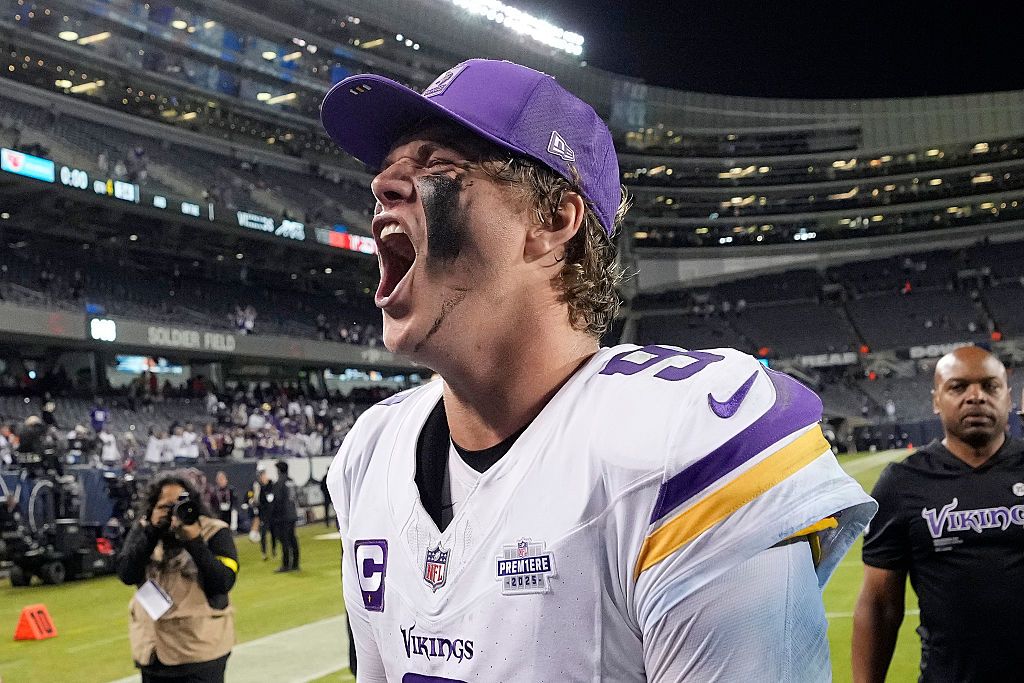
Sunday night drops a rematch of last January’s college title duel, now played under the U.S. Bank Stadium lights with quarterback J.J. McCarthy making his Minneapolis debut opposite quarterback Michael Penix Jr. DK frames it like a true Week 2 stress test: Vikings -3.5 (-105), moneyline -180, and a 44.5 total. Minnesota has owned the recent series (4-0 last four with a +45 point differential) and stacks trend strength at home (8-1 straight up, 7-2 ATS last season; 5-0 ATS in September since 2024), but this isn’t a coronation; it’s just the second game of the year for both squads. Below is my prediction for NFL Week 2’s Sunday Night Football game between the Minnesota Vikings and the Atlanta Falcons.
Here’s how I’ll play it. I’ll be pumping out these predictions for individual games all season, with plenty of coverage here on DraftKings Network. Follow my handle @dansby_edits for more betting plays.
Vikings vs. Falcons prediction, preview
Start with identity. Head coach Kevin O’Connell has quarterback J.J. McCarthy operating a balanced script: 47.2% run rate and 52.8% pass rate, with Minnesota churning 120 rushing yards and 4.6 per carry in Week 1. The efficiency print from the team metrics explains the plan: Vikings EPA per run sat at -0.04 (near neutral), while EPA per pass was a negative -0.48—exactly why O’Connell leaned on running backs Aaron Jones Sr. and Jordan Mason late in Chicago. The tempo helps the defense; Minnesota ran 55.0 offensive snaps last week versus Atlanta’s 78.0, a deliberate throttle that keeps Brian Flores’ unit fresh.
The defense is the fulcrum. Defensive efficiency ranks fifth for Minnesota and 23rd for Atlanta, and the Vikings’ front already flashed bite: defensive tackle Javon Hargrave produced 2.0 sacks in the opener as Flores ratcheted blitz rate in the second half. That’s the right pressure recipe for quarterback Michael Penix Jr., who threw 42 times in Week 1. Atlanta’s profile screams pass-first (67.1% pass rate) with real dropback efficiency (EPA per pass 0.26), but the run phase cratered at -0.39 EPA per carry and just 69 rushing yards. In raw terms, that was 2.5 yards per carry with only three rushes gaining 5+ yards, and the Falcons finished 6-for-15 on third down (40.0%), a direct byproduct of those early-down stalls. If Flores erases run fits again, Atlanta lives in long downs against disguise and heat.
Personnel tilts the leverage downs. Wide receiver Justin Jefferson shook off a choppy Soldier Field surface to score, and he returns to the fast track where he cleared 73 receiving yards in every home game last year. Corner A.J. Terrell will fight, but Minnesota’s motion stacks pull zone defenders and force communication across the new-look Falcons secondary. That back end arrives shorthanded: safety Jordan Fuller is on IR, a tangible loss when O’Connell dials the post-snap switch releases that spring Jefferson and tight end T.J. Hockenson into voids. Meanwhile, Atlanta must devote bodies to running back Bijan Robinson underneath after he posted 6 catches for 100 yards in Week 1—attention that widens throwing lanes for McCarthy’s high-percentage concepts. Zooming out on Robinson: last season he ranked third in rushing with 1,456 yards and 14 touchdowns, averaging 85.6 rushing yards per game at 4.8 yards per carry, and he added 61 catches for 431 yards. In Week 1 he piled up 124 scrimmage yards with a 50-yard catch-and-run score, accounting for 34.6% of Atlanta’s total offense; the ground piece lagged at 12 carries for 24 yards (2.0 per). Tampa Bay contacted him at or behind the line on 10 of those 12 carries, a signal that Atlanta may again tilt his usage toward the passing game when pressure shows.
Falcons vs. Vikings pick, best bet
Minnesota rallied from down 11 to beat Chicago 27–24 as McCarthy went 13-for-20 for 143 yards with 2 passing scores and a rushing touchdown; the rookie’s 21-point fourth quarter was about composure and sequencing, not fluke. The purple are 5-0 ATS in September since 2024 and 7-2 ATS at home last season. Atlanta, by contrast, dropped its opener 23–20 despite outgaining Tampa Bay 358–260 because that run-game floor vanished (12 carries for 24 yards for Robinson) and the offense bogged in the red zone. Drive data backs that up: the Falcons were 1-for-2 in the red zone, drew eight penalties for 55 yards, and missed a 44-yard field goal with :06 left. The macro table you supplied shows the separation: Minnesota ranks 13th in offensive efficiency and 5th in defensive efficiency; Atlanta is eighth on offense but 23rd on defense. Add turnover margin—Vikings 3rd, Falcons 23rd—and you get the exact blueprint for a late cover in a one-score script.
Yes, Atlanta can punch. Wide receiver Drake London drew 15 targets, and tight end Kyle Pitts grabbed seven balls; they will test a Vikings defense that sits 22nd in “defensive explosiveness” against a Falcons offense that ranks 5th in explosiveness. But explosiveness works only if you can earn the right to call shots. With Minnesota’s front forcing 2nd-and-9s and 3rd-and-7s, Flores can stack simulated pressures and rotate late, turning Penix into a stationary target. The Falcons’ path requires flipping the early-down math and outrunning Minnesota’s blitz rules; Week 1 says they’re not there yet.
Minnesota’s spread lane still carries small projected value (implied cover probability 51.4% versus 48.0% break-even, according to PFF), and the situational edges are sticky: home dome, short game via run rate, and the better havoc defense. Even with injuries (left tackle Christian Darrisaw and edge Andrew Van Ginkel out), the Vikings’ advantage is where this game swings—interior pressure and coverage disguises that compress the Falcons’ intermediate windows.
Minnesota is 4–0 in the last four against Atlanta and has outscored the Falcons by 45 points in those meetings. McCarthy doesn’t have to spray 35 throws; he must manage the middle eight, leverage Jefferson on choice routes, and let Mason and Jones grind a defense that sat 23rd a year ago and just allowed three passing touchdowns. The Vikings’ defense dictates, the offense closes with a four-minute drive, and the dome does the rest.
Final: Vikings 27, Falcons 20. Vikings cover the small number at home with their glorious sicko of a defensive coordinator and their ascending offense behind their quarterback, who’ll be hyped to the moon with new-dad energy.
As for props, let’s lean on building around Justin Jefferson receiving yards. Jefferson returns to the fast track where he cleared 73 receiving yards in every home date last season and tagged Atlanta for two touchdowns in December; A.J. Terrell will press, but Minnesota’s motion stacks and switch releases manufacture free access, and Jordan Fuller’s IR absence thins Atlanta’s back end. Expect Kevin O’Connell to script quick-game volume for J.J. McCarthy—who attempted only 20 passes in Week 1—to keep the pocket clean, making Jefferson’s 80+ yards the most bankable angle.
Best bet: Vikings -3.5 (-105) vs. Falcons
Tail it with me in the DKN Betting Group here!
Best prop lean: Justin Jefferson 80+ total receiving yards (-105)
Tail it with me in the DKN Betting Group here!