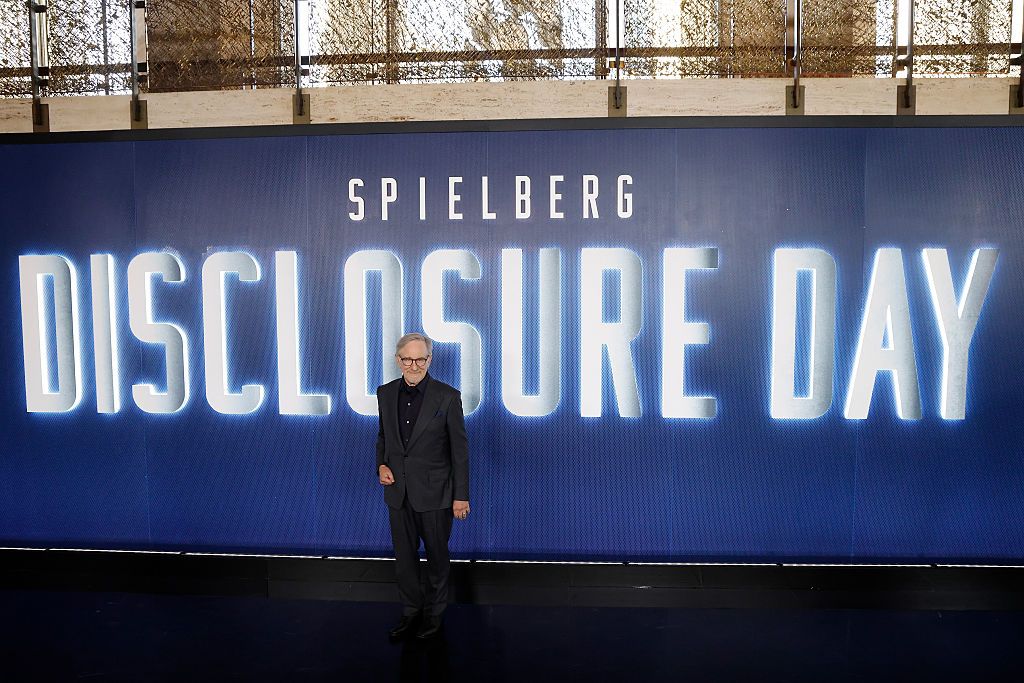
Steven Spielberg opens Disclosure Day with a crowd staring at a spectacle, which is a very Spielberg place to begin. The spectacle happens to be professional wrestling, that lurid American miracle of choreographed violence, collective faith, and men pretending civilization still has enforceable rules. Somewhere in the noise sits Daniel Kellner, played by Josh O’Connor as a scrappy, bug-eyed whistleblower whose whole body seems to know the state is already chasing him. He has proof that extraterrestrial life exists, along with evidence that the Wardex Corporation has helped keep that truth buried. Within minutes, Daniel is moving through the familiar Spielberg gauntlet: panic, pursuit, improvised courage, and the awful knowledge that the universe has picked him for a job he did not request.
My full review is below, with significant spoilers.
Disclosure Day: full review
The movie then cuts to Margaret Fairchild, Emily Blunt’s Kansas City meteorologist, whose life has gone wrong in a quieter and more intimate register. A cardinal flies into her apartment and lands on the kitchen island, and that’s your launchpad encounter. It is lovely—turning first contact into something domestic, delicate, and faintly absurd. Hugo (Colman Domingo) later explains that alien life presents itself as animals so humanity can look without recoiling. Spielberg gets a beautiful image from that idea: the universe crossing the threshold as a small red bird, bringing cosmic terror-truths into the room on a lark, as a lark(-ish).
After the visitation, Margaret starts speaking languages she never learned. She hears things she should not hear. She reads private pain with alarming precision, as if grief has become legible to her. Her husband Jackson, played by Wyatt Russell with blessedly normal comic irritation, becomes her witness, driver, protector, and audience surrogate as Wardex begins closing in. The truth Daniel carries needs to be seen. The signal moving through Margaret needs to be translated. Spielberg builds his newest alien movie around two people turned into instruments before they fully understand the song.
That premise has immediate charge, and it also has an immediate structural problem. Movies built around exposé have to sprint toward revelation, yet the most complexly human material almost always waits on the other side. The mad dash can be thrilling, especially with Spielberg at the wheel, but the revelation itself is rarely the richest part. What happens after truth becomes public? What does a government do when secrecy fails? What does a marriage do when one person becomes a cosmic receiver? What does faith do after the sky stops being metaphor? Disclosure Day knows those questions exist, then spends most of its runtime racing toward the moment before they can fully bloom.
For a while, the race is pleasurable. Disclosure Day gives Spielberg black-car convoys, farmhouse hideouts, ominous corporate command rooms, electromagnetic weirdness, and a salt-and-pepper institutional villain in Noah Scanlon. Colin Firth plays Scanlon with the grave authority of a man who believes every immoral act is backed by policy if spoken into a headset. Colman Domingo’s Hugo Wakefield hovers around the movie’s center as the apparent liaison between alien life and humanity, a serene keystone connecting Daniel, Margaret, Scanlon, and In Vivo 17, the alien presence whose captivity gives the film its spiritual wound. Domingo plays Hugo with warmth, sorrow, and a preacher’s calm. He also knows exactly what the screenplay needs him to know at any given minute.
The mythology suggests grandeur, though it often behaves like machinery. Daniel has evidence. Margaret has reception. Hugo has history. Scanlon has the machines. Three alien devices sit inside the plot like sacred props, waiting to move the story through its appointed stations. The pieces glow with mystery from a distance, then start looking suspiciously convenient up close. What are the devices? When were they left behind? Why are there precisely three? How can Scanlon alone use the third? Spielberg treats those questions as atmosphere, then asks wonder to fill the empty space.
Wonder fills plenty. The filmmaking in Disclosure Day is often extraordinary, in the way Spielberg’s filmmaking can still be extraordinary without calling attention to its own sweat. He directs action with a spatial clarity that feels almost rude in the age of franchise sludge. The sequence where Daniel and Margaret’s car gets jackknifed between the train and the tracks is pure machine-age terror, every angle clean, every impact legible, every cut alive to momentum. It is suspense as kinetic architecture. Spielberg knows where everyone is, where danger is coming from, and how long an audience can hold its breath before panic becomes pleasure.
The scene that follows is even lovelier. Daniel and Margaret escape into a storage car full of musical instruments, and the movie finally lets the chase exhale without losing motion. Margaret is unraveling. Daniel reaches for something physical. He places her hand on piano chords, trying to teach her the language of the universe through vibration, pressure, and touch. For a few minutes, Disclosure Day becomes the movie it keeps reaching toward. Cosmic communication stops being a thesis and becomes wood, wire, sound, breath, skin, and fear. Two chosen people become two frightened people trying to stay inside their bodies.
It all works so well because it understands the simplest truth in the film. If the universe has a language, human beings would still need to feel it through intimate connection. Daniel is not giving Margaret exposition. He is grounding her, and maybe grounding himself. He is reaching for proof that alien contact has not turned every person near it into a component. The piano scene gives the film its best metaphor and its best human connection, though Spielberg wisely keeps the charge desperate instead of swoony. It is intimacy under cosmic duress, the exact emotional climate where his sentiment can still devastate.
O’Connor and Blunt both have Spielberg dreamer in their range, which is part of what makes the movie intermittently frustrating. Blunt has carried that quality before, even inside very different genre machines like Edge of Tomorrow and A Quiet Place: the flinty exterior, the private ache, the sense of a person trying to keep terror from becoming visible. Margaret lets her add comic bewilderment and reluctant wonder to that arsenal. O’Connor, meanwhile, makes Daniel a surprisingly scrappy Spielberg action protagonist. He has none of the sleek competence of a franchise hero. He crawls, scrambles, flinches, bolts, improvises, and looks vaguely offended that destiny keeps escalating.
Daniel belongs to a familiar Spielberg lineage of burdened ordinary men, the kind of figure who gets drafted into history by forces with no interest in his consent. Like James Ryan, he did not ask to become the moral center of someone else’s mission. Yet Hugo, the apparent human liaison to alien life, has shouldered him with the burden of bringing civilization-crumbling truth to the entire fucking planet. O’Connor plays that burden beautifully. He gives Daniel a nervous, wounded intelligence, along with the slightly feral survival instincts of a man whose fear has become his most attuned instinct.
The actors keep finding human beats. The script, frustratingly, keeps hurrying past them. Daniel and Margaret are chosen by the moment, then mostly fleshed out inside that moment. Their interior lives feel vivid in flashes, especially when Spielberg gives them action, touch, or silence. Their functions stay clearer than their histories. Daniel must disclose. Margaret must translate. Hugo must connect. Scanlon must suppress. The film moves fast enough to make those functions exciting, then slows just enough to reveal how thin some of the people remain.
Margaret’s arc suffers most from that impatience. She escapes the hospital and calls Daniel in confused terror, understandably shattered by the violation of her own mind. Then, almost immediately, she starts discussing her gift as a “flow state.” The leap feels enormous. Blunt can sell dawning comprehension in a glance, but the movie moves Margaret from horror to fluency with suspicious speed. Spielberg wants her ready for the finale. The woman inside the phenomenon needs more time to be scared.
That rushed acceptance weakens the film’s empathy sequences. Margaret touches people, sees into them, and offers reassurance with a soft, glowing certainty. Sometimes Blunt saves these scenes by playing the gift as overload, as an invasion she cannot comfortably inhabit. Other times, Disclosure Day drifts into divine customer-service cinema. The mood turns a little Bruce Almighty, a little Mother Teresa by way of premium-format spectacle. Humanity queues up for emotional triage, and Margaret dispenses healing in close-up.
That tendency reaches its most exposed form in the finale. Margaret becomes the translator of a message twice removed from what appears to be a displaced extraterrestrial matriarch. The message, finally, is simple. It is noble, clean, and deeply Spielbergian. It also belongs to a familiar science-fiction tradition in which life beyond Earth arrives with superior emotional intelligence, having evolved through furnaces of empathy while humanity remains stuck with secrecy, militarization, and very poor listening skills.
There is beauty in that idea. There is convenience, too. The aliens in Disclosure Day seem to have crossed time, space, grief, and captivity to deliver the gentlest possible admonishment to a species that has spent the movie making Noah Scanlon’s cynicism too human. The final plea—the words of which I will not reveal here, because it is a special thing to experience for yourself—wants to enlarge the film into a civic prayer. It lands with feeling, but also with the softness of a gorgeous greeting card projected across the sky.
The spectacle around that plea still has undeniable force. The raw footage of extraterrestrial life held my theater in silence, and Spielberg knows exactly how rare that shared hush has become. For one sequence, the title becomes the experience. Disclosure happens. The room goes still. People lean forward. I wondered if some of this was real, or how real a rendering it was. The novelty is powerful because the movie has spent two hours promising the impossible, then finally lets us look.
That power may also be the film’s ceiling. Disclosure Day depends heavily on the first encounter with its own revelation. Once disclosure happens, it has happened. A second viewing would leave the machinery exposed: the chase paths, the three devices, the withheld footage, the characters arranged around a global broadcast, the careful escalation toward awe. Spielberg can make machinery sing, and he often does here. He cannot make every gear disappear.
His strongest flourishes arrive in the margins, where story pressure gives way to pure cinematic appetite. The farmhouse sequence, where Daniel inches toward a Wardex car, has the old movie-mad charge. The camera follows him with delicious suspense, then abandons him for its own punchline, slipping toward the passenger seat as if the frame has developed a mischievous private agenda. That is Spielberg still playing, still thinking through movement, still finding jokes inside geography. Several characters in Disclosure Day would benefit from having as much personality as that camera move.
John Williams, meanwhile, gives the movie its most shameless pleasures. Scanlon walks into rooms under brass so ominous it could invade Poland. Wardex gets the full empire treatment: command screens, clipped orders, menacing convoys, and music that turns bureaucracy into dark ceremony. It is nostalgic, overripe, and frequently delightful. Spielberg and Williams know this language so well that even the clichés arrive polished to a ceremonial shine.
The nostalgia is part of the pleasure and part of the trap. Disclosure Day clearly wants to converse with Close Encounters of the Third Kind, Minority Report, The Post, and even The Fabelmans. It has the UFO awe, the surveillance paranoia, the whistleblower urgency, and the late-Spielberg ache for childhood, memory, and reconciliation. Yet the film’s most interesting ideas keep pointing beyond its ending. It feels built as a doorway, then determined to be the whole house. It collapses under its own blockbuster pressure.
That is why the movie kept making me think of prestige television, especially something with the metaphysical patience and staying power of The Leftovers. The premise cries out for aftermath. What happens after the two American passengers are found? This is Spielberg foreign politics, here. Were there Russian passengers? Chinese passengers? Did other governments possess their own artifacts, prisoners, translators, or human technology? Does Margaret become a prophet, a weapon, or a deity? Does Daniel, the translator, eventually come into conflict with Margaret, the executor? What happens inside Margaret and Jackson’s relationship when one partner becomes humanity’s living antenna, and the other person might want her back after flubbing her mid-movie?
A 100-minute pilot could have made disclosure the beginning. Spielberg makes it the destination. That choice gives the film velocity, but it compresses the richest material into implication. The movie is so hellbent on revelation that it leaves the consequences standing outside the frame, where they immediately become more intriguing than several events inside it.
Still, a merely decent Spielberg movie remains a strange and valuable object. Disclosure Day contains 45 minutes of rapturous cinema, several gorgeous cinematographic flourishes, one tremendous action sequence, one lovely scene of human grounding, and enough craft to embarrass most franchise spectacle. It also contains thin characters, shaky mythology, overromanticized empathy, and a final message that reaches for transcendence with both hands and grabs, really, at nothing more than the smash-to-black.
The result is a good movie with the bones of a great story. Spielberg finds awe in the machine, in the chase, in the light, and in the hush before the world changes. He struggles to make the people as mysterious as the event. Once the revelation arrives, the movie has spent its miracle, and it took a long time to get there. What remains is admiration, frustration, and the faint ache of a better story waiting on the other side of disclosure.
Disclosure Day FAQ
When does Disclosure Day come out?
Disclosure Day opened in theaters Friday, June 12, 2026.
How long is Disclosure Day?
The film runs 2 hours, 25 minutes.
Who’s starring?
Emily Blunt stars as Margaret Fairchild, with Josh O’Connor as Daniel Kellner. Colin Firth, Colman Domingo, Eve Hewson, Wyatt Russell, Elizabeth Marvel, and Hettienne Park also appear.
Who made Disclosure Day?
Steven Spielberg directed Disclosure Day from a screenplay by David Koepp. John Williams composed the score.
What is Disclosure Day about?
Disclosure Day follows a whistleblower and a meteorologist pulled into a global revelation about alien life, hidden government knowledge, and humanity’s ability to receive the truth.